


Engine-related mechanical issue forces New York-to-Rome flight to divert to Newfoundland with 280 people aboard
Delta Flight Lands Safely at St. John’s International Airport
ATLANTA — A Delta Air Lines Airbus A330 carrying 267 passengers and 13 crew members made an emergency landing in Newfoundland after experiencing an engine-related mechanical issue during a flight from New York to Rome.
Delta Flight DL182 departed John F. Kennedy International Airport at 5:43 p.m. on Sunday, August 23, for a scheduled journey of approximately eight and a half hours to Rome Fiumicino Airport. Roughly four hours into the transatlantic flight, the crew identified a mechanical problem involving one of the aircraft’s engines.
The pilots declared an emergency and diverted to St. John’s International Airport, a major alternate landing point for aircraft operating across the North Atlantic.
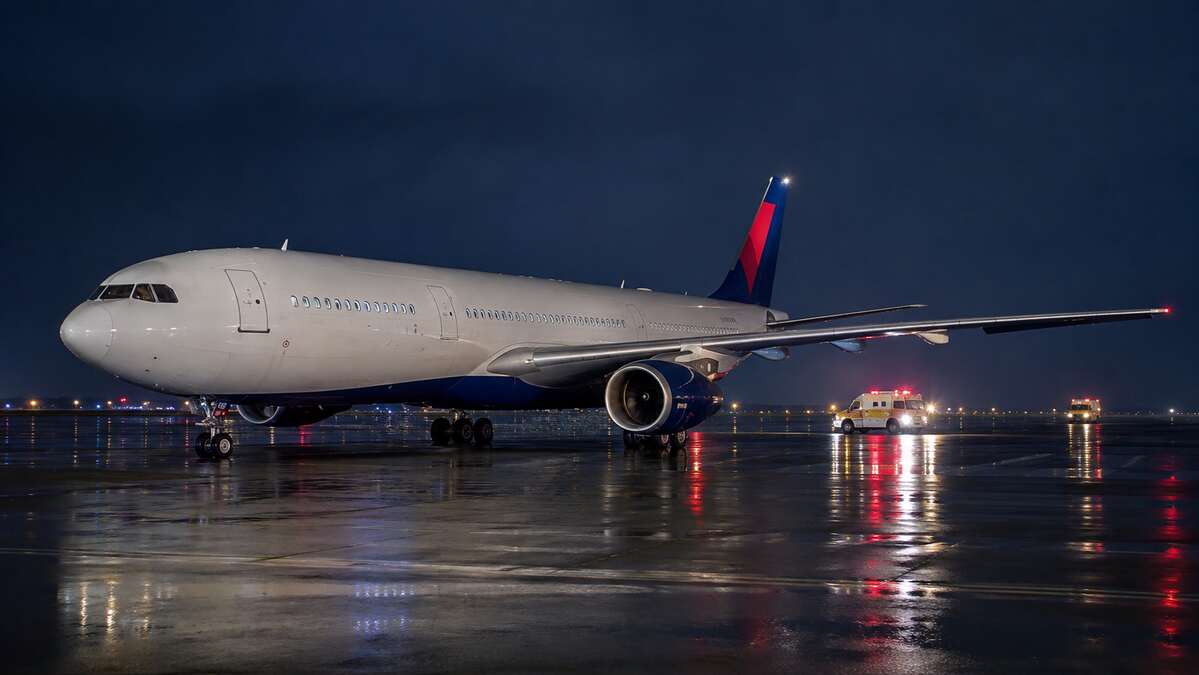
The Airbus A330-300, registered as N823NW, landed safely in St. John’s at 11:15 p.m. Airport emergency crews met the aircraft after it arrived, and all 280 people aboard disembarked without incident.
St. John’s airport spokesperson Ryan Howell confirmed that the passengers and crew safely left the aircraft.
Delta provided hotel accommodation and meal vouchers to affected travelers while arranging replacement transportation. The airline later sent another aircraft to Newfoundland to return the passengers to New York, where they were rebooked on flights to Italy.
Passengers Returned to New York for Rebooking
The replacement aircraft, registered as N428DX, departed St. John’s at 9:50 a.m. on August 24 and arrived at New York JFK at 11:07 a.m.
Passengers were subsequently placed on new flights to Italy, extending a journey that had already been interrupted several hours after departure.
Simple Flying reported on the diversion and contacted Delta for additional information. An airline spokesperson confirmed that Flight DL182 diverted because of a mechanical issue involving one of the aircraft’s engines and emphasized that passenger and employee safety remained Delta’s top priority.
Initial accounts characterized the incident as a “mechanical emergency.” Delta later provided additional detail, identifying one of the A330’s engines as the source of the problem.
The airline said the flight crew followed standard operating procedures and chose to divert as a precaution. Delta apologized to customers for the disruption and thanked the pilots, cabin crew and ground personnel who assisted during the response.
CBC also reported that the carrier apologized to affected travelers while reiterating that safety remained its highest priority.
Newfoundland Airport Plays Key Transatlantic Role
Location Makes St. John’s a Practical Diversion Point
St. John’s International Airport is an important diversion airport for commercial aircraft crossing the North Atlantic. Its eastern Canadian location allows aircraft experiencing mechanical trouble, medical emergencies or other operational problems to leave transatlantic routes and land before continuing toward Europe or returning deeper into North America.
The airport can accommodate widebody aircraft used on international routes, including the Airbus A330. For Flight DL182, St. John’s was the closest capable North American airport available while the jet was operating over the Atlantic.
Diverting to Newfoundland allowed the pilots to resolve the situation on the ground instead of continuing toward Rome with an engine-related issue that had not been fully assessed.
Such diversions can create significant logistical challenges for airlines, particularly when hundreds of international passengers require lodging, meals, replacement aircraft and new connections. Delta’s decision to return the travelers to JFK enabled the carrier to use its New York operations to arrange onward flights.
Aircraft Was Operating Near Capacity
A330 Carried 267 Passengers Across Three Cabins
N823NW was delivered to Delta in August 2015 and was approximately 11 years old at the time of the incident. The aircraft is part of Delta’s long-haul fleet, which includes more than 30 Airbus A330 jets serving international markets.
The A330-300 involved is configured to accommodate 293 passengers across three cabins. Its layout includes 34 business-class seats, 40 premium seats and 219 economy seats.
With 267 passengers aboard, Flight DL182 was operating near capacity, with 26 seats unoccupied. No injuries were reported among the passengers or 13 crew members.
The safe landing underscored the role of established emergency procedures and strategically located diversion airports in maintaining safety across heavily traveled North Atlantic routes.
