


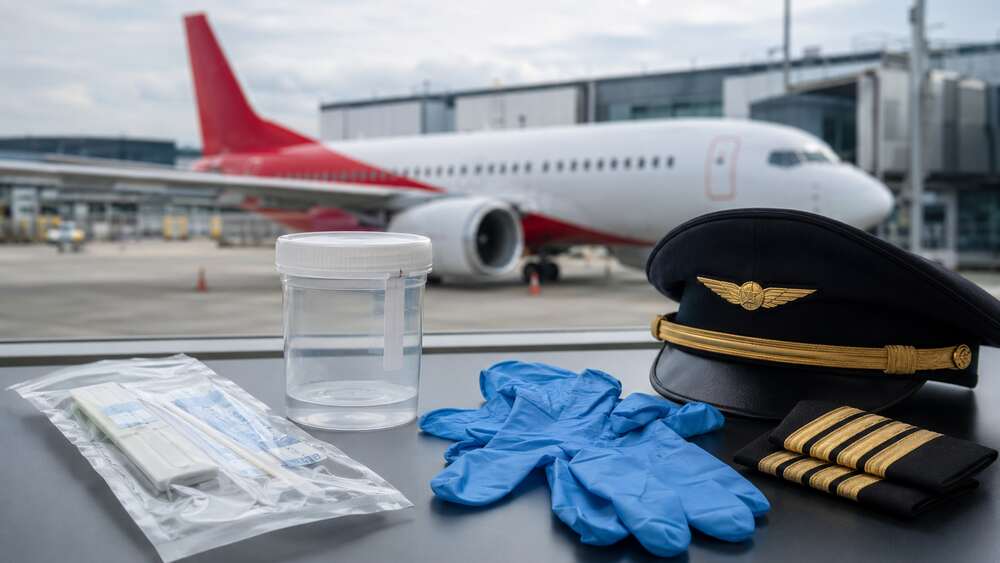
Air India will require its entire pilot workforce to undergo screening for prohibited substances and restricted medications, significantly expanding its testing program after a captain involved in a serious midair incident reportedly tested positive for marijuana.
The mandatory initiative covers pilots at both Air India and its low-cost subsidiary, Air India Express. It goes beyond Indian regulations requiring airlines to randomly test at least 10% of their flight crews annually for psychoactive substances.
Airline Broadens Pilot Screening Program
Air India began the expanded testing program after an Airbus A320neo operating from Phuket, Thailand, to New Delhi experienced a sudden altitude loss on Aug. 4. The aircraft dropped approximately 300 feet during cruise before stabilizing and landing safely in the Indian capital.
The airline said in an internal memo that it considered broader screening necessary despite already complying with existing aviation regulations.
“We nevertheless now feel that it is important to go further,” Air India said in the memo, according to Reuters.
The carrier said the initiative was designed to reinforce safety and professional standards while reassuring passengers, employees, regulators and other stakeholders.
Testing will be conducted during training sessions at Air India’s academy in Gurugram, after flights at briefing centers and offices, and at other locations designated by pilots’ home bases. The screening will cover prohibited psychoactive substances and medications restricted under aviation rules.
Air India Express Pilots Included
Pilots employed by Air India Express are also subject to the mandatory program. Including the budget subsidiary gives the Tata Group-owned airline broader oversight of compliance across its consolidated aviation operations.
The decision represents a substantial increase from the regulatory minimum. Random testing provides a sample of compliance across an airline’s workforce, while screening every pilot gives Air India a more comprehensive assessment at a specific point in time.
The expanded program supplements India’s aviation safety framework and does not replace the continuing random-testing requirement.
Phuket-Delhi Incident Remains Under Investigation
Air India Flight AI2379 was carrying 137 passengers and eight crew members when it experienced the sudden altitude variation. Passengers and crew members were injured, and the aircraft landed safely in Delhi.
Both pilots were removed from flying duties while authorities opened an investigation. India’s Aircraft Accident Investigation Bureau classified the occurrence as a serious incident and secured the flight data recorder and cockpit voice recorder for examination. Airbus and France’s Bureau of Enquiry and Analysis for Civil Aviation Safety are providing technical assistance.
Following the flight, both pilots underwent screening for psychoactive substances. A source familiar with the matter told Reuters that the captain subsequently tested positive for marijuana in a confirmatory laboratory test.
Test Result Does Not Establish Cause
Investigators have not established a connection between the reported test result and the aircraft’s altitude loss.
A preliminary Airbus assessment reviewed by Reuters indicated that the aircraft briefly lost key flight-control functions after all three hydraulic systems registered losses. The elevators and ailerons were reportedly unavailable for approximately four seconds before the systems recovered. The assessment did not determine the root cause.
Authorities are continuing to review flight information, maintenance records, aircraft systems and crew actions. The final investigation will determine what caused the altitude loss and whether human, mechanical or other factors contributed to the incident.
Safety Oversight Becomes a Business Priority
The new screening policy comes as Air India works to rebuild confidence following the June 2025 crash of a London-bound flight shortly after takeoff from Ahmedabad. The accident killed 241 people aboard the aircraft and 19 people on the ground. One passenger survived.
Air India is also pursuing a wider operational turnaround involving fleet renewal, service improvements and the integration of its aviation businesses. Former Ethiopian Airlines chief Tewolde Gebremariam recently assumed leadership of the carrier as it addresses safety, regulatory and operational pressures.
Screening all pilots gives the airline a visible mechanism for strengthening internal oversight. However, the investigation into Flight AI2379 will proceed independently, and its conclusions will be necessary to establish the circumstances behind the sudden altitude loss.
