


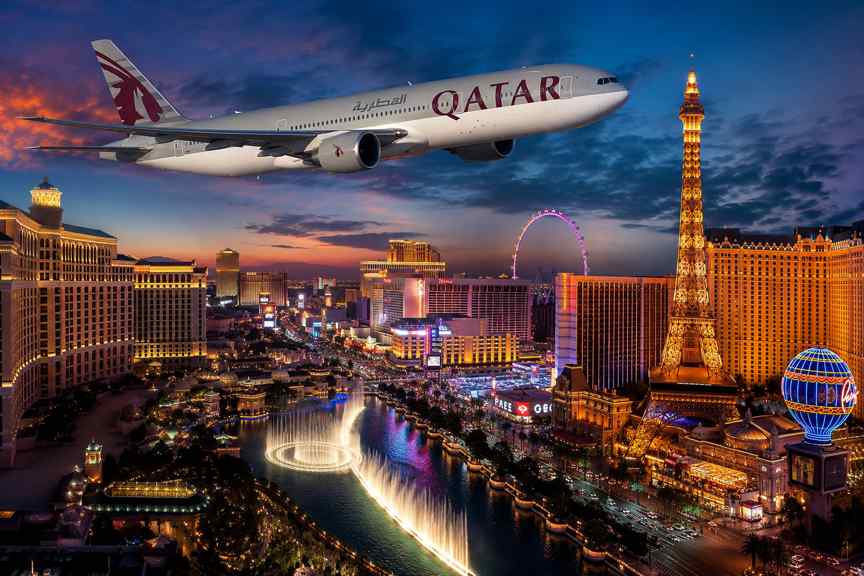
Gulf carrier once planned nonstop Doha-Las Vegas flights, but changing geopolitical realities halted the expansion before launch
Qatar Airways once set its sights on connecting Doha with Las Vegas, aiming to become the first Gulf carrier to offer nonstop service to Nevada’s entertainment capital. Although the route was announced with plans to begin operations in early 2018, it never materialized after the 2017 Gulf blockade forced the airline to reassess its network strategy.
Today, Qatar Airways remains one of the largest international airlines serving the United States, operating flights from Doha Hamad International Airport to 11 U.S. destinations. However, Las Vegas continues to be absent from its route network, underscoring how geopolitical events can reshape airline expansion plans for years.
Qatar Airways’ Las Vegas Ambitions Ended Before Takeoff
Planned service would have expanded U.S. footprint
Qatar Airways announced its intention to launch nonstop flights between Doha Hamad International Airport and Harry Reid International Airport in Las Vegas on January 12, 2017. At the time, the airline had been serving the United States for a decade after inaugurating flights to Newark in 2007 and had steadily expanded its American network to 10 destinations.
The Las Vegas route was scheduled to begin on January 8, 2018, using the Boeing 777-200LR. The airline planned to operate four flights each week in both directions, reflecting what appeared to be a measured approach to building demand in the Nevada market.
Had the service launched, Qatar Airways would have become the first Gulf-based airline to operate scheduled flights to Las Vegas.
Gulf Blockade Forced Network Changes
Regional airspace restrictions reshaped expansion strategy
Only months after the Las Vegas announcement, Qatar faced a major diplomatic crisis that fundamentally altered the airline’s operational environment.
In 2017, several neighboring countries imposed a regional blockade on Qatar, restricting aircraft registered in the country from using the airspace of Bahrain, Egypt, Saudi Arabia and the United Arab Emirates.
Those restrictions required Qatar Airways to redesign numerous flight paths while also reconsidering planned international expansion.
As a result, the Las Vegas route was shelved before carrying its first scheduled passenger. Planned services to Rio de Janeiro and Santiago de Chile were also abandoned as the airline shifted its focus toward maintaining existing operations during the period of disruption.
Although the blockade eventually ended, the Las Vegas service has never been revived.
Qatar Airways Maintains Strong U.S. Presence
Eleven American destinations remain in the network
Despite abandoning its Nevada plans, Qatar Airways has continued expanding its presence across the United States.
During July, the airline scheduled 418 flights to U.S. destinations. New York’s John F. Kennedy International Airport remains its busiest American gateway with 93 scheduled flights, averaging roughly three daily departures.
Dallas/Fort Worth follows with 62 scheduled flights during the month, while Chicago, Houston, Miami, Seattle and Washington Dulles all receive daily or more frequent service.
Additional U.S. destinations include Atlanta, Boston, Los Angeles and San Francisco, giving Qatar Airways one of the broadest U.S. networks among Middle Eastern carriers.
Passenger Demand May Explain Why the Route Never Returned
Traffic figures remain modest between Doha and Las Vegas
Market data suggests the airline may have avoided launching a route with limited passenger demand.
According to Simple Flying, only 2,775 passengers traveled between Doha and Las Vegas in both directions during the past year, averaging approximately eight travelers per day.
Even Las Vegas’ largest Middle Eastern market—Tel Aviv—generated only 26,918 annual passengers, or roughly 74 travelers each day.
Those figures illustrate the relatively small size of the market compared with Qatar Airways’ established U.S. destinations, many of which benefit from significantly stronger business and connecting traffic.
Las Vegas continues to attract international long-haul service, though most overseas flights are concentrated on Europe rather than the Middle East or Asia.
London Heathrow leads the city’s long-haul schedule with 75 flights during July, followed by Amsterdam with 31 and Frankfurt with 30. Seoul remains Las Vegas’ only nonstop long-haul destination in Asia, meaning most travelers from the Middle East must connect through another international hub before reaching Nevada.
Las Vegas Travel Guide
Planning a Visit Beyond the Casinos
While Las Vegas is best known for its casinos and entertainment venues, the city attracts millions of visitors each year with a wide variety of attractions that extend well beyond gambling.
Most visitors arrive through Harry Reid International Airport, the primary gateway to the city and the largest operating base for Southwest Airlines.
The Las Vegas Strip remains the center of the tourist experience, offering major hotels, world-famous resorts, live entertainment, restaurants and attractions within a relatively compact area. Downtown Las Vegas, particularly around Fremont Street, provides a different atmosphere with a more walkable layout and historic casinos.
Travelers looking to manage expenses often combine complimentary attractions—such as walking the Strip or visiting public displays—with ticketed performances and excursions, creating a balanced itinerary without significantly increasing costs.
Best time to visit
Spring, from March through May, and fall, from September through November, are generally considered the most comfortable seasons for visiting Las Vegas.
Spring offers warm daytime temperatures with cooler evenings, while fall provides pleasant weather suitable for outdoor sightseeing.
Summer temperatures frequently exceed comfortable levels for extended outdoor activities, making hotel pools among the busiest attractions during the season. Winter is comparatively mild during the day, although evenings can become cool and many resort pools suspend operations.
Although Qatar Airways never realized its ambitions of linking Doha directly with Las Vegas, the story serves as an example of how geopolitical developments can alter aviation strategies overnight. Nearly a decade after the original announcement, the proposed route remains one of the airline’s most notable expansion plans that never left the ground.
