


Singapore Airlines’ ultra-long-haul New York routes rely on hidden crew bunks, four-pilot rosters, and specially configured Airbus A350 aircraft
SINGAPORE — Operating the world’s longest commercial flights requires more than additional fuel capacity and premium seating. Behind the scenes, airlines depend on carefully planned crew rotations, hidden rest compartments, and specialized aircraft layouts to keep operations running smoothly during journeys lasting nearly 19 hours.
Singapore Airlines continues to hold the record for the world’s longest commercial service with its nonstop flights between Singapore Changi Airport and New York John F. Kennedy International Airport, along with its closely ranked route to Newark Liberty International Airport. Both flights are operated daily using the airline’s specially modified Airbus A350-900ULR aircraft.
The flights regularly exceed 18 hours in duration and have become a showcase for the operational demands of ultra-long-haul aviation. According to aviation industry reports cited by Simple Flying, Singapore Airlines also sells more premium seats to the New York market than any other U.S. destination, underscoring the commercial importance of the routes.
Singapore Airlines Built A Specialized Operation Around Ultra-Long-Haul Flying
A350-900ULR Designed For Extended Range
Singapore Airlines relaunched its nonstop Newark service in 2018 using flights SQ21 and SQ22, introducing the Airbus A350-900ULR, a specialized ultra-long-range version of the aircraft.
The subvariant includes software enhancements that increase usable fuel capacity, structural and aerodynamic modifications later incorporated into standard A350-900 models, and a deactivated forward cargo hold to prioritize range performance.
The Newark service was temporarily suspended during the COVID-19 pandemic before returning in 2022.
The airline’s New York JFK operation, marketed as SQ23 and SQ24, was launched during the pandemic period as cargo demand surged globally. Initially, Singapore Airlines deployed a standard Airbus A350-900 to maximize freight capacity before eventually transitioning the route to the A350-900ULR as passenger demand recovered.
SQ24 departs Singapore around midday, while SQ22 leaves shortly after midnight for Newark. Return flights from JFK depart in the evening, while Newark-bound returns leave in the morning.
Premium-Focused Cabin Configuration
No Economy Class On Ultra-Long-Haul Flights
Unlike Singapore Airlines’ standard Airbus A350-900 fleet, the A350-900ULR aircraft are configured almost entirely around premium travel.
Data from aeroLOPA shows the standard A350-900 carries 253 passengers across three cabins, including 42 business-class seats, 24 premium economy seats, and 187 economy seats.
The A350-900ULR, however, accommodates only 161 passengers, consisting of 67 business-class seats and 94 premium economy seats. The aircraft does not feature an economy cabin.
Passengers seeking economy fares between Singapore and New York instead travel via Singapore Airlines’ one-stop Boeing 777 service through Frankfurt.
The reduced seat count allows the carrier to optimize passenger comfort while preserving the aircraft’s operational range on some of the longest scheduled routes in aviation.
How Airlines Manage Crew Fatigue On 18-Hour Flights
Four Pilots And Rotating Cabin Crews
Because these flights exceed standard duty time limitations, Singapore Airlines assigns four pilots to each ultra-long-haul operation. The cockpit crew includes two captains and two first officers.
The cabin crew consists of 13 flight attendants, including the purser.
During takeoff and landing, all crew members remain seated at their assigned stations. Once the aircraft reaches cruising altitude, the pilots split into alternating teams, with one pair actively operating the aircraft while the other rests.
Flight attendants follow a similar rotation system. After the initial meal service, portions of the cabin crew move to designated rest areas while the remaining attendants continue passenger service duties.
Crew members typically rotate every two to three hours to ensure adequate rest before the final phase of the flight, when the full crew returns to active duty.
Although the aircraft carries only 161 passengers, Singapore Airlines maintains relatively high staffing levels to support premium onboard service standards.
Hidden Crew Rest Areas Above The Passenger Cabin
Separate Sleeping Areas For Pilots And Flight Attendants
Modern long-haul aircraft designs increasingly incorporate dedicated crew rest facilities hidden above the passenger cabin.
The concept first appeared on the Boeing 777 and later expanded to aircraft including the Boeing 787 and Airbus A350. Smaller widebody aircraft such as the Airbus A330 and Boeing 767 generally lack sufficient space for overhead crew rest modules.
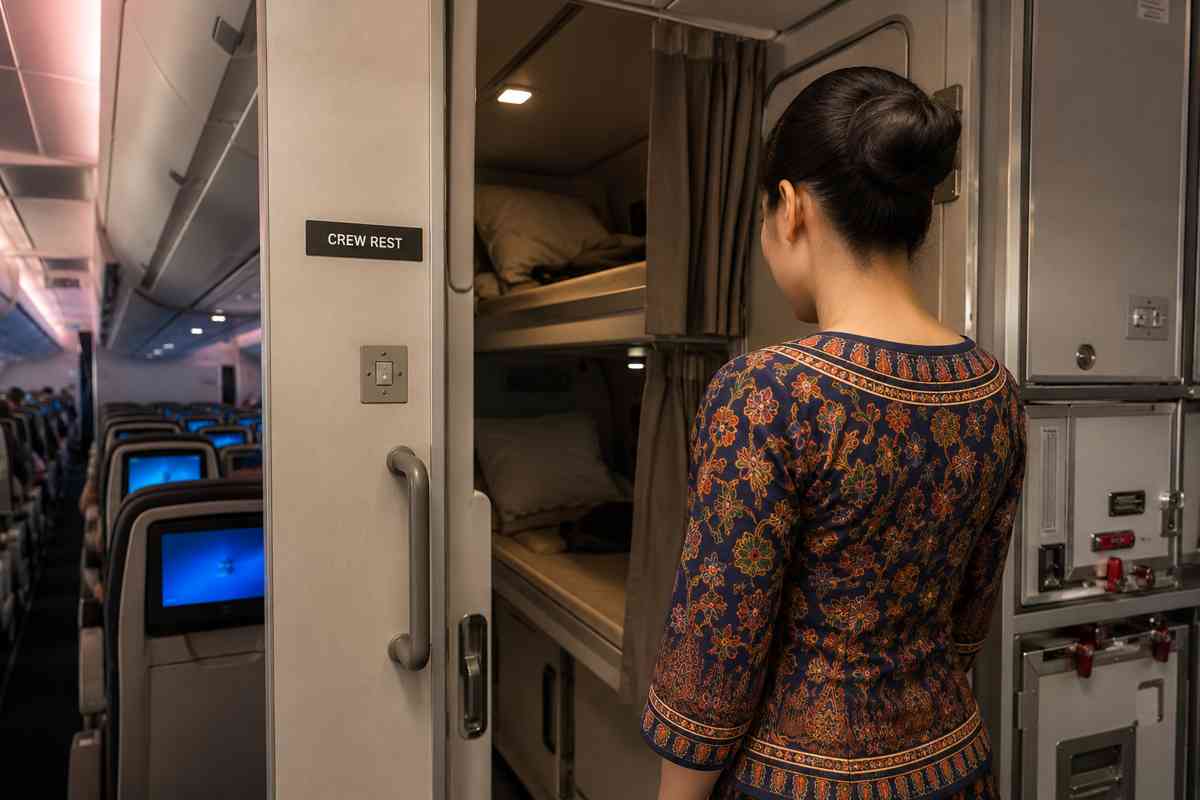
On Singapore Airlines’ A350-900ULR aircraft, flight attendant bunks are located near the rear of the cabin and accessed through a staircase positioned near the fourth set of exit doors.
The compartment contains eight sleeping bunks fitted with privacy curtains. Crew members can rest, read, or use onboard Wi-Fi while off duty.
Pilots use a separate rest compartment positioned above the forward business-class section. The pilot area includes two beds and an armchair, with the lowered ceiling above the business-class cabin often indicating the hidden rest facility overhead.
Ultra-Long-Haul Competition Continues To Grow
Singapore Airlines’ Singapore-to-New York routes currently remain the longest in the world by distance, measuring more than 8,280 nautical miles. However, Qantas is preparing to challenge that record through its upcoming Project Sunrise initiative.
The Australian carrier plans to introduce Airbus A350-1000ULR aircraft capable of nonstop flights from Sydney and Melbourne to London Heathrow and New York JFK.
Unlike Singapore Airlines’ all-premium approach, Qantas intends to include economy seating with additional legroom. Each aircraft will carry 238 passengers across first, business, premium economy, and economy cabins.
Despite the forthcoming competition, Singapore Airlines’ ultra-long-haul operation remains one of the most distinctive premium aviation products currently in commercial service.
