


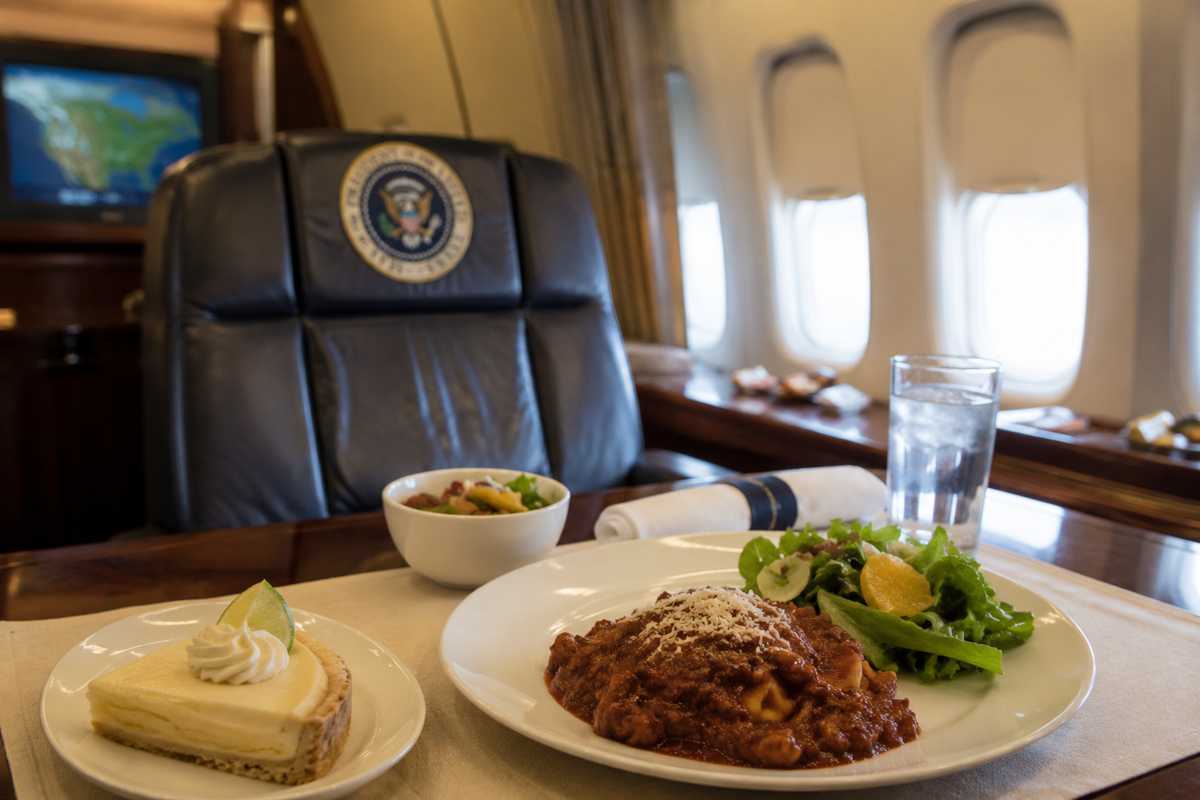
Inside the Meals Served to the White House Press Corps Aboard Air Force One
WASHINGTON, D.C. — From beef ragu and lobster salad to chocolate cake and freshly prepared sandwiches, the meals served aboard Air Force One offer a far different experience from what most travelers encounter on a standard domestic flight.
A recent review by Daily Caller White House correspondent Reagan Reese provided a rare glimpse into the catering operation aboard the presidential aircraft during a two-day trip covering routes to Las Vegas (LAS) and Phoenix (PHX). While the president receives customized meals based on personal preferences, the journalists traveling in the White House press pool are served separately prepared dishes that are billed directly to their employers.
The aircraft itself — the modified Boeing 747-200B designated VC-25A — is operated by the U.S. Air Force’s 89th Airlift Wing out of Joint Base Andrews. Beyond its advanced communications and security systems, the aircraft maintains a sophisticated onboard culinary operation capable of preparing restaurant-style meals at 35,000 feet.
What Reporters Eat During Presidential Travel
According to Reese’s account, the food quality aboard Air Force One exceeded expectations typically associated with domestic air travel.
On one of the longer flight segments, reporters were served beef ragu accompanied by a spring salad and key lime pie. Reese described the entrée as substantial and satisfying, noting that the beef ragu was generously portioned with a rich amount of sauce and meat.
The accompanying salad included crisp greens, fruit, and a light dressing, while the dessert received a more mixed reaction. Reese observed that the key lime pie lacked the tart flavor usually associated with the classic dessert.
During the shorter Las Vegas-to-Phoenix segment, the press pool received an Italian sub served on an asiago bagel alongside kettle chips and a chocolate chip cookie. Reese identified the cookie as the highlight of that particular meal service.
In another onboard meal service, reporters were served lobster salad with a croissant and chocolate cake. Reese ultimately concluded that the food quality aboard the presidential aircraft was “legitimately good.”
The experience contrasts sharply with the increasingly scaled-back service offerings on many domestic commercial flights. Major U.S. carriers have reduced complimentary onboard amenities in economy cabins over the years as airlines continue focusing on cost management and ancillary revenue.
The Specialized Culinary Operation Behind Air Force One
Military Flight Attendants Handle Meal Preparation
Air Force One carries two fully operational galleys designed to support extensive in-flight meal service for the president, staff, security personnel, and traveling media.
Meals are prepared and coordinated by specially trained military flight attendants assigned to the 89th Airlift Wing. These personnel are responsible for sourcing ingredients, preparing meals, and managing onboard service while adhering to strict security and food safety procedures.
Joint Base Andrews also operates a dedicated culinary training program for flight attendants assigned to special air missions. The program includes collaboration with chefs from the White House Mess and the vice president’s residence to ensure service standards meet presidential-level expectations.
The training reflects a broader aviation trend once seen among premium international airlines. Before the pandemic, carriers such as Etihad Airways employed professionally trained chefs to prepare and plate meals for first-class passengers during long-haul flights.
White House Press Pool Covers Meal Costs
Meals Are Not Complimentary
Despite the premium experience, reporters traveling aboard Air Force One are required to pay for their meals.
Meal expenses are billed directly to each journalist’s employer, with domestic meal services typically costing between $20 and $25. Some documented examples place individual meal charges at approximately $23.
The policy applies equally to all accredited members of the presidential press pool regardless of outlet size or reporter seniority.
The arrangement reflects long-standing White House travel procedures designed to separate government operations from media expenses while allowing reporters to accompany the president during official travel.
The Aircraft Behind the Presidential Experience
The VC-25A aircraft serving as Air Force One contains roughly 4,000 square feet of modified interior cabin space configured specifically for presidential operations.
The president’s private suite includes a bedroom, lavatory, shower, dressing room, and office space. The aircraft also features a conference room that can function as a dining area, communications centers, staff workspaces, and a fully equipped medical suite capable of supporting emergency procedures during flight.
One of the aircraft’s most significant operational features is its ability to conduct in-flight refueling, extending its range well beyond the approximately 7,800-mile baseline capability of the aircraft. The system allows the plane to remain airborne for extended periods if required during emergencies or international operations.
The Origins of Air Force One
How the Presidential Call Sign Was Created
The “Air Force One” designation dates back to 1953 during the presidency of Dwight D. Eisenhower.
The call sign was introduced after an Eastern Air Lines commercial flight using the number 8610 briefly shared the same airspace as the aircraft carrying the president, creating confusion for air traffic controllers.
To prevent similar incidents, the government established “Air Force One” as the exclusive call sign for any U.S. Air Force aircraft carrying the sitting president.
Before 1962, presidents generally traveled aboard aircraft configured similarly to commercial planes. That changed when a customized Boeing 707 entered service as the first jet specifically modified for presidential use.
First Lady Jacqueline Kennedy helped shape the aircraft’s iconic interior design, establishing the modern tradition of purpose-built presidential aircraft that continues with today’s VC-25A fleet.
