


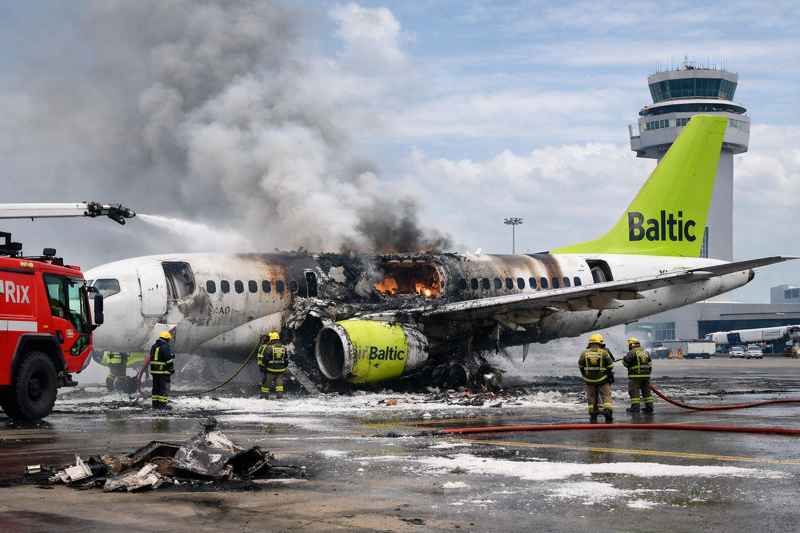
RIGA — An Airbus A220-300 operated by airBaltic has been declared a total loss following a maintenance-related ground fire at Riga International Airport, marking the first hull loss of the aircraft type since its commercial introduction in 2016.
The aircraft, registered YL-AAO, was undergoing scheduled heavy maintenance when the incident occurred on June 14, 2025. Engineers had initiated a routine auxiliary power unit test—a standard pre-service procedure—when the fire broke out, according to details released by investigators.
Fire Origin Linked to Environmental System Component
Maintenance crews were conducting post-maintenance testing while the aircraft was parked when flames were first observed in the central fuselage. The fire was later traced to the ozone filter unit, a component of the environmental control system responsible for converting ozone into breathable oxygen and maintaining cabin air quality.
The blaze caused extensive thermal damage, particularly to the fuselage and wing root structure. As a result, the aircraft was immediately removed from service and subjected to detailed technical inspections.
Damage Deemed Beyond Economic Repair
Following months of evaluation, Airbus engineering teams completed a full structural and economic assessment in December 2025. The findings concluded that repairing the aircraft would not be financially viable.
The damage affected critical structural areas, making restoration impractical despite the aircraft being relatively young. According to Aerospace Global News, the jet was just over six years old and had been among the earlier A220 deliveries to airBaltic.
The aircraft was insured and operated under a leasing agreement. airBaltic confirmed that it has filed an insurance claim related to the loss, which remains under review.
A First for the A220 Program
The incident represents the first known hull loss of the Airbus A220 globally. In aviation terms, a hull loss indicates that an aircraft is damaged beyond economic repair, regardless of whether it is physically destroyed.
Since entering service, the A220 has maintained a strong safety record and has been widely adopted by airlines for its efficiency and performance on short- to medium-haul routes.
While no prior A220 incidents resulted in total aircraft loss, there have been isolated operational events. In 2024, an aircraft operated by Swiss International Air Lines experienced an engine failure and smoke event that led to an emergency diversion and one fatality. In a separate, unrelated case the same year, an individual unlawfully entered an active engine area involving a Delta Air Lines A220 during ground operations in the United States, resulting in a fatality.
Industry experts emphasize that these incidents are not indicative of systemic design issues and have not significantly impacted confidence in the aircraft type.
airBaltic’s Fleet Strategy Remains Unchanged
airBaltic remains one of the largest operators of the A220, with more than 50 aircraft in active service. The Latvian carrier has centered its fleet strategy around the type, citing its fuel efficiency, lower operating costs, and flexibility across its route network.
The airline has not indicated any changes to its fleet plans following the incident. Analysts note that a single hull loss—particularly one linked to a ground maintenance event— is unlikely to alter long-term fleet strategies or manufacturer reputation.
Focus on Maintenance Safety and Investigation
The Riga incident highlights the importance of strict maintenance protocols and system reliability during testing phases. Post-maintenance checks are critical moments when multiple aircraft systems are reactivated and evaluated, increasing the need for precise oversight.
Investigators have identified the ozone filter unit as the origin of the fire but have not suggested any widespread safety concern related to the component across the global A220 fleet.
No injuries were reported during the incident, and operations at Riga International Airport continued with minimal disruption.
A Rare but Significant Event
As the insurance process continues and final investigative conclusions are awaited, the loss of YL-AAO stands as a rare but notable event in the operational history of the Airbus A220 program.
Despite the incident, the aircraft type continues to be regarded as a reliable and efficient option for airlines worldwide, with strong demand and an expanding global footprint.
