


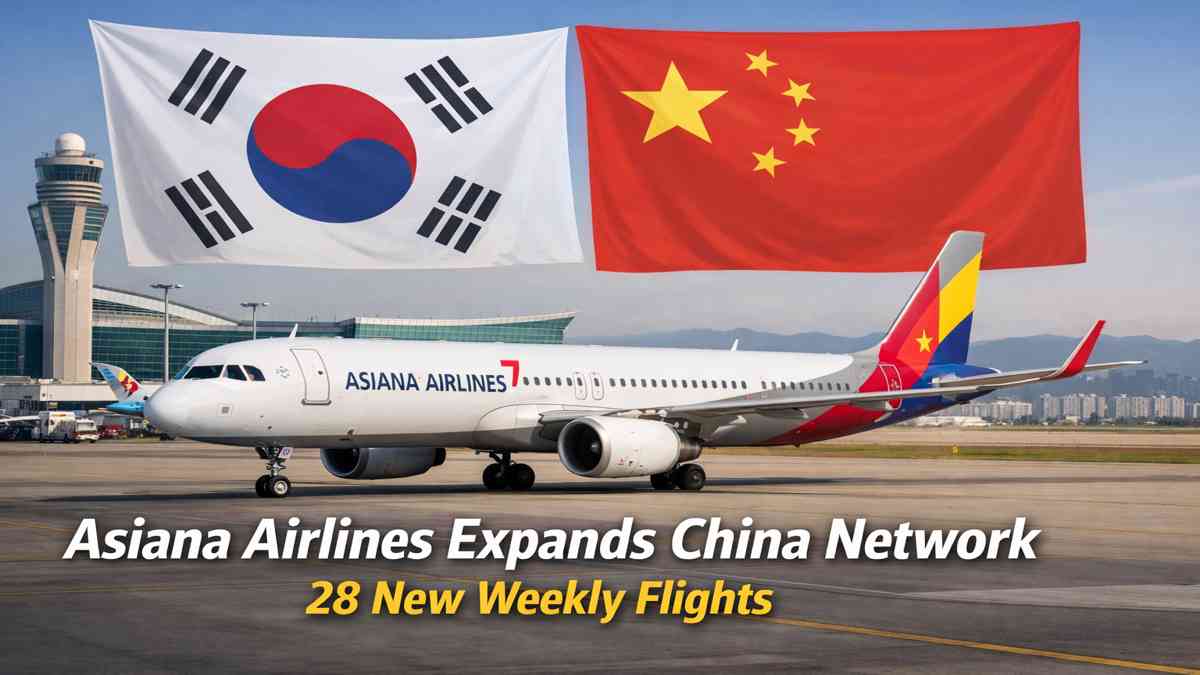
Asiana Airlines is significantly expanding its China network as cross-border travel demand between South Korea and China continues to rebound, adding 28 weekly flights beginning March 29 and increasing overall China service by 20 percent compared with its winter schedule.
Under the revised timetable, the Seoul-based carrier will operate a total of 161 weekly flights across 18 routes linking South Korea with major Chinese cities. The expansion underscores Asiana’s strategy to capture recovering passenger demand while reinforcing Incheon’s position as a key aviation hub in Northeast Asia.
Network Growth Reflects Demand Recovery
The additional capacity comes as travel flows between the two countries strengthen following the easing of travel restrictions and the extension of visa-free entry policies. Asiana said the expanded schedule is designed to support both business and leisure travel, with a focus on markets that have shown sustained recovery in passenger volumes.
By late March, the airline’s China operations will exceed pre-winter levels, reflecting confidence in the durability of demand. The expansion also aligns with broader industry trends, as carriers across the region gradually restore international capacity that was reduced during the pandemic.
Resumption of Key Routes
A central component of the expansion is the resumption of daily services on the Incheon–Chengdu and Incheon–Chongqing routes, both of which were suspended during the winter season. These flights will be operated using 188-seat Airbus A321neo aircraft, allowing Asiana to increase capacity while benefiting from improved fuel efficiency and lower operating costs.
In addition to the resumed routes, flights between Incheon and Beijing will increase from 17 to 20 per week, responding to rising demand from both corporate travelers and tourists. The Incheon–Dalian route will also see three additional afternoon services, bringing the total to 10 weekly flights.
Frequency Increases Across Multiple Cities
Asiana is also increasing frequencies on several secondary routes to provide passengers with greater scheduling flexibility. Services to Tianjin and Nanjing, which currently operate three and six times per week respectively, will see additional flights as part of the expanded schedule.
Further frequency increases are planned later in the spring. According to the Korean JoongAng Daily, from May 6 the airline will raise flights on the Incheon–Changchun route from seven to nine per week, reflecting steady growth in passenger traffic. From May 8, one additional weekly service will be added on the Incheon–Yanji route, increasing the total to eight flights per week. These routes primarily serve leisure travelers and visiting friends and relatives traffic.
Popular Destinations Drive Load Factors
Asiana has identified Chengdu and Chongqing as particularly strong performers within its China network. The airline said both cities continue to attract Korean travelers for cultural tourism, cuisine, and regional attractions, contributing to consistent improvements in load factors.
The carrier views these markets as strategically important, not only for point-to-point demand but also for onward connectivity within China. Increased frequencies are expected to enhance the airline’s competitiveness against regional rivals as capacity across the market continues to normalize.
Policy Support and Sales Expansion
Rising demand has been supported by favorable travel policies. China’s extension of visa-free entry for Korean nationals through the end of the year has helped accelerate outbound travel recovery, while inbound travel to South Korea has increased as Chinese visitors return for shopping, entertainment, and Korean popular culture. Visa-free entry for Chinese tour groups visiting Korea has further strengthened bilateral travel demand.
To support the network expansion, Asiana has also stepped up its commercial presence in China. Since February 2, the airline has operated an official direct sales channel on Ctrip, China’s largest online travel agency. In addition, the carrier conducted promotional activities on Alibaba-owned travel platform Fliggy during the Singles’ Day period in November 2025, aiming to broaden its customer base and stimulate demand.
Long-Term Strategy
An Asiana spokesperson said the airline plans to continue increasing capacity between Korea and China to support tourism and economic exchange. The carrier views the latest network expansion as a key step in strengthening long-term ties between the two countries and positioning itself for sustained growth as international travel continues to recover.
With the added flights, Asiana is signaling confidence that demand in one of its most important international markets will remain resilient through the remainder of the year.
