


British Airways is facing renewed criticism after a Business Class passenger experience on a 14-hour nonstop flight raised concerns about the airline’s execution of basic onboard service standards. The incident, which occurred on a long-haul route linking Asia and the United Kingdom, has prompted broader discussion about operational consistency, crew responsiveness, and the durability of customer loyalty in premium cabins.
The flight in question operated between Hong Kong International Airport and London Heathrow Airport, covering approximately 9,648 kilometers with a scheduled duration exceeding 14 hours. On such ultra-long-haul services, expectations around cleanliness, attentiveness, and access to essential amenities are generally higher, particularly for Business Class passengers paying a premium fare.
Business Class Lavatories Fall Below Expectations
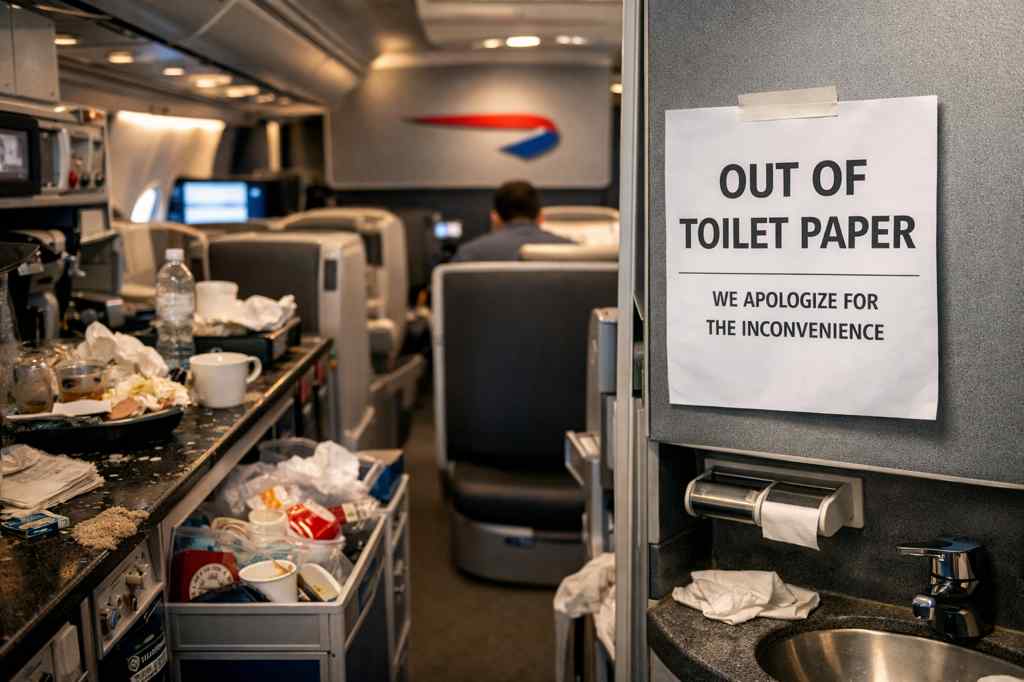
Several hours into the flight, onboard lavatories were reported to be in a neglected condition for more than four hours. According to PYOK, conditions included sticky floors, overflowing waste bins, and a complete absence of toilet paper and tissues.
For a premium cabin product, these deficiencies suggest a breakdown in routine cabin checks rather than an isolated oversight. Photographic evidence taken during the flight reportedly showed that multiple paper products had run out entirely, reinforcing concerns that restrooms were neither inspected nor restocked for an extended period.
The issues were not confined to a single lavatory. The widespread nature of the problem raised questions about whether standard service procedures were consistently followed throughout the flight.
Signs of Broader Cabin Neglect
Attention to shared spaces appeared to be lacking beyond the restrooms. The galley area was described as cluttered with spills and food debris during deplaning, suggesting that cabin tidiness was not maintained over the course of the flight.
When multiple service zones show visible neglect, it points to broader execution challenges rather than momentary pressure on cabin crew. Maintaining shared areas is considered a core responsibility on ultra-long-haul operations, particularly during overnight sectors when passengers rely heavily on cabin facilities.
Meal Service and Crew Responsiveness Concerns
Service shortcomings extended into the meal service. During the main meal period, the passenger attempted to signal cabin crew for assistance for approximately 20 minutes without response. Although the call button was pressed, it was reportedly canceled without follow-up.
Eventually, the passenger walked to the galley to request a meal. Crew initially declined, citing food temperature limitations related to safety standards. After further discussion, only soup was provided, resulting in the passenger consuming little more than soup during the 14-hour journey.
Breakfast was later skipped by choice, based on prior dissatisfaction with the airline’s breakfast offerings, with plans to eat after landing. While voluntary, this decision does not offset the earlier failure to provide a complete meal during standard service.
Loyalty Status and Shifting Passenger Perceptions
The traveler and their companion were long-standing top-tier frequent flyer members with British Airways. Recent policy changes, however, have made re-qualifying for that status unlikely. This experience reportedly accelerated doubts about whether continued loyalty to the airline remains justified.
Direct flight availability had historically been a key factor in maintaining loyalty. The incident prompted renewed consideration of whether convenience alone outweighs perceived declines in service consistency within premium cabins.
Industry Standards for Lavatory Maintenance
Public reaction to the incident was divided. Some defended the airline, suggesting heavy restroom usage by other passengers or arguing that travelers should request assistance directly. Others viewed these defenses as misplaced, noting that allowing lavatories to deteriorate to the point where all paper products are exhausted is widely considered unacceptable.
Standards for onboard restroom upkeep vary globally. East Asian carriers often expect frequent inspections, surface cleaning, waste removal, and consistent restocking. Middle Eastern airlines also emphasize regular maintenance, though execution can vary. European and North American carriers may face contractual or workload constraints, but running out of all hygiene supplies on a long-haul flight is not considered acceptable under any service model.
Accountability and Baseline Expectations
No airline delivers flawless service on every flight, and crew members can face unexpected challenges that disrupt routines. These realities provide context but do not excuse the erosion of non-negotiable service standards.
Passengers should never have to question the availability of essential hygiene items onboard. Feedback of this nature provides a clear opportunity for airlines like British Airways to reassess execution and reinforce baseline expectations in premium cabins, where reliability is as critical as comfort.
