


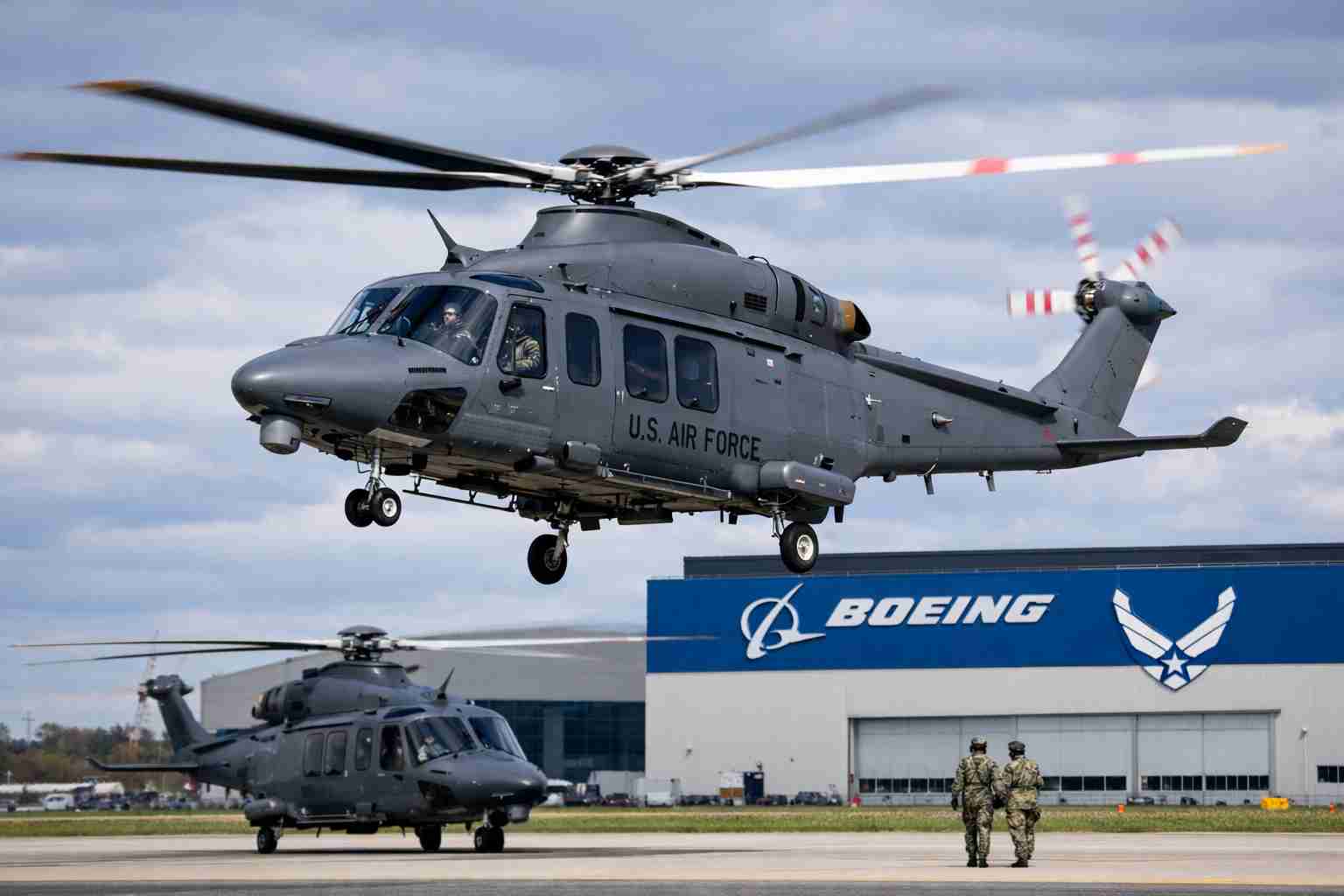
Boeing has secured a new contract from the U.S. Air Force to build four additional MH-139A Grey Wolf helicopters, continuing the steady expansion of a program central to America’s nuclear security and domestic defense missions. The latest award lifts the total number of MH-139A aircraft under contract to 38 and marks Boeing’s second production contract for the helicopter in the past five months.
The order was confirmed at Boeing’s rotorcraft facility near Philadelphia International Airport and reflects the Air Force’s urgency to modernize its rotary-wing fleet. The MH-139A is replacing the aging UH-1N Huey helicopters, some of which have been in service for decades and no longer meet current mission demands.
Contract Details and Program Growth
Under the new agreement, Boeing will produce four additional MH-139A helicopters and provide associated sustainment services. The contract follows a $173 million award issued in September for eight aircraft. Together, the two recent awards have a combined value exceeding $262 million, underscoring the scale and momentum of the program.
With this latest contract, the Air Force now has 38 MH-139A helicopters on order. Of those, 21 aircraft have already been delivered, including 12 helicopters supplied under a low-rate initial production contract awarded in 2023. The steady flow of deliveries highlights the program’s transition from early production into a more mature manufacturing phase.
The rapid sequence of awards points to the Air Force’s determination to field the new helicopter quickly, particularly for missions tied to national strategic security.
Mission Role and Operational Importance
The MH-139A Grey Wolf plays a critical role in safeguarding intercontinental ballistic missile fields across the American Midwest. These patrol missions are a cornerstone of the nation’s nuclear deterrence posture, requiring aircraft that can operate reliably across vast, often remote areas.
Beyond missile field security, the helicopter supports a range of additional missions, including search and rescue, security response, and contingency transport. Compared with legacy platforms, the MH-139A offers notable improvements in speed, range, payload capacity, and survivability, enabling faster response times and greater operational flexibility.
Aircraft Capabilities and Design
The MH-139A is based on the commercially proven Leonardo AW139, which Boeing has modified with military-specific systems to meet U.S. Air Force requirements. By leveraging a mature commercial design, the Air Force benefits from reduced development risk while still gaining advanced, mission-tailored capabilities.
The helicopter features a maximum cruise speed of approximately 165 knots and a range exceeding 570 nautical miles, depending on configuration. It can carry up to 15 passengers or a mix of troops and cargo, making it suitable for both patrol duties and rapid response operations.
Key specifications include a maximum takeoff weight of roughly 15,300 pounds, twin Pratt & Whitney PT6C-67C engines, and a digital glass cockpit equipped with advanced navigation systems. The aircraft is also capable of carrying external sling loads and transporting cargo internally, expanding its utility across diverse mission sets.
Industrial Impact and Acquisition Strategy
The MH-139A program carries significant industrial implications for the U.S. aerospace sector. Boeing’s work on the aircraft, together with Leonardo’s manufacturing contributions, supports more than a thousand jobs in the Philadelphia region and across the broader United States.
Strategically, the program aligns with the Air Force’s evolving acquisition approach, which increasingly emphasizes adaptable, commercially derived platforms. By modifying an existing helicopter design, the service accelerates delivery timelines and lowers technical risk while still achieving meaningful capability upgrades.
For Boeing, the additional MH-139A order strengthens its position in the competitive U.S. military rotorcraft market. The company continues to highlight safety, quality, and sustainment performance as central elements of the program as production scales.
Technical Features and Survivability Enhancements
In addition to its performance characteristics, the MH-139A incorporates numerous structural and survivability enhancements tailored to Air Force missions. The airframe has been reinforced to withstand frequent low-altitude operations and repetitive patrol cycles typical of missile field security.
The helicopter is equipped with secure, military-grade communications, avionics compatible with night vision goggles, crashworthy seating, and energy-absorbing structures to improve crew safety. Survivability is further enhanced through self-sealing, ballistic-tolerant fuel tanks and optimized system routing designed to reduce vulnerability.
A wide cabin layout, large sliding doors, and external sling load capability allow the aircraft to support troop transport, medical evacuation, and cargo missions with minimal reconfiguration.
Outlook for the Grey Wolf Program
The latest contract underscores sustained momentum behind the MH-139A Grey Wolf program and highlights the U.S. Air Force’s determination to modernize critical domestic defense missions without delay. As deliveries continue and production ramps up, the helicopter is positioned to become a long-term cornerstone of U.S. Air Force security operations for decades to come.
