


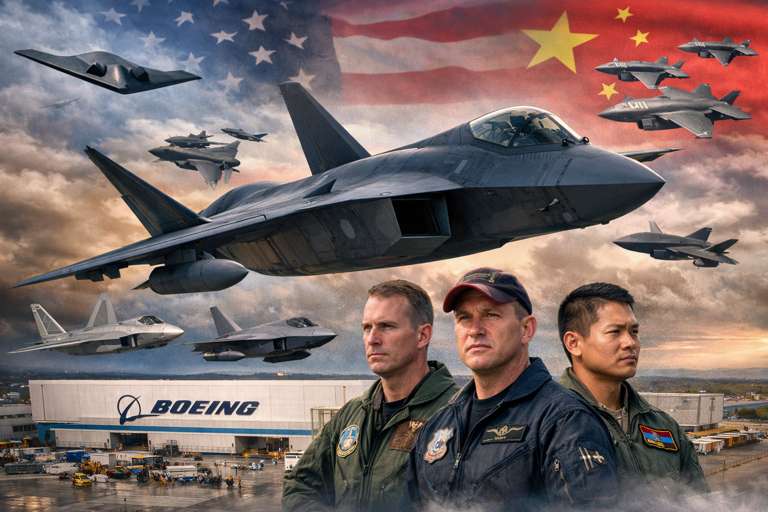
ARLINGTON — Boeing has secured a pivotal contract from the U.S. Air Force to develop the F-47, a sixth-generation fighter central to the military’s Next-Generation Air Dominance (NGAD) program. Valued at more than $20 billion for engineering and manufacturing development alone, the award is intended to replace the F-22 Raptor and redefine how the United States fights in the air for decades to come.
The win offers Boeing a critical defense lifeline at a time when its commercial aviation business has faced sustained pressure. Yet the decision has also prompted skepticism from former fighter pilots and defense analysts who question whether Boeing can deliver such an advanced aircraft on schedule and within budget.
A System, Not Just a Fighter
NGAD is designed as far more than a traditional aircraft program. The F-47 will serve as a crewed command platform operating alongside autonomous drone wingmen known as Collaborative Combat Aircraft. These unmanned systems are expected to carry weapons, sensors, or electronic warfare payloads, expanding the reach and survivability of the fighter while reducing risk to pilots.
The Air Force views this manned-unmanned teaming concept as essential to maintaining air superiority against near-peer competitors over the next three to four decades. The program is also a direct response to China’s rapid advances in military aviation and integrated air defense systems.
Boeing’s victory over Lockheed Martin to win the contract marks its most significant combat aircraft win in decades, following years in which rivals dominated major fighter and bomber programs, according to defense media reports.
Skepticism From Former Pilots
Concerns emerged quickly after the award. Former U.S. Air Force pilot C.W. Lemoine pointed to recurring delays and technical challenges in Boeing programs such as the KC-46 tanker and the T-7A trainer, questioning whether the company can execute a clean-sheet fighter design without repeating past problems.
Former Navy and Air Force instructor pilot T.K. Hartsock highlighted the limited public information about the F-47 and warned that integrating cutting-edge technologies on an aggressive timeline remains a major challenge. Former F-35 pilot Hasard Lee emphasized that the aircraft’s promised performance advantages remain theoretical until validated through testing and production.
Underlying these critiques are familiar risks: cost overruns, schedule slips, and Boeing’s limited recent experience designing a fighter from scratch.
Legacy Experience and Its Limits
Boeing’s current fighter portfolio includes the F-15EX Eagle II and the F/A-18 Super Hornet. However, both aircraft trace their origins to McDonnell Douglas, which Boeing acquired in 1997. While Boeing has modernized and sustained these jets, it did not design them from inception.
A similar pattern applies to the B-1 bomber, originally developed by North American Rockwell before Boeing acquired its defense business. Critics argue that upgrading legacy platforms differs fundamentally from creating a new stealth fighter optimized for future warfare.
Execution Challenges and Stealth Debate
Recent Boeing-led programs have faced execution hurdles. The KC-46 Pegasus tanker endured repeated delays and quality issues before reaching operational status, while the T-7A Red Hawk trainer encountered engineering and timeline problems. Broader manufacturing and safety concerns in Boeing’s commercial aircraft division have further strained confidence in the company’s program management discipline.
Stealth expertise is another focal point. Lockheed Martin built the F-117, F-22, and F-35 stealth fighters, while Northrop Grumman produced stealth bombers including the B-2 and B-21. Boeing has yet to deliver an operational stealth fighter, though its Bird of Prey demonstrator and X-32 prototype contributed to earlier stealth research efforts.
Timeline, Costs, and Strategic Stakes
Engineering development for the F-47 is expected to continue through the late 2020s, with prototype flights anticipated before the decade ends. Initial operational capability is widely projected for the early to mid-2030s, aligning with plans to retire portions of the F-22 fleet. Any significant delays could force costly extensions of F-22 operations and introduce readiness risks.
While the initial contract exceeds $20 billion, total program costs over decades could reach hundreds of billions of dollars, depending on fleet size and sustainment needs. Analysts expect per-aircraft costs to exceed those of the F-35 due to advanced capabilities and limited production volumes.
Why the Air Force Chose Boeing
Despite the concerns, the Air Force appears to have weighed broader industrial and strategic factors. Boeing reportedly offered competitive cost structures, digital engineering methods, and manufacturing approaches aligned with modular, upgradeable aircraft designs. Awarding the contract also helps preserve competition within the U.S. defense industrial base, avoiding concentration of advanced fighter development within a single company.
Production is expected to center on Boeing’s St. Louis facilities, supporting thousands of jobs across the national defense supply chain. Major subcontractors and propulsion partners have yet to be publicly named.
The Road Ahead
As China accelerates its own sixth-generation fighter ambitions, the stakes surrounding the F-47 are unusually high. Success would restore Boeing’s standing as a premier combat aircraft developer and reinforce U.S. air dominance. Failure or delay, however, could narrow America’s long-held advantage in the skies.
