


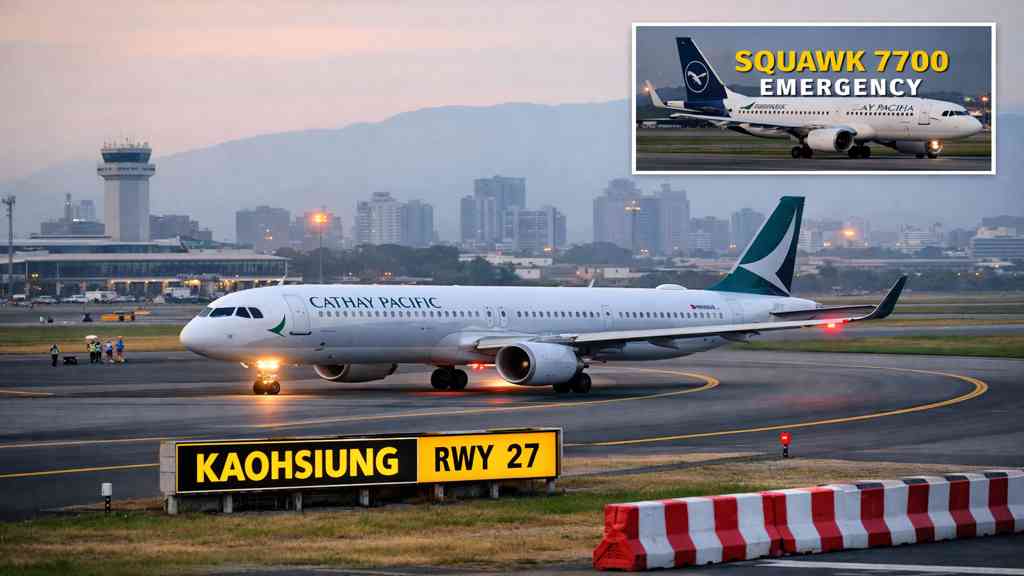
A Cathay Pacific Airways flight bound for Hong Kong was forced to return to its departure airport shortly after takeoff on Sunday due to a technical issue, disrupting travel plans for roughly 200 passengers but underscoring the aviation industry’s conservative approach to safety and risk management.
The flight, operated by Cathay Pacific, involved an Airbus A321neo aircraft and was scheduled to operate as CX449 from Kaohsiung to Hong Kong. The airline confirmed that the aircraft returned to Kaohsiung International Airport after an onboard system indicated a potential technical irregularity during the climb phase.
Flight CX449 Turns Back Shortly After Departure
Cathay Pacific flight CX449 departed Kaohsiung at 7:46 a.m. local time on Sunday. Shortly after takeoff, pilots identified an unspecified technical issue and made the decision to discontinue the flight in accordance with standard safety procedures.
The aircraft landed safely back at Kaohsiung International Airport at 8:26 a.m., about 40 minutes after departure. The Airbus A321neo operating the service has a seating capacity of 202 passengers, and approximately 200 travelers were onboard at the time of the return.
Cathay Pacific stated that the decision to return was made to ensure passenger and crew safety. Maintenance inspections began immediately after landing to identify and resolve the issue before the aircraft could be cleared to re-enter service, according to reporting by the South China Morning Post.
Passenger Rebooking and Operational Recovery
Following the precautionary landing, passengers disembarked normally and were assisted by ground staff with rebooking onto alternative flights to Hong Kong later the same day. To ease the inconvenience caused by the disruption, airline teams provided meal vouchers and refreshments at the airport.
Cathay Pacific also deployed aircraft with higher seating capacity on additional services from Kaohsiung to help accommodate displaced passengers and stabilize the day’s flight schedule. The airline apologized for the disruption and thanked customers for their patience during the recovery process.
Such measures are typical of full-service carriers seeking to minimize downstream impacts from unplanned aircraft returns, particularly on high-frequency regional routes like Kaohsiung–Hong Kong.
Standard Safety Procedures in Commercial Aviation
Unscheduled returns to the departure airport are a routine aspect of airline operations when flight crews receive system alerts or detect anomalies shortly after takeoff. Aviation safety protocols prioritize resolving potential issues on the ground rather than continuing a flight with unresolved technical uncertainties.
Cathay Pacific emphasized that passenger safety remains its highest priority and that all operational decisions follow strict international aviation safety regulations. Engineers are able to conduct more thorough inspections at the departure airport, where maintenance facilities, spare parts, and technical expertise are readily available.
Comparable Incident Involving Lufthansa
A similar precautionary return occurred recently involving Lufthansa, highlighting that such events are not uncommon across global carriers. Lufthansa flight LH2473 returned to London shortly after departure after the crew detected a technical issue.
The Airbus A320 had departed London Heathrow Airport at 11:55 local time for Munich Airport. Within 23 minutes, pilots identified a system concern and transmitted squawk code 7700, the universal signal indicating a general emergency. Air traffic control granted immediate priority handling.
Flight tracking data shows the aircraft climbed to approximately 14,000 feet before entering a controlled holding pattern over London. After assessing the situation, the crew elected to return to Heathrow, where comprehensive maintenance and operational support were available. The aircraft landed safely, and no injuries were reported.
Understanding Squawk Code 7700
Squawk 7700 is used by pilots to alert air traffic control to an emergency situation requiring immediate attention. While the code does not specify the nature of the problem, it ensures priority routing, emergency readiness, and rapid coordination among aviation authorities.
In the Lufthansa case, early detection and adherence to established procedures allowed for a controlled return and minimized operational risk. Lufthansa later confirmed the return was due to technical reasons but did not disclose system details, which is standard practice while inspections are underway.
Safety Over Schedule Reliability
Both the Cathay Pacific and Lufthansa incidents illustrate the aviation industry’s emphasis on safety over schedule reliability. While precautionary returns can disrupt travel plans and airline operations, they are widely viewed as evidence of effective safety systems and disciplined crew decision-making.
Airlines typically arrange passenger rebooking or replacement aircraft following such events, ensuring travel continuity while maintaining rigorous safety standards.
