


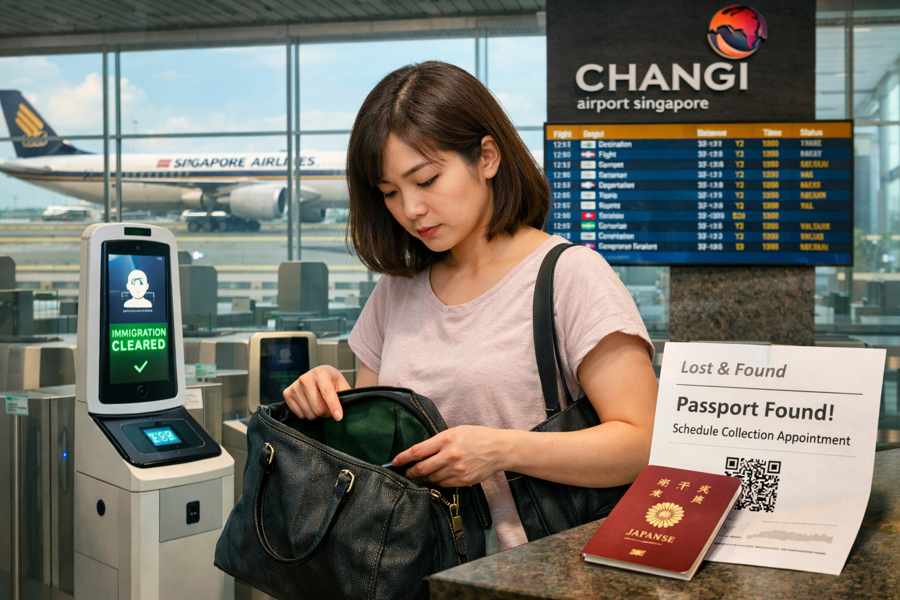
SINGAPORE — A Japanese traveler’s lost passport — left behind on a Singapore Airlines flight — has drawn attention to the efficiency and potential blind spots of Singapore’s increasingly automated border control systems, after she was able to clear immigration without physically presenting the document.
The incident involved a passenger identified as Nao, who arrived in Singapore on January 14, 2026, aboard a Singapore Airlines (SQ) flight from Nagoya, Japan. According to her account, Nao only realized her passport was missing the day after arrival, despite having successfully exited Singapore Changi Airport and returned home.
The episode underscores both the operational strengths of biometric immigration clearance and the continuing responsibility of travelers to safeguard essential documents, even as airports reduce reliance on manual checks.
Arrival Without Realizing the Loss
Nao landed at Singapore Changi Airport at approximately 4:10 p.m. on January 14 after departing from Nagoya’s Chubu Centrair International Airport. After disembarking from the aircraft, she proceeded through immigration using Singapore’s facial recognition-based clearance system.
Unaware that her passport was no longer in her possession, Nao completed arrival formalities and left the airport without opening her bag or retrieving her travel document. The passport, it later emerged, had been left onboard the aircraft.
The seamless nature of the biometric clearance meant there was no moment at which a physical passport was requested or checked by an immigration officer, allowing the oversight to go unnoticed.
Lost Passport Discovered by Airport Staff
Nao only became aware of the issue the following morning. At 9:29 a.m., she received an email from SATS’ lost and found department, the ground handling and airport services provider at Changi Airport.
The email informed her that her passport had been recovered and was being securely held at the baggage arrival station at Terminal 2. It also included instructions and a QR code to schedule an appointment for passport collection.
Initially, Nao suspected the email might be fraudulent. Having already cleared immigration without difficulty, she had no immediate reason to believe her passport was missing or had been found by airport authorities.
How Biometric Clearance Enabled the Oversight
Upon further reflection, Nao realized that Singapore’s automated immigration system had allowed her to complete entry procedures without a manual document check. She later shared her experience on Instagram, noting that the facial recognition process was so smooth that she did not notice her passport was absent.
Singapore Changi Airport has steadily expanded biometric clearance for arriving passengers as part of a broader push toward automation. Eligible travelers can complete immigration formalities using facial data previously enrolled with authorities, reducing processing time and congestion at arrival halls.
For airlines and airports, the system improves throughput and operational efficiency. For passengers, it minimizes wait times and physical handling of documents — benefits that are increasingly valued in high-traffic international hubs.
Questions Around Data and Communication
While relieved to have her passport recovered quickly, Nao also expressed concerns about personal data security, according to local media outlet Mothership.
She questioned how SATS had obtained her email address, though she acknowledged the overall efficiency of the process and expressed gratitude to airport staff for safeguarding her passport until it could be returned.
From an operational perspective, the incident highlights the coordination between airline crews, ground handlers, and airport authorities in managing lost property, particularly sensitive items such as passports.
Broader Implications for Airport Automation
The case illustrates how advanced airport automation can occasionally obscure simple human errors. While biometric immigration systems are designed to enhance security and efficiency, they may also reduce the visual cues that remind travelers to confirm they have essential documents in hand.
For business travelers and frequent flyers, the episode serves as a reminder that responsibility for travel documents ultimately remains with the passenger, regardless of how advanced border processing becomes.
At the same time, the swift recovery and secure handling of the lost passport reflect the robustness of Singapore’s airport operations — a factor that continues to reinforce Changi Airport’s reputation as one of the world’s most efficient aviation hubs.
As global airports increasingly adopt passport-less travel technologies, incidents like this may shape future discussions around safeguards, traveler awareness, and data integration across airlines and border agencies.
