


A Resounding No After Years of Stagnant Pay
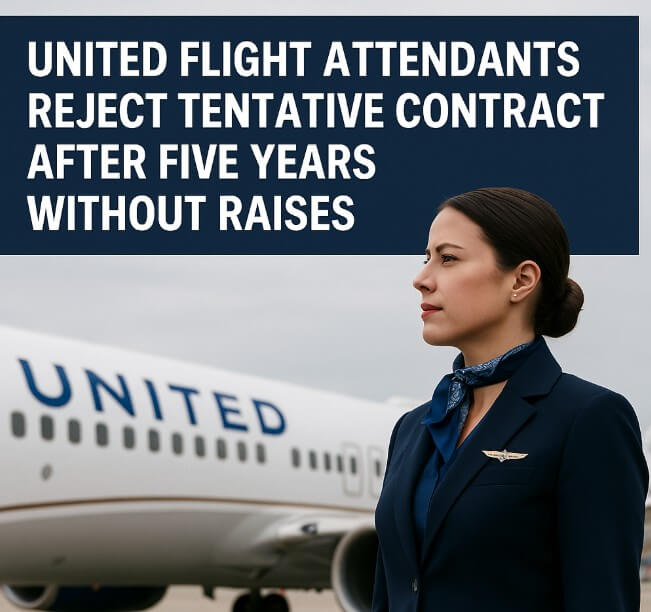
CHICAGO — United Airlines flight attendants have rejected a tentative labor agreement after nearly five years without a pay raise, sending negotiators back to the table and highlighting deep dissatisfaction over compensation, scheduling, and quality-of-life protections.
More than 71% of voting flight attendants opposed the agreement negotiated by their union, the Association of Flight Attendants-CWA. The rejection followed a prolonged period in which inflation significantly eroded real wages, with the union estimating that flight attendants lost roughly 25 percent of their purchasing power during the contract hiatus.
The proposed deal offered average wage increases of less than 27 percent. While union leadership characterized the agreement as the strongest outcome achievable under current conditions, many members said the increases fell short of restoring lost income and failed to justify ratification after years of concessions.
Pay Was Central, But Not the Only Issue
Although wages were a primary concern, opposition extended beyond compensation. Contract language governing layover hotels drew particular criticism, with flight attendants warning that the provisions could allow lower-quality accommodations farther from city centers.
Others voted against the deal on principle, arguing that accepting an initial proposal would weaken the union’s leverage in future negotiations. Following the vote, union leadership acknowledged that it had misread member priorities during the first round of talks.
In response, the union surveyed flight attendants to better understand concerns, especially around scheduling practices and layover standards. Those findings are now shaping the next phase of negotiations.
Limited Leverage in a Constrained Labor Environment
The bargaining process has been heavily influenced by regulatory realities. Airline labor relations fall under the Railway Labor Act, and strikes have not been authorized under either the Trump or Biden administrations. That limitation has sharply reduced labor’s leverage, forcing unions to rely on internal trade-offs rather than external pressure.
Union leaders have noted that pushing for higher costs at United would inevitably prompt management to seek offsets elsewhere. As a result, issues that appeared settled earlier in negotiations have resurfaced as talks continue.
Scheduling Returns to the Forefront
As renegotiations progressed, United moved to place previously resolved concessions back on the table, with scheduling emerging as a central issue. Management has said that any enhancements to compensation or work rules must be balanced by efficiency improvements.
United told flight attendants it had begun a “joint process with AFA to modernize bidding” designed to increase flexibility and choice. The union sharply disputed that framing, stating that management instead presented a list of concessions that had already been rejected in the tentative agreement.
Union leadership emphasized that no improved offer was being withheld and cautioned members against expecting automatic gains from voting the deal down.
What the Preferential Bidding System Is
At the heart of the scheduling dispute is the Preferential Bidding System, or PBS. Under traditional seniority-based scheduling, flight attendants select from a published list of trip lines in strict seniority order. PBS replaces that approach with an algorithm-driven model.
Flight attendants submit ranked preferences that may include days off, credit hours, trip length, report times, aircraft types, destinations, commutability, and reserve versus lineholder status. These preferences are layered and processed simultaneously by an optimization engine that balances individual priorities against coverage needs, legal requirements, and contractual rules.
While seniority remains a factor, it operates within the system rather than determining outcomes directly.
Why Flight Attendants Strongly Oppose PBS
From the airline’s perspective, PBS offers clear advantages. It improves coverage of undesirable flying, reduces unassigned trips, lowers manual scheduling workloads, and minimizes the need for premium pay. United’s broader investment in AI and AI-adjacent efficiency tools makes PBS a natural operational objective.
For flight attendants, however, the system is often viewed as opaque and unforgiving. PBS can generate schedules that technically satisfy preferences while violating practical expectations. A crewmember requesting “no redeyes,” for example, may still receive a 5:30 a.m. report time.
Senior flight attendants are especially resistant, arguing that PBS reduces predictability and weakens the visible benefits of seniority built over long careers.
Industry Context and Likely Outcome
Several major U.S. airlines, including American and Alaska, already use PBS for flight attendants. Still, United had previously agreed to forego the system in earlier talks. Its reappearance now is widely seen as a tactical move rather than a firm implementation plan.
By advancing a proposal that flight attendants overwhelmingly oppose, management creates bargaining room to later withdraw it in exchange for agreement elsewhere. Given the intensity of opposition and prior agreements, PBS is unlikely to be implemented in the final contract.
As negotiations continue, both sides face tight constraints. United is unlikely to materially exceed the financial terms already offered, while the union must show tangible progress to secure ratification. The path forward is expected to hinge on selective concessions that allow both parties to claim victory — and finally bring an end to years of stagnant pay.
