


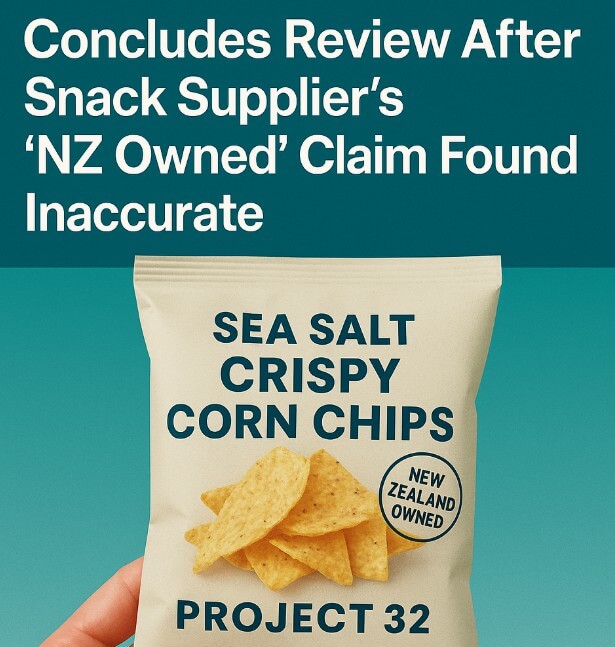
Air New Zealand has completed an internal investigation into onboard snack provider Project 32, determining that the supplier’s packaging inaccurately claimed the company was “New Zealand Owned.” The airline has initiated corrective measures and strengthened its supplier-verification processes following the findings.
Discrepancy Over Ownership Prompts Inquiry
The airline launched the review after concerns emerged that Project 32’s ownership structure did not match its branding. While the packaging promoted the business as locally owned, inquiries revealed that its shareholders were Australian entities and its directors, Daniel and David Rifkin, were based in Australia.
Air New Zealand, which operates major hubs in Auckland (AKL), Wellington (WLG), and Christchurch (CHC), said the issue required immediate attention due to the company’s emphasis on transparent supplier relationships. According to reporting from NewsTalkZB, the airline determined that “the statement printed on Project 32’s packaging was not accurate at the time it was produced.”
Project 32 has supplied a range of snack products for both domestic and international flights since November 2023.
Findings Confirm Ownership Misalignment
Although Project 32 was registered in New Zealand, Air New Zealand said it did not meet the ownership criteria implied by the “New Zealand Owned” label. The airline concluded that corrective action was essential to maintain accurate product information for passengers and uphold the integrity of its procurement practices.
The airline said “the matter required prompt clarification given the airline’s emphasis on transparent supplier relationships,” underscoring the importance of consistent and accurate claims across onboard offerings.
Supplier Cooperation and Ownership Changes
Air New Zealand reported that Project 32 worked cooperatively throughout the review process. Following the concerns raised, the supplier moved to restructure its leadership. “The company appointed New Zealander Janice Tan as a director, effectively shifting the business to New Zealand ownership,” the airline said.
Project 32 also committed to redesigning its packaging artwork, with updates already underway to ensure future stock reflects accurate ownership information. The business further agreed to increase transparency around its charitable donation model, shifting from annual to quarterly reporting to provide “greater clarity.”
Despite the discrepancy, existing stock will remain in circulation due to food-safety and sustainability considerations. Air New Zealand noted that current packaging is tied to the products’ gluten-free certification, and discarding it would create unnecessary waste. The airline added that donations tied to already-produced stock must also remain on schedule to support community programmes for the year.
Strengthened Verification and Compliance Measures
Following the investigation, Air New Zealand introduced more stringent checks to prevent similar issues in the future. “This includes enhanced verification protocols for supplier packaging claims and more detailed checks before new products enter service,” the airline stated.
The carrier emphasized that supplier compliance is now a heightened priority, reflecting growing customer expectations for accurate sourcing and product information. These standards will be applied across all product categories as part of a broader effort to reinforce transparency in the airline’s supply chain.
Broader Implications for Supplier Oversight
The Project 32 review highlights the pressures companies face to ensure accuracy in branding and supply-chain communications. For Air New Zealand, the incident underscores the need for rigorous verification processes, especially as customers increasingly evaluate brands based on ethics, sourcing and authenticity.
With ownership changes in place and packaging updates underway, Air New Zealand and Project 32 aim to restore alignment between branding and business structure. The airline says its updated verification steps will help maintain customer trust and prevent future misstatements across its onboard offerings.
