


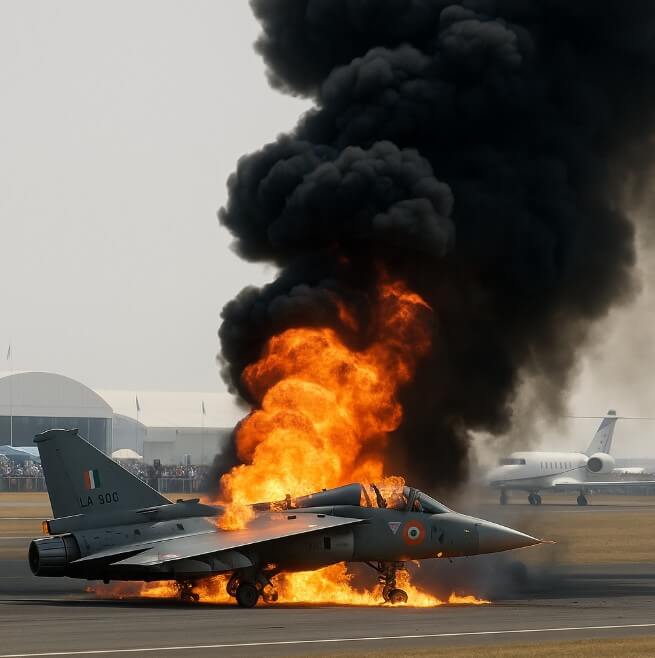
Deadly Crash During High-Profile Aerial Display
The Indian Air Force’s light combat aircraft program suffered a major setback Friday after a HAL Tejas fighter jet crashed during a demonstration flight at the Dubai Air Show, killing its pilot and prompting an immediate investigation by Indian military authorities.
The single-engine jet went down at approximately 14:10 local time at Al Maktoum International Airport during the final scheduled aerial display of the day. Witnesses described a sudden loss of control as the aircraft executed a low-altitude maneuver, followed by a steep, irreversible descent. The impact triggered a fireball visible across the airfield, sending thick black smoke rising over the runway and briefly halting the airshow.
Eyewitness Accounts and Emergency Response
Eyewitness accounts indicated no sign that the pilot had ejected prior to the crash. Emergency crews responded within minutes, cordoning off the site as crowds were moved back. The Indian Air Force later confirmed that the pilot sustained fatal injuries and announced that a formal court of inquiry would be convened to determine the cause.
Authorities in Dubai said their defense ministry is coordinating with Indian officials in the early stages of the technical assessment. The IAF described the loss as a moment of profound grief and pledged transparency throughout the investigation. According to the statement, the aircraft involved was a production-model Tejas, the domestically developed fighter at the center of India’s military aviation modernization push.
Tejas: A Pillar of India’s Indigenous Defense Strategy
The Tejas is a 4.5-generation, multirole combat aircraft designed by the Aeronautical Development Agency and built by Hindustan Aeronautics Limited. Featuring a delta-wing design, fly-by-wire controls, and a single imported powerplant—reportedly a General Electric F404-series engine in this particular aircraft—the jet has been positioned as a cornerstone of India’s “Make in India” defense manufacturing strategy. The platform is intended to replace aging MiG-21 variants and bolster air-defense and strike capabilities across several IAF squadrons.
Previous Incidents and Growing Safety Scrutiny
Friday’s crash marks only the second known loss of a Tejas aircraft in active service. The first occurred in March 2024 in Rajasthan, when a pilot successfully ejected. While the Tejas program has enjoyed strong political backing and growing production orders, the fatal nature of the Dubai accident is expected to intensify scrutiny of the aircraft’s reliability, maintenance standards, airshow suitability, and flight-control systems.
Airshow Risks and Operational Considerations
Airshow demonstrations typically require strict safety margins because of the high-performance maneuvers flown over large public audiences. Aviation analysts note that even experienced pilots can face unpredictable aerodynamic loads at low altitude, and small deviations in control response may prove catastrophic in confined airspace. The crash is likely to prompt a reassessment of display envelopes, emergency egress protocols, and procedures for international demonstration flights.
Impact on Procurement and Export Ambitions
The timing adds pressure to a program already navigating tight production commitments. In September 2025, India’s Defence Ministry approved the procurement of 97 additional Tejas aircraft, with deliveries expected to begin in 2027. The order was intended to accelerate squadron inductions and expand India’s domestic aerospace manufacturing base. Analysts say the Dubai incident may force renewed evaluation of training, certification, and quality assurance processes, particularly for aircraft presented on global stages.
Export prospects, a key aspiration for HAL, may also face headwinds. Airshow demonstrations are strategically important for marketing indigenous defense platforms, and a high-visibility crash can dampen international interest. Countries considering the Tejas for light-fighter roles may now seek additional information on the investigation’s findings before advancing any procurement discussions.
A Critical Moment for India’s Aerospace Ambitions
For HAL and the Aeronautical Development Agency, the incident represents a test of the program’s resilience and the credibility of India’s broader efforts toward aerospace self-reliance. While accidents involving fighter aircraft are not uncommon globally, the loss of a pilot during an international showcase is a significant setback.
The Tejas crash at the Dubai Air Show 2025 is a tragic blow to India’s aviation prestige. With its pilot lost and investigations now underway, the outcome could influence not only the future of the Tejas programme, but also how India presents its indigenous fighter jets on the world stage.
