


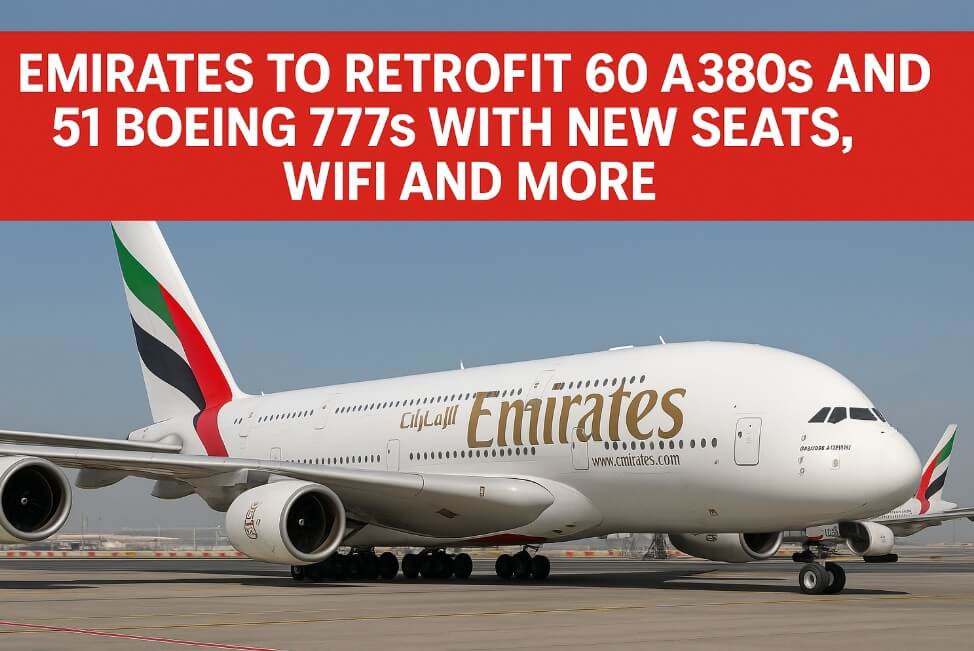
Emirates Airline is accelerating its next wave of cabin upgrades, setting the stage for one of the largest interior retrofit efforts currently underway in global aviation. The Dubai-based carrier plans to overhaul 60 Airbus A380s and 51 Boeing 777s beginning in August 2026, a move designed to bring its existing fleet in line with the newest aircraft joining its network.
The project, which will be carried out at Emirates’ engineering hub at Dubai International Airport, marks a significant extension of an initiative that began three years ago. It introduces new seating across all classes, refreshed cabin design, upgraded inflight entertainment, and the installation of Starlink high-speed Wi-Fi. The goal: to deliver a consistently modern onboard experience even as the airline expands and diversifies its long-haul fleet.
A Multi-Partner Upgrade Effort
Emirates Engineering is working alongside Airbus, Safran, Recaro, Panasonic, Starlink, and UUDS to execute the next phase of the retrofit. For the A380, the work includes redesigned seating and a new onboard lounge layout. Both the A380 and 777 fleets will be equipped with Panasonic’s Astrova entertainment platform, a uniform system intended to standardize the inflight experience across 111 aircraft once the retrofit is completed.
According to the airline, these upgrades stem from a long-term plan to work closely with manufacturers and technology partners on product development. That includes improvements in comfort, privacy, digital services, and advanced cabin systems—features intended to keep pace with the innovations available aboard newly delivered aircraft.
Sir Tim Clark, President of Emirates Airline, said the retrofit programme reinforces the company’s longstanding approach to fleetwide consistency and passenger experience.
“Emirates’ retrofit programme is about continuously elevating standards across our entire fleet. Working with our long-standing partners, we’re taking this commitment a step further with the aim of delivering product consistency at scale, in tandem with next-generation innovations in seating, entertainment, and connectivity being brought into service with our newly delivered fleet. Our customers expect an excellent experience every time they fly Emirates, and this investment ensures we deliver on that promise in the years to come, wherever they travel with us.”
Cabin Enhancements Across All Classes
The next generation of Business Class seating, inspired by the leather-clad Safran S Lounge design used in Emirates’ A350 jets, will be rolled out across both the A380 and 777. The seats will feature improved privacy, wireless charging, customizable lighting, additional storage, minibar amenities, and multiple power options including USB-C ports.
Premium Economy, a cabin Emirates has rapidly expanded across its fleet, will be outfitted with Recaro seats featuring mechanical recline, wide leather cushions, leg and footrests, adjustable headrests, and integrated device charging. A 13.3-inch screen and side cocktail table aim to elevate comfort while keeping the product positioned as a strong value option for long-haul travelers.
Economy Class will transition to Safran Z400 seats, designed specifically for long-haul usability. These seats include an eight-way adjustable headrest and other refinements intended to enhance comfort on extended segments across the airline’s global network.
Entertainment and Connectivity Upgrades
A key component of the retrofit is the introduction of the Panasonic Astrova inflight entertainment system. The platform features 4K OLED HDR10 screens, spatial audio, and compatibility with passengers’ personal Bluetooth devices. Every seat will also gain 67W USB-C charging—enough power to support laptops and other high-demand electronics.
The system integrates the Arc 3D 4K moving map and a personalized recommendation engine tied to Emirates’ Skywards loyalty program, helping travelers discover relevant content while giving the airline data-driven insights into viewing patterns.
At the same time, Emirates is accelerating the rollout of Starlink satellite connectivity across all retrofitted A380 and 777 aircraft. By incorporating antenna installation into the retrofit cycle, the airline expects to speed up the introduction of high-speed, low-latency Wi-Fi across its long-haul operations.
Scaling a Global Retrofit Programme
Emirates launched its retrofit initiative in 2021 with 120 aircraft. The scope expanded to 191 aircraft in early 2024 and later grew to 219 aircraft. To date, 76 jets have completed the refurbishment process. Each A380 requires about 22 days of work, while each Boeing 777 takes 18 days. Completed aircraft are reintroduced into the network at a rate of roughly two per month.
As the world’s largest operator of A380s and one of the largest operators of Boeing 777s, Emirates continues to position its retrofit strategy as a way to sustain product reliability and consistency across a fleet that spans widely varied aircraft ages and configurations.
With the next phase set to begin in 2026, the airline is preparing for what will become one of the most extensive cabin modernization efforts in commercial aviation—one aimed at keeping its signature long-haul experience aligned with evolving passenger expectations.
