


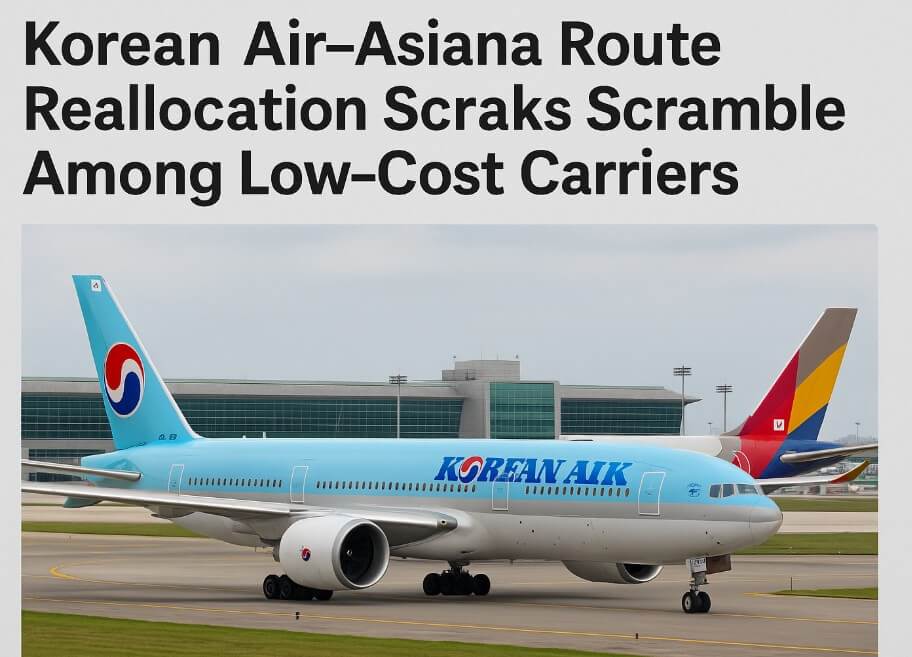
SEOUL — South Korea’s aviation sector is entering a new phase of competition as low-cost carriers (LCCs) race to claim flight routes vacated by Korean Air and Asiana Airlines under a government-directed merger remedy. The redistribution of 10 prime routes, both domestic and international, has triggered a surge of interest from independent carriers eager to expand their networks.
The Ministry of Land, Infrastructure and Transport (MOLIT) closed applications this week for six international and four domestic routes, marking a pivotal step in the implementation of the Korea Fair Trade Commission’s (KFTC) conditions for approving the Korean Air–Asiana merger. The government has moved swiftly to reallocate the routes, signaling its intent to preserve competition in key markets.
Regulatory Framework and Rationale
The KFTC’s approval of the merger was contingent on divesting airport slots and traffic rights on 34 routes to third-party carriers. The decision aimed to prevent the creation of monopolies or duopolies that could emerge from the integration of South Korea’s two largest full-service airlines.
The current batch of 10 routes represents the next stage in fulfilling those antitrust requirements. They include major international routes from Incheon (ICN) to Seattle (SEA), Honolulu (HNL), Guam (GUM), Jakarta (CGK), and London, as well as Busan (PUS) to Guam. On the domestic side, the Gimpo (GMP)–Jeju (CJU) and Gimpo–Gwangju (GWJ) routes are being opened for reassignment.
Industry analysts note that the scope of the redistribution underscores the depth of regulatory concern over concentration at major hubs. According to the Korean JoongAng Daily, the measures reflect the structural remedies the KFTC deemed essential to maintaining market balance in both domestic and international corridors.
Low-Cost Carriers Seize the Opportunity
Independent LCCs are closely watching the outcome, viewing the reallocation as a rare opportunity to capture high-demand routes long dominated by legacy carriers. Among the international slots, the Incheon–Jakarta route is considered one of the most coveted, offering both growth potential and strategic value.
A source familiar with the matter said, “Jakarta is not a guaranteed high-profit route. But once you enter it, competitors find it hard to break in.” The city’s proximity to major South Korean corporate operations ensures a consistent base of business travelers, adding to its allure for expanding LCCs.
While long-haul routes to destinations like London or the U.S. remain beyond the operational range of most low-cost carriers, regional destinations such as Jakarta and Guam fit well within their current capabilities. Domestically, routes like Gimpo–Jeju and Gimpo–Gwangju—traditionally strongholds for Korean Air and Asiana—are now open to budget competitors such as Jeju Air and Eastar Jet, which may leverage their cost efficiencies to undercut established players.
Industry observers believe the redistribution could reshape competition at both national and regional airports. “For domestic carriers, this represents a rare growth opportunity,” one analyst said. “Opening access to these routes could shift market dynamics and enhance connectivity across Korea.”
Selection Process and Criteria
The selection process is designed to ensure that only truly independent carriers benefit from the reallocation. In the first round, applicants undergo an eligibility review to confirm they are not controlled by Korean Air, Asiana, or their low-cost subsidiaries. Authorities also assess potential risks to fair competition.
The second phase will evaluate each applicant’s operational readiness and sustainability. Criteria include safety records, passenger convenience, long-term viability, and contributions to regional airports. According to MOLIT, qualified carriers will be notified in late November, with final selections expected by the end of December.
Industry Impact and Outlook
Officials expect the new routes to begin operations as early as the first half of 2026, depending on the selected carriers’ readiness. The outcome could redefine the domestic airline hierarchy, giving LCCs an opportunity to expand their presence and challenge traditional incumbents.
For Korean Air and Asiana, the completion of the reallocation process is essential to fully integrate their networks under merger conditions. Compliance with the KFTC’s remedies remains a prerequisite for operational and strategic alignment of the merged entity.
Industry experts predict that the route redistribution will reverberate beyond the immediate winners. By widening access to high-traffic corridors, the government aims to foster a more competitive and diversified market structure—one less reliant on two dominant full-service carriers.
“The process is a prerequisite to fully integrating their networks while adhering to antitrust conditions,” a government official noted. “The opportunity alone signals a structural change in South Korea’s aviation sector.”
As the evaluation process unfolds, attention is turning to which LCCs will ultimately claim these routes—and how their entry may reshape passenger choices, ticket prices, and connectivity in both domestic and regional markets. The reallocation marks a defining moment in the evolution of South Korea’s air transport landscape, signaling a future in which competition, not consolidation, drives growth.
