


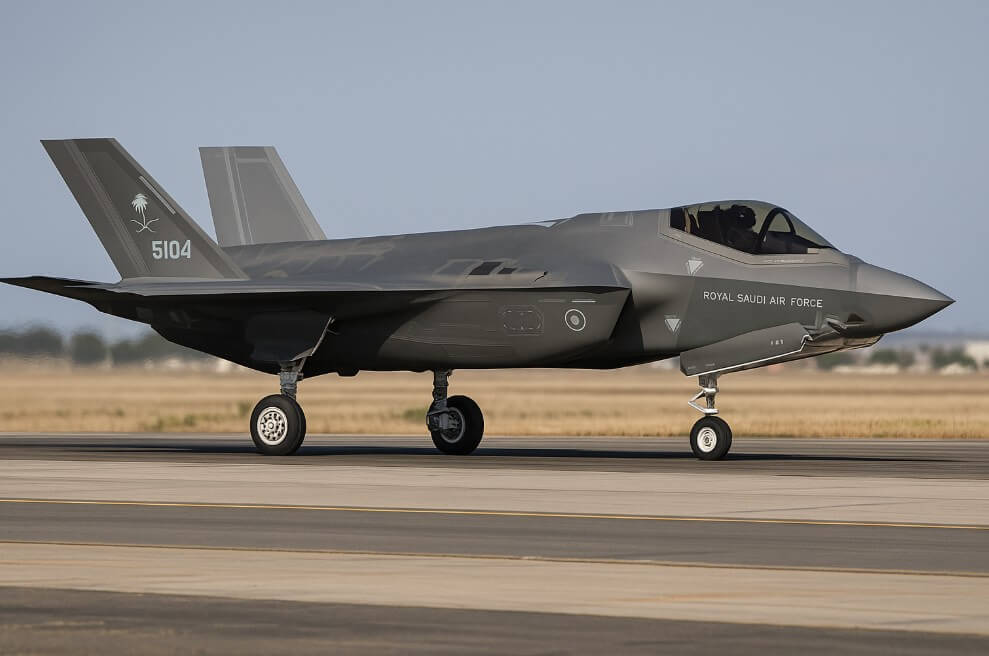
Riyadh’s renewed push to acquire the world’s most advanced fighter jet could reshape Middle Eastern military dynamics and mark a new phase in U.S.-Saudi relations.
Saudi Arabia’s long-standing request to purchase the F-35 Lightning II stealth fighter appears to be advancing within the Pentagon, according to sources cited by Reuters. If approved, the deal would make the Kingdom the first Arab nation to operate a fifth-generation stealth aircraft—ending Israel’s exclusive control of the F-35 in the region and signaling a significant realignment in Gulf security.
A High-Stakes Defense Deal
The proposed acquisition forms part of a broader $142 billion arms package originally approved by the Trump administration in May 2025. While the F-35 was initially excluded, recent developments suggest the jet has reemerged as a centerpiece of U.S.-Saudi defense cooperation.
Riyadh first expressed formal interest in acquiring 48 F-35s in 2017. Washington, however, hesitated at the time, citing its obligation to maintain Israel’s “qualitative military edge” under U.S. law. Now, officials say the deal is regaining traction as the Pentagon’s policy division reviews the proposal. Approvals are reportedly awaiting top-level clearance, including potential sign-off by former President Donald Trump and subsequent notification to Congress.
The progress underscores both Washington’s renewed willingness to arm its Gulf ally and Riyadh’s persistent pursuit of advanced deterrence capabilities amid an increasingly volatile regional landscape.
Diplomatic Leverage and Regional Strategy
Defense sources suggest the F-35 deal may also be linked to broader diplomatic initiatives, including a potential normalization agreement between Saudi Arabia and Israel. Washington has reportedly weighed connecting the arms sale to renewed diplomatic overtures under the framework of the Abraham Accords.
The previous normalization effort collapsed in 2023 following renewed violence in Gaza, but observers say Trump could leverage the promise of F-35 deliveries as a powerful incentive to bring Riyadh back to the table.
If successful, such an agreement could not only reshape Arab-Israeli relations but also cement the U.S. as the dominant broker of both peace and security architecture in the Middle East.
Riyadh’s Expanding Air Power
The Royal Saudi Air Force (RSAF) already operates one of the region’s most advanced fleets, including the F-15SA, F-15SR, Eurofighter Typhoon, and Panavia Tornado. The addition of the F-35—capable of stealth operations, advanced electronic warfare, and real-time battlefield integration—would mark a generational leap in Saudi air combat capability.
The Kingdom has previously explored alternative options, including Turkey’s KAAN stealth fighter and procurement of Turkish Akinci unmanned combat aerial vehicles (UCAVs). Yet, defense analysts note that approval of the F-35 would likely eclipse these alternatives, given the aircraft’s combat-proven record and interoperability with Western systems.
Israel’s Exclusive Edge and Regional Tensions
Israel remains the only Middle Eastern operator of the F-35, fielding its own modified version, the F-35I “Adir.” The aircraft has already seen action against Iranian targets, bolstering Israel’s dominance in regional air power.
Tel Aviv has consistently underscored its legal right to maintain military superiority, warning Washington against sales of comparable systems to neighboring Arab states. Israeli defense officials and analysts have voiced concern that extending F-35 access to Saudi Arabia could erode this edge.
Critics also warn that potential technology leakage—though speculative—could expose sensitive U.S. systems to adversaries such as Russia, China, or Iran. As a compromise, some Israeli policymakers have proposed restricting the Saudi F-35 variant, excluding the planned Block 4 upgrade that would enhance weapons integration and electronic warfare capabilities.
Alternatives and Future Pathways
Should the F-35 sale face renewed delays, Riyadh has multiple fallback strategies. Germany’s recent decision to lift its veto on Eurofighter exports opens the door to expanded Typhoon acquisitions. France’s Rafale fighter also remains a credible alternative, offering a means for Saudi Arabia to diversify its fleet while maintaining high-performance standards.
Longer term, the Kingdom may consider joining the Global Combat Air Programme (GCAP)—a sixth-generation fighter development initiative led by the United Kingdom, Japan, and Italy. Such participation would provide Saudi Arabia with a stake in next-generation aerospace technologies, safeguarding its strategic position should U.S. approvals remain uncertain.
Strategic Implications
Analysts view Riyadh’s pursuit of the F-35 as more than an arms purchase; it represents a statement of intent. By seeking the world’s most sophisticated fighter, Saudi Arabia aims to cement its status as a central military power in the Gulf, capable of projecting influence and defending its interests across a rapidly changing region.
If finalized, the F-35 sale could redefine the balance of air power in the Middle East, deepen U.S.-Saudi defense integration, and reshape the geopolitical landscape for years to come.
Stay tuned for developments as Washington and Riyadh continue negotiations on one of the most consequential arms deals of the decade.
