


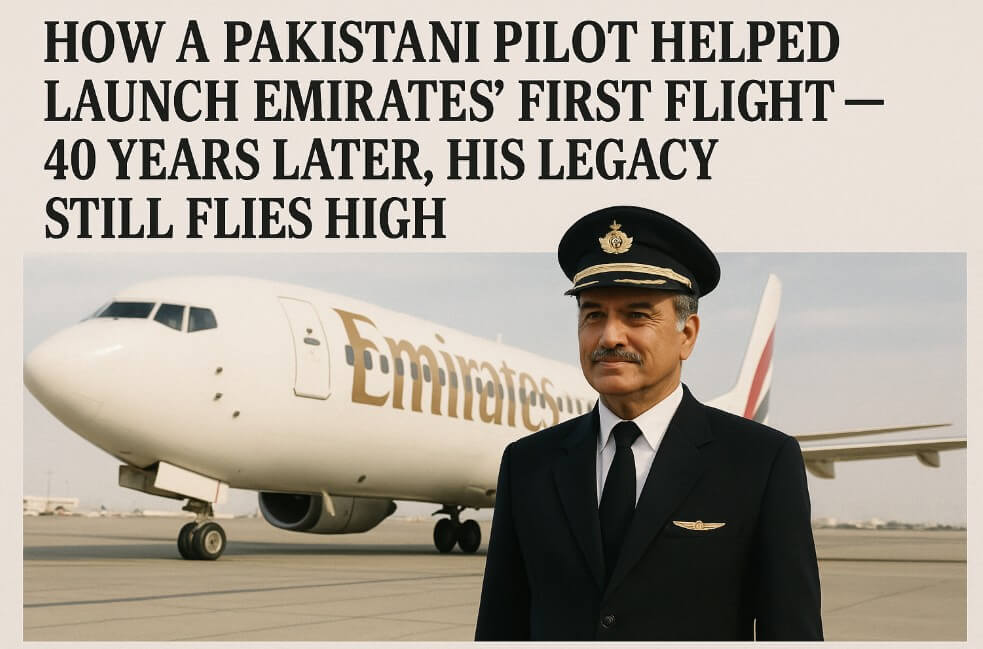
DUBAI — Forty years ago this week, a modest flight from Dubai to Karachi laid the foundation for what would become one of the world’s most influential airlines. On October 25, 1985, Captain Fazle Ghani, a seasoned Pakistani pilot, commanded Emirates’ inaugural flight, EK600, from Dubai International Airport to Karachi, Pakistan — an event that marked both the birth of the airline and a new chapter in Gulf aviation history.
The flight, operated with a leased aircraft from Pakistan International Airlines (PIA), carried more than passengers. It carried the ambitions of a young nation eager to establish its own global carrier. As Emirates marks its 40th anniversary this week, it is once again shining a light on the collaboration, vision, and courage that took flight that day — and the man who helped make it possible.
Building an Airline from the Ground Up
When the UAE decided to establish its own airline in the mid-1980s, it turned to neighboring Pakistan for technical support and expertise. According to Gulf News, PIA stepped forward with both aircraft and manpower, leasing an Airbus A300B4-200 and a Boeing 737-300 to the new airline and dispatching a team of aviation professionals to Dubai.
At the center of that effort was Captain Fazle Ghani, then a senior PIA pilot with extensive command experience. He was appointed Project Director and Chief Pilot for Emirates’ fledgling operations. Ghani arrived in Dubai on October 1, 1985, and immediately began coordinating with Sheikh Ahmed bin Saeed Al Maktoum and Maurice Flanagan, Emirates’ first Managing Director.
Over the next few weeks, Ghani and a small team of Pakistani pilots, engineers, and crew members worked tirelessly to prepare the airline for launch. With limited resources and tight deadlines, they conducted test flights, trained crews, and established operational protocols. Despite the constraints, the team’s focus on safety and reliability set the foundation for Emirates’ long-term reputation.
Ghani would later recall those days with fond humor, noting how “some crew members wore oversized uniforms and mismatched caps” — reminders of just how humble the airline’s beginnings were. What mattered, he often said, was that the aircraft were safe, the schedules were met, and the dream took off.
A Symbolic First Route
Emirates’ decision to operate its first commercial flight to Karachi was both practical and symbolic. The short route to Pakistan reflected not only the technical and operational assistance provided by PIA but also the cultural and regional ties that had long linked the two nations.
Flight EK600, piloted by Captain Ghani, departed Dubai International Airport on the morning of October 25, 1985, and landed safely in Karachi — a short hop that represented a giant leap for the UAE’s aviation ambitions. Later that day, a second flight to Mumbai, commanded by Captain Ejaz ul Haq, completed Emirates’ launch schedule.
PIA’s then-chief, Air Marshal Arshad Malik, would later describe Ghani as the “lead founder pilot of Emirates,” crediting his professionalism and leadership in setting the tone for the airline’s early operations. Those early flights established more than a route map — they defined a culture of precision and service that remains synonymous with Emirates today.
Honoring a Pioneer
Decades later, Emirates publicly recognized Captain Ghani’s contributions. In 2018, the airline invited him as a guest of honor for its first-ever Airbus A380 flight to Pakistan, which landed in Islamabad. Standing beside the world’s largest passenger aircraft, the veteran pilot expressed pride in seeing how far the airline had come — from two leased aircraft to a global fleet serving over 140 destinations.
Captain Fazle Ghani later passed away in Swabi, Khyber Pakhtunkhwa, after a prolonged illness. But his role in shaping Emirates’ earliest chapter continues to be celebrated both in Pakistan and the UAE. His story remains a powerful reminder that great enterprises often begin with collaboration across borders — and the courage of individuals willing to chart new skies.
From Two Planes to a Global Powerhouse
Today, Emirates operates one of the world’s largest fleets of wide-body aircraft, serving six continents and more than 140 cities. Its growth from a small regional carrier to a global brand has become a case study in strategic expansion, service innovation, and branding excellence.
In a statement marking its 40th anniversary, the airline paid tribute to the pioneers who helped launch its first flight. “The passion, skill, and determination of early aviators like Captain Fazle Ghani remain at the heart of Emirates’ story,” the statement read. “Their legacy lives on in every flight we operate today.”
What began as a partnership between two nations four decades ago has since evolved into a global aviation success story. Yet, for many, the defining image remains that of a Pakistani pilot at the controls of a modest aircraft on a clear October morning — lifting not just a plane, but the promise of a new era in flight.
