


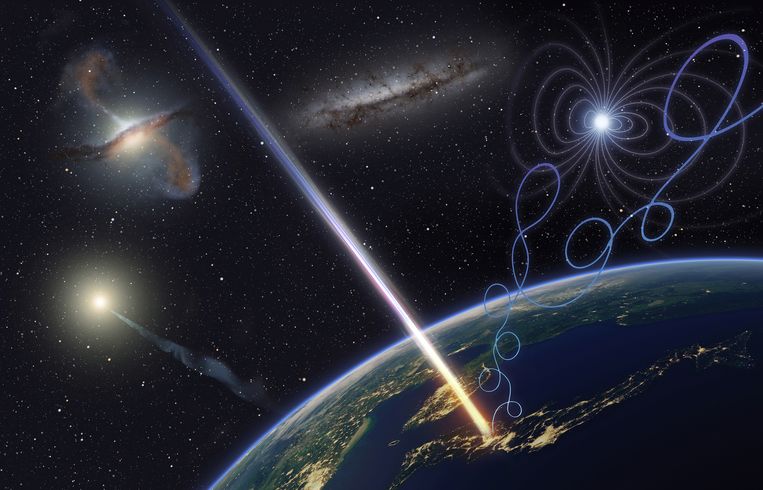
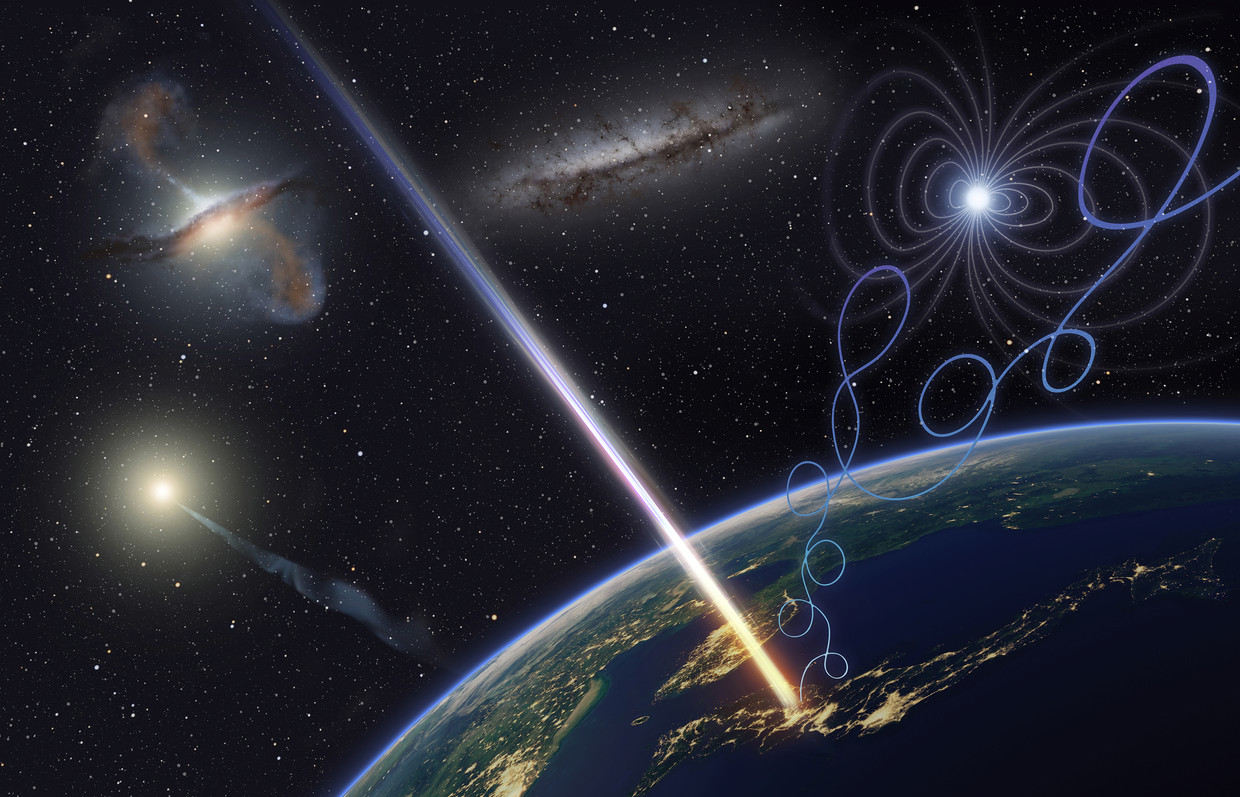
This particle hit the Earth with a force of 240 eV, physicists wrote Thursday in an article in the trade journal. Sciences. This is about forty million times greater than the energy with which protons collide at the CERN Institute of Physics’ Large Hadron Collider, the world’s most powerful particle accelerator.
“It’s an amount of energy that we as humans could never give to a particle. It’s so big that it’s frankly beyond my imagination. I’ve worked in this field,” says Charles Timmermans of Radboud University, an expert in the field of these types of cosmic particle effects. Eighteen years ago.”
About the author
Georg van Hal is the scientific editor of the Volkskrant newspaper. Books about astronomy, physics, and space travel. Van Hal published books on everything from the universe to the smallest, most basic elements of reality.
Once in a century
Timmermans follows the rival Pierre Auger Observatory in the Southern Hemisphere to experiment with the telescope array, which witnessed this special particle impact the other side of the planet. And the fact that you need such specialized experiments for this is that it is very difficult to capture these highly energetic cosmic particles. They occur very rarely on Earth, appearing on average only once every century over an area of one square kilometre. To increase measurement opportunities, these observatories monitor a large area. In the case of the telescope array in Utah, USA, its area is about 700 square kilometers.
Timmermans says there are three reasons why physicists spend so much effort looking for these types of particle effects. “First of all, we’ve known since the 1960s that these types of particles exist, but we don’t understand how they could exist. It’s a mystery and we want to solve it.”
“Secondly, when we discover how nature accomplishes something that we could never do ourselves, it can be very educational. And finally: we can now see what happens in the atmosphere when such a very energetic particle collides with other particles there. This is an experiment that we cannot They are performed in the laboratory, and by watching them we learn more about how physics works.
The void in the universe
Hence, the newly discovered particle also throws up a new puzzle for physicists. After analysis, it appears to come from an area in the sky where there is actually not much, which is called a void in the large-scale structure of the universe. However people expect that you would need something like a black hole or an active galaxy to give such a particle the necessary motion.
“It’s really amazing and completely unexpected,” says Timmermans. There are possible explanations, the researchers write in their professional article. The particle may have been deflected much more strongly along its path by the cosmic magnetic field than physicists previously thought. Or this is also possible: maybe they don’t understand enough about how particle physics really works. Timmermans: “So this is a very important discovery in this area of research.”
