


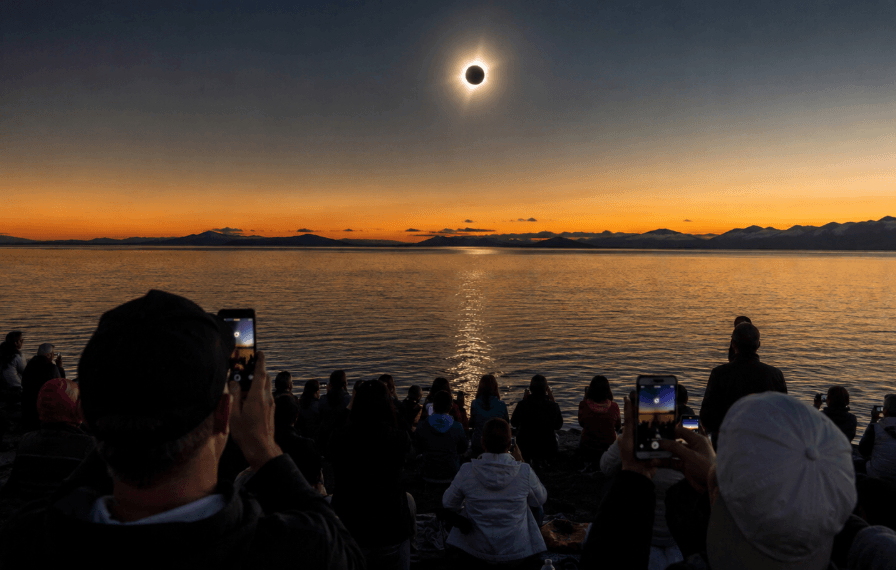
The only total solar eclipse of 2026 will sweep across parts of the Northern Hemisphere on Wednesday, Aug. 12, bringing a brief period of daytime darkness to areas along its narrow path. While the United States is outside the path of totality, parts of Alaska and the Northeast will still see a partial eclipse.
A solar eclipse occurs when the moon passes between Earth and the sun, temporarily blocking some or all of the sun’s visible disk. Total solar eclipses occur somewhere on Earth roughly every 18 months, but any individual location can wait centuries between appearances.
Where Will the 2026 Total Solar Eclipse Be Visible?
The path of totality crosses remote areas of the Northern Hemisphere, including northern Greenland, before reaching western Iceland and northern Spain.
Spain is an especially notable viewing destination because the country has not experienced a total solar eclipse since 1905.
Although relatively few populated areas fall directly within the path of totality, a much larger region will experience a partial solar eclipse. Population data from Columbia University’s Center for International Earth Science Information Network indicates that about 230 million people will be able to see at least 90% of the sun obscured.
Major European cities including Madrid, London and Paris will experience significant partial coverage.
What Will the Eclipse Look Like in the United States?
The eclipse will be far less dramatic in the U.S. than the total solar eclipse that crossed the country in April 2024.
Fairbanks, Alaska, will offer the strongest U.S. view, with approximately 37% of the sun covered. Boston will see about 16% coverage, while New York City will experience roughly 9%. Philadelphia will see about 7%, and Toronto will experience approximately 8%.
What Time Is the 2026 Solar Eclipse?
Because the eclipse’s path crosses the far northern portion of the globe, totality will move from its beginning to its end in roughly one hour and 45 minutes.
The total eclipse begins in extreme northern Russia at approximately 1 p.m. Eastern Time, or 17:00 UTC.
It reaches northeastern Greenland at around 1:30 p.m. ET before moving toward western Iceland at approximately 1:45 p.m. ET. In Reykjavík, maximum totality occurs at 5:48 p.m. local time.
The eclipse then travels across the North Atlantic. London will reach its maximum partial eclipse of about 91% at 7:13 p.m. local time, or 2:13 p.m. ET.
Totality reaches northern Spain at approximately 2:30 p.m. ET. Valencia will experience totality at about 8:32 p.m. local time. The entire path of totality ends around 2:45 p.m. ET.
Partial Eclipse Times in North America
For North American viewers, Toronto reaches its maximum eclipse at approximately 1:40 p.m. local time, while New York City reaches its maximum at about 1:54 p.m.
In Fairbanks, Alaska, the eclipse reaches its maximum point at approximately 8:27 a.m. local time.
How to Safely Watch the Solar Eclipse
People inside the path of totality can expect the sun to be completely blocked for approximately two minutes, depending on their exact location.
Certified solar eclipse glasses are necessary when looking directly at the sun during the partial phases. Ordinary sunglasses do not provide adequate protection against potentially permanent retinal damage.
Viewers in the path of totality may remove their eclipse glasses only during the brief period when the sun is completely covered by the moon. The glasses must be put back on as soon as any portion of the sun begins to reappear.
Anyone watching only a partial eclipse must keep proper solar viewing protection on throughout the event.
When Is the Next Total Solar Eclipse in the U.S.?
Americans hoping for another total solar eclipse at home face a lengthy wait.
The next total solar eclipse visible from the United States arrives in 2044. Its path will cross only Montana, North Dakota and South Dakota.
Another total eclipse follows in 2045, offering a much broader coast-to-coast viewing opportunity. Its path will begin in Northern California and travel eastward toward Florida.
Cities expected to fall within that eclipse’s path include Reno, Nevada; Colorado Springs, Colorado; Tulsa, Oklahoma; Little Rock, Arkansas; Jackson, Mississippi; and Orlando, Florida.
Another total solar eclipse will cross parts of the Southeast in 2052, including sections of Florida, Georgia and South Carolina. The northeastern United States will have to wait until May 1, 2079, for its next total eclipse.
2026 Eclipse Offers a Rare Astronomical Event
For viewers in Greenland, Iceland and Spain, Wednesday’s eclipse offers the rare experience of totality, while millions elsewhere in Europe and North America will see varying degrees of a partial eclipse.
Wherever the eclipse is visible, proper eye protection remains essential during every partial phase. For Americans who remember the nationwide excitement surrounding the 2024 eclipse, the Aug. 12 event provides another opportunity to watch one of astronomy’s most striking natural phenomena—even if the best views this time are across the Atlantic.
