Belgian scientists discover water vapor, sulfur dioxide, and sand clouds on an exoplanet: “We now look at planetary evolution differently” | Science and the planet
A team of European astronomers, led by researchers from KU Leuven, studied the nearby exoplanet WASP-107b. Using the James Webb Space Telescope, they were able to peer deep into the exoplanet’s thin atmosphere. There they discovered not only water vapor and sulfur dioxide, but even silicon clouds (sand). The results of the study appeared today in the popular journal Nature.
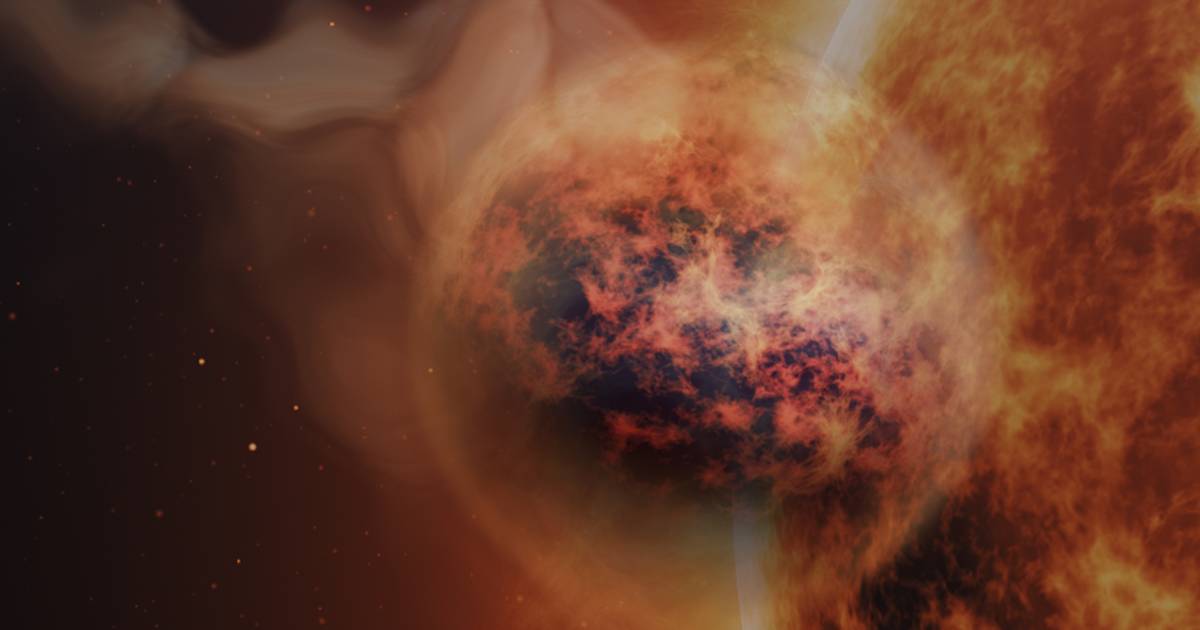
look. Animated video of the exoplanet WASP-107b
What have scientists studied and discovered?
Astronomers around the world are using advanced instruments aboard the James Webb Space Telescope (JWST) to make pioneering observations of exoplanets. These are planets that orbit stars other than our sun. One such fascinating world is WASP-107b, a unique gas giant orbiting a star slightly cooler and less massive than our Sun. The planet’s mass is similar to that of Neptune, but much larger. Almost as big as Jupiter. This makes WASP-107b rather “thin” compared to the gas giants in our solar system. This thinness allows astronomers to look about 50 times deeper into the planet’s atmosphere.
The team of astronomers took full advantage of this exoplanet’s remarkable scattering to reveal the complex chemical composition of its atmosphere. Because the signals that a space telescope can detect are much stronger in a thin, less dense atmosphere than in a compressed atmosphere. As a result, they discovered the presence of water vapor and sulfur dioxide (SO2) and silicone withdrawal. Surprisingly, they found no trace of the greenhouse gas methane (CH).4).
What exactly does this discovery mean?
This discovery provides science with important insights into the dynamics and chemistry of this intriguing exoplanet. For example, the absence of methane indicates the presence of a warm core, which can teach you something, for example, about the movement of heat in the planet’s atmosphere.
Second, the discovery of sulfur dioxide, known from the smell of burning matches, was a great surprise. Previous models had predicted its absence, but new climate models of WASP-107b’s atmosphere now show that its thinness may have allowed sulfur dioxide to form in the atmosphere. Although the parent star is cooler, the light particles the star emits can penetrate deep into the thin atmosphere. This allows the chemical reactions necessary to form sulfur dioxide to occur.
The spectrum obtained by scientists with the space telescope shows that sulfur dioxide and water vapor are present in the clouds. This is not the first time that clouds have been found on an exoplanet, but it is the first time that their chemical composition has been determined. In this case, it is composed of small particles of silicon, a substance familiar to humans and commonly found in many parts of the world as the main component of sand.
“The James Webb Space Telescope is revolutionizing the scientific description of exoplanets at an unprecedented pace,” says the professor. Lin Dessen from KU Leuven. “The discovery of sand clouds, water vapor and sulfur dioxide in this exoplanet’s fragile atmosphere by JWST’s MIRI instrument is a critical event. It changes our understanding of planetary formation and evolution and sheds new light on our solar system.”
It’s like the water vapor and cloud cycle on our Earth, but with droplets of sand
In the case of WASP-107b, which has a temperature of about 500 degrees Celsius in the outer atmosphere, conventional models predicted that these silicon clouds should form deeper in the atmosphere, where temperatures are much higher. Because unlike Earth’s atmosphere, where water freezes at low temperatures, silicon molecules in gas giants freeze at temperatures up to 1000 degrees Celsius. In addition, clouds of sand fall high in the atmosphere. How can these sand clouds persist at high altitudes?
According to Dr. Michelle Min: “The fact that we see these sand clouds high in the atmosphere probably means that the sand raindrops are evaporating in the very deep, hot layers of the atmosphere. The resulting silicon vapor then goes back up, where it condenses again to form silicon clouds. This is similar to Much like the water vapor and cloud cycle on our Earth, but with droplets made of sand, this continuous cycle is responsible for the continued presence of sand clouds in the atmosphere of planet WASP-107b.
This pioneering research not only sheds light on the strange world of WASP-107b, but also expands the boundaries of our understanding of exoplanetary atmospheres. It also represents an important milestone in exoplanet exploration, revealing the complex interplay of chemical processes and climatic conditions on these distant worlds. “The James Webb Space Telescope allows for in-depth analysis of the atmosphere of an exoplanet that we don’t have in our solar system. We are discovering entirely new worlds!” Dr. says Others Derek.
It will be interesting to see how our instrument reveals the atmosphere of this interesting exoplanet
The Belgians also contributed instruments on board the James Webb Space Telescope
Belgian engineers and scientists also played a key role in the design and development of the MIRI instrument, including the Center Spatial de Liège (CSL), Thales Alenia Space (Charleroi), and OIP Sensor Systems (Oudenaarde). At the Institute of Astronomy at the University of Leuven, instrument scientists have extensively tested the MIRI instrument in special test chambers that simulate the space environment.
“Together with our colleagues across Europe and the United States, we have been building and testing the MIRI instrument for nearly 20 years. “It will be interesting to see how our instrument reveals the atmosphere of this interesting exoplanet,” says instrument specialist Dr. Bart Vandenbosch. From the University of Leuven.
‘On Earth, only living organisms can make this gas’: Has the James Webb Space Telescope found the first sign of life on an exoplanet?
‘This only happens once every 10,000 years’: Star explosion hits Earth with ‘gamma flash’, disrupting the ionosphere
look. Belgian astronaut Raphael Leguais performs his first spacewalk
Free unlimited access to Showbytes? Which can!
Log in or create an account and never miss a thing from the stars.