

Close Menu
Aviation Analysis – Industry Travel NewsAviation Analysis – Industry Travel News
    Facebook X (Twitter) Instagram
    Facebook X (Twitter) Instagram
    Aviation Analysis – Industry Travel NewsAviation Analysis – Industry Travel News
    Subscribe
    • Home
    • Top News
    • World
    • Economy
    • Science
    • Tech
    • Sport
    • Entertainment
    • Contact Form
    Aviation Analysis – Industry Travel NewsAviation Analysis – Industry Travel News
    Home»Science»The 21-ton Chinese rocket will fall to Earth after the launch of the space station
    Science

    The 21-ton Chinese rocket will fall to Earth after the launch of the space station

    Moses YarboroughBy Moses YarboroughJuly 27, 2022No Comments3 Mins Read
    Share Facebook Twitter Pinterest LinkedIn Tumblr Email
    The 21-ton Chinese rocket will fall to Earth after the launch of the space station
    Share
    Facebook Twitter LinkedIn Pinterest Email Copy Link
    Byers explained that space debris does not pose a significant danger to humans, but larger pieces can cause damage if they land in populated areas. Because of the increase in space debris, these small opportunities are becoming increasingly likely, especially in the global south, according to research published in Natural Astronomy The Magazine, where the chances of rockets falling at the latitudes of Jakarta, Dhaka, Byers said. And Lagos is almost three times larger than those in New York, Beijing or Moscow.

    “This risk can be completely avoided because there are now technologies and mission designs that allow for controlled re-entry (usually in remote areas of the ocean) rather than out of control and therefore completely random,” he said in an email.

    Holger Kraj, head of the European Space Agency’s Space Debris Office, said international best practice is to conduct controlled reentry, targeting a remote part of the ocean, when the risk of casualties is very high.

    He added that the return range of the missile was geographically limited between latitudes 41 degrees south and latitudes 41 degrees north of the equator.

    A spokesman for the US Space Command said it would monitor the fall of the Chinese missile to Earth.

    Depending on changing weather conditions, the exact point of the rocket stage’s entry into Earth’s atmosphere “can only be determined within hours of its re-entry,” the spokesperson said, but it is estimated that it will enter Earth’s atmosphere on August 1. .

    The 18th Space Defense Squadron, part of the US Army that tracks returns, will also provide daily updates on its location.

    CNN has reached out to China’s manned space agency for comment.

    Space debris weighing more than 2.2 tons is typically transported to a specific location in its first orbit around the Earth, said Jonathan McDowell, an astronomer at the Harvard-Smithsonian Center for Astrophysics.

    “The thing is that large objects usually don’t go into orbit without an active control system,” he said.

    “With no active control system in place, there is no engine that can be restarted to bring it back to Earth…it spins in orbit and eventually burns up due to friction with the atmosphere,” McDowell said. He told CNN.
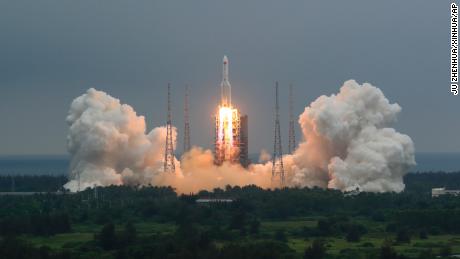
    Chinese missile debris fell to the ground.  This is not the first time.

    Last year, China came under fire for its handling of space debris after another unit launched a similar rocket. His remains sank 10 days after he was released into the Indian Ocean off the Maldives.

    NASA said China failed to “meet responsible standards”.

    “Space-faring nations need to reduce the risks to people and property on Earth from re-entry of space objects and increase transparency regarding these processes,” NASA Administrator Bill Nelson said at the time.

    China responded to criticism, accusing the United States of “increasing concern” about the rocket’s return, accusing American scientists and NASA of “acting against their conscience” and of being “anti-intellectual.”
    In 2020, the core of a Chinese rocket – which weighs about 20 tons – has reached Earth’s atmosphere, flying directly over Los Angeles and Central Park in New York City before finally plunging into the Atlantic Ocean.

    Space junk like old satellites enter Earth’s atmosphere on a daily basis, although most of it goes unnoticed because it burns long before it hits Earth.

    Only the largest space debris – such as spacecraft and missile parts – poses a very small risk to humans and infrastructure on Earth.

    Share. Facebook Twitter Pinterest LinkedIn Tumblr Email
    Moses Yarborough

    Devoted music ninja. Zombie practitioner. Pop culture aficionado. Webaholic. Communicator. Internet nerd. Certified alcohol maven. Tv buff.

    Related Posts

    Neodymium Magnet Uses and Safety Tips for 2025

    October 4, 2025

    Researchers want to whiten clouds to combat global warming

    August 28, 2024

    “Blockchain DNA” is possible after scientific progress

    August 26, 2024
    Navigate
    • Home
    • Top News
    • World
    • Economy
    • Science
    • Tech
    • Sport
    • Entertainment
    • Contact Form
    Pages
    • About Us
    • DMCA
    • Contact Form
    • Privacy Policy
    • Editorial Policy
    STAY UPTODATE

    Get the Latest News With Aviationanalysis.net

    OFFICE

    X. Herald Inc.
    114 5th Ave New York,
    NY 10011, United States

    QUERIES?

    Do you have any queries? Feel free to contact us via ourĀ Contact Form

    Visit Our Office

    X. Herald Inc.
    114 5th Ave New York,
    NY 10011, United States

    • About Us
    • DMCA
    • Contact Form
    • Privacy Policy
    • Editorial Policy
    © 2025 ThemeSphere. Designed by ThemeSphere.

    Type above and press Enter to search. Press Esc to cancel.