


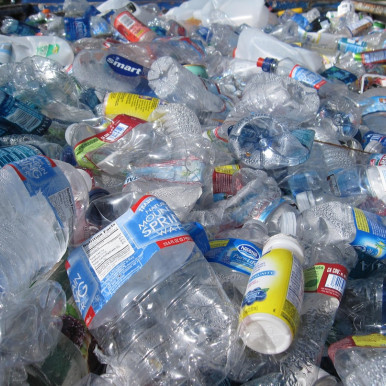

Engineers from the United States have made an enzyme that breaks plastic more efficiently using artificial intelligence. In some cases, the enzyme was able to break down the plastic as early as 24 hours.
Plastic is extremely useful and in today’s world even an indispensable material. However, one of the things’ great advantages is also the big drawback: plastic doesn’t or doesn’t biodegrade. For example, a plastic bag in nature takes several decades to be weathered, and the tiny bits of microplastic this produces will likely remain for centuries to come. Millions of tons of plastic end up in the ocean every year.
bacteria
But there is hope. Every now and then bacteria appear that can digest plastic thanks to special enzymes. A research team at the University of Texas has successfully synthesized an improved version of these enzymes. Researchers wrote last week that with this, plastic can be broken down within 24 hours if all goes well temper nature†
The synthetic enzyme is called FAST-PETase – the acronym stands for functional, active, stable and tolerant – and is based on natural enzymes produced by bacteria. Ideonella sakaiensis Used to digest polyethylene terephthalate (PET).
This bacteria was discovered in 2016 by Japanese researchers in a landfill, where it lived on a diet of PET bottles. Over the next four years, researchers from Britain’s University of Portsmouth were able to grow and slightly incorporate PET-digesting enzymes, resulting in a new variant that was more efficient and therefore faster.
Artificial intelligence
Now there has been an improvement in efficiency. Texas researchers used artificial intelligence to predict the changes an enzyme would have to go through in order to digest plastics faster and break PET polymers down into simple particles even at relatively low temperatures (between 30 and 50 degrees Celsius).
They tested it on fifty different plastic packages. And successfully. This enzyme is suitable for use on an industrial scale, the researchers themselves say in a university press release.
“The possibilities are endless, thanks to this approach, we will soon be able to aspire to a truly circular plastic economy,” says Hal Alper of the University of Austin in a press release.
melt or burn
Perhaps the latter is a bit exaggerated. Reducing the use of single-use plastics can potentially help in the fight against plastic waste.
Currently, more than 400 million tons of plastic are produced annually, and 12% of this plastic production is PET. And let this be exactly the kind of plastic that can actually be melted into granules for reuse.
Even 75 percent of the plastic that can be recycled now goes to the incinerator, so there is still a lot to achieve there, says Jos Keurentjes, Transition Team Plastics president and manager. Utah Energy Innovation Centerrecently argued in The engineer. Ultimately, rescue must come from a set of actions.
Editorial photo: Tanvi Sharma, via Unsplash.com
If you found this article interesting, sign up for our weekly newsletter for free.
