


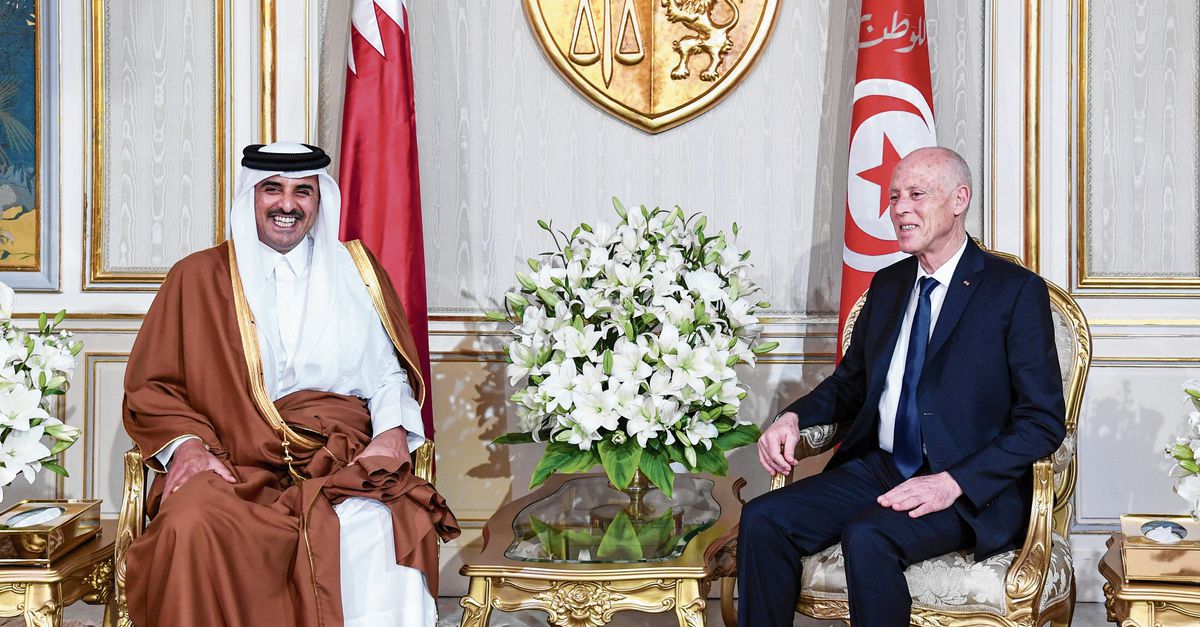
When Tunisian President Kais Saied took office in 2019, he enjoyed a reputation as a politically unfit. Inexperienced, not wealthy, not very charismatic and not a member of any political party. He always refused invitations from abroad. The Tunisians concluded that he was afraid of flying.
But this faltering president has been compared to Napoleon III since he seized power on July 25. Like that French emperor in the nineteenth century, he staged a coup and seized sovereignty. He said last week that Saeed had suspended parliament and the constitution and ruled only by decree.
For the growing opposition, it feels like back to square one. Ten years after the birth of democracy, the Arab region’s only success at the time, Tunisia remained with a dictator “beyond the former dictator Ben Ali,” say Saied’s critics.
At a time when the Tunisian economy is virtually bankrupt and money is being sought to complete this year’s budget. Meanwhile, Said is having problems with several of his major foreign economic partners.
Chancellor Angela Merkel, for example, called a few days ago “to signal to the president the need for a return to parliamentary democracy”. This pressure has also previously come from the United States, the European Union’s foreign affairs chief Josep Borrell and the Group of Seven industrialized nations.
President Saeed shrugs his shoulders with intense emotion at this interference from other countries. He prefers to brag about promises of financial assistance from “friendly countries”, which will be enough to bring the Tunisian economy out of stagnation. The pledges came in August during visits to Tunisia by high-level delegations from the UAE and Saudi Arabia.
Payment in the back
It’s nothing new for Gulf countries to give coup plotters in the region a financial boost, says Sami Hamdi, the Algerian-Tunisian director of an international strategy consultancy firm in London. “The same thing happened in Egypt. The moment Sisi ousted President Morsi, the UAE sent $3 billion and Saudi Arabia $5 billion.”
Only this alliance is causing Said to get into trouble again with other countries in the region, such as neighboring Algeria, as well as with the Tunisians themselves. Algeria does not want Tunisia to become a pawn in the hands of the UAE and Saudi Arabia.
Domestically, there are fears that the Gulf states will lend a hand to the Tunisian president, as they hope for the return of a secular dictatorship. Therefore, these countries were going to take part in the preparations for the coup. It is no coincidence that a Tunisian cartoonist recently painted Said as a “robot made in the UAE”.
In the past year there have already been reports of orchestrated acts of protest from the UAE
When uprisings erupted in Tunisia, Libya, Egypt, and other countries in 2011, authoritarian leaders in the UAE and Saudi Arabia feared that their regimes were also in danger. For this reason, they, especially in Egypt and Libya, began to rage against the (alleged) Muslim Brotherhood, the main winners of the first democratic elections. In Egypt they helped Sisi in power.
Supporting the army and army commanders has not been an obvious choice in Tunisia, because the military there has traditionally been kept out of politics. That is why some analysts doubt that they chose the police in Tunisia. Hamdi: “There are a lot of people from the old regime there. They want to keep their positions at all costs.”
The Gulf states have also targeted Muslim democrats from the Ennahda party, which has won nearly all elections since 2011, has been in power almost continuously and has roots in the Muslim Brotherhood.
dismissal of the president
According to Hamdi, the UAE’s participation dates back to 2014. Soon, the Emirates ended up with the PDL party, a continuation of the party of the ousted autocratic President Ben Ali in 2011. Occasionally, the emirate’s ambassador to Tunisia was a guest at party rallies. After that, the PDL party laid the foundation for a happy coup. The party has succeeded in completely undermining confidence in Parliament – and Ennahda as the largest party. Gradually, Tunisians became convinced of the need to abolish parliament.
Last June, foreign media, including Turkish, reported protests organized by the Tunisian authorities, and organized by the UAE. At the time, the Tunisian public prosecutor’s office was said to have opened an investigation into “calls on social networks for action against state institutions, the revolution and the dissolution of parliament.” According to the accusation, the account of one of those activist groups on Facebook is operated by “two people in the United Arab Emirates”.
Al-Nahda accuses the UAE of being behind the most popular Facebook business group. This claim cannot be verified because the page in question has since been removed. Remarkably, however, none of the Facebook working groups are still active with a Tunisian IP address.
/s3/static.nrc.nl/images/gn4/stripped/data76910999-7b1b15.jpg)
Photo Getty Images
“Saeed is obsessed with power,” said Gohar Mubarak, a former advisor to Said’s first prime minister, on a hot afternoon in a crowded cafe in Tunis. “He must have been carefully prepared for this coup with the support of the UAE, Saudi Arabia and Egypt,” he added.
Mubarak campaigned for Said in 2019 and then helped form Said’s first government. “In early March, Said was completely involved in a conflict with the then prime minister, the Ennahda movement and a few other parties. From that moment he started training everything,” says Jawhar Ben Mubarak. “Things like important legislation, the establishment of a constitutional court.”
He remembers the “happy transformation” after his visit to President Sisi last April. “That was the beginning,” he says. Back home, Said’s rhetoric became more hostile, aggressive and “un-Tunisian”. Suddenly he hinted at a political role for the army and Ennahda had to pay for it.
In mid-May, Said’s former spokeswoman and confidant Rashida El-Nifer claimed in a radio interview that “there is a possibility that the staff has hacked the president, and that there are people in the presidency who work for anti-democratic parties.”
separate requirements
Since the beginning of July, activist groups have appeared on Facebook calling on the masses to take to the streets on July 25, the day to celebrate the proclamation of the republic. Although there was always a demonstration somewhere due to the economic and political crisis, this was different. More hateful, more hostile, with sometimes unusual demands: “A general in the army should be appointed at the head of every province and every department.”
Already on July 22, Dhahi Khalfan Tamim, a senior soldier in the UAE army, saw the coup coming. Three days before Saeed seized power, Major General Al Shami @Dhahi_Khalfan tweeted: “Good news! Soon a new harsh blow will be dealt to the Muslim Brotherhood.”
On the evening of 25 July, following the news of Said’s coup, someone in Egypt tweeted “#Tunisia_revolution against the Muslim Brotherhood”. The hashtag was collectively retweeted from the UAE, Saudi Arabia and Egypt, and fake accounts from Mexico, Brazil and South Africa. The research agency ICAD found that only 1.2 percent of interactions came from Tunisia.
A version of this article also appeared in NRC on the morning of October 1, 2021
