


A NASA spacecraft landed on an asteroid, avoiding rocks the size of buildings, in order to collect a handful of cosmic debris for analysis back on Earth.
The space agency team in charge of the Osiris-Rex project said preliminary data showed that sample collection proceeded as planned and that the spacecraft took off from the surface of asteroid Bennu.
“I can’t believe we actually did,” said chief scientist Dante Loretta of the University of Arizona. “The spacecraft did everything it was supposed to do.”
NASA Osiris Rex
(OSIRISREx)The retraction burn has completed I am now turning to a safe distance away from Bennu. pic.twitter.com/bXk2ufSneS
NASA Administrator Jim Bridenstein offered his congratulations, saying, “We are on our way to bring back the largest sample brought home from space since Apollo. If all goes well, this sample will be studied by scientists for generations to come.”
The Osiris-Rex spacecraft sent confirmation of its short communication with the asteroid Bennu more than 200 miles (322 meters) away, prompting cheers from the mission team. But it may take a week before scientists know how much, if any, seizures have been taken, and if another attempt is needed. If successful, Osiris-Rex will return samples in 2023.
The US mission follows a Japanese-run one called Hayabusa2, which is due to return to Earth in December carrying samples collected from the 4.5 billion-year-old asteroid, Ryugu. When it lands in the Australian desert, it will be the first subsurface asteroid sample to return to Earth.
At Bennu, the Osiris-Rex spacecraft took four and a half hours to make its way from its narrow orbit to the surface, following commands previously sent by ground controllers near Denver.
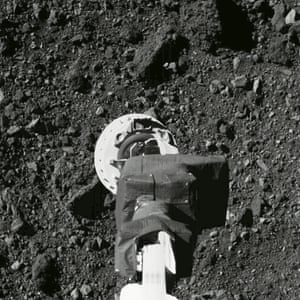
Because the asteroid is only 1,670 feet (510 meters) wide, Benno’s gravity was too low for the Osiris Rex to land. As a result, the spacecraft had to reach out with its 11-foot (3.4 m) robotic arm and attempt to grab at least 2 ounces (60 grams) of Benno.
Heather Ennos of the University of Arizona, deputy scientist for the mission, described the operation as “a surface kissing with a short touch and launch measured in just seconds.”
The coronavirus pandemic has caused a delay of two months. Operation Tuesday was considered the most daunting part of the mission, which began with a launch from Cape Canaveral in 2016.
The Osiris-Rex spacecraft, a spacecraft the size of a van, aims to have a place equivalent to a few parking spaces on Earth in the middle of the asteroid’s Nightingale crater. After nearly two years orbiting Benno, the spacecraft found that this location contained the largest speck of particles small enough to swallow them up.
After determining that the coast was clear, Osiris-Rex closed in the last few yards for sampling. The spacecraft is programmed to release compressed nitrogen gas to move the surface, then absorb any pebbles or loose dust.
Scientists want between 2 ounces (60 grams) and 4 pounds (2 kilograms) of the crumbly, carbon-rich black Benno believed to contain the building blocks of our solar system.
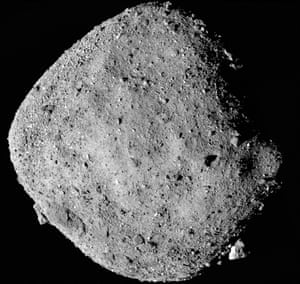
The head of the NASA scientific mission, Thomas Zurbuchen, likened Benno to a Rosetta Stone, “something that’s out there that tells us the entire history of our planet, and the solar system, over the past billions of years.”
Another benefit: Bennu has a slight chance of hitting the ground late in the next century, although not as a life terminator. The more scientists know about the paths and properties of potentially dangerous space rocks like this one, the better. The Osiris-Rex is able to perform up to three touch and launch maneuvers should a shortfall. Regardless of the number of attempts required, samples will not return to Earth until 2023 to close a mission valued at over $ 800 million. The sample capsule will parachute into the Utah desert.
“This will be another important day for us. This is definitely the main event of the mission at the moment,” said Lucy Lim, a NASA scientist.
Meanwhile, NASA plans to launch three more asteroid missions in the next two years, all in one direction.
With The Associated Press
