


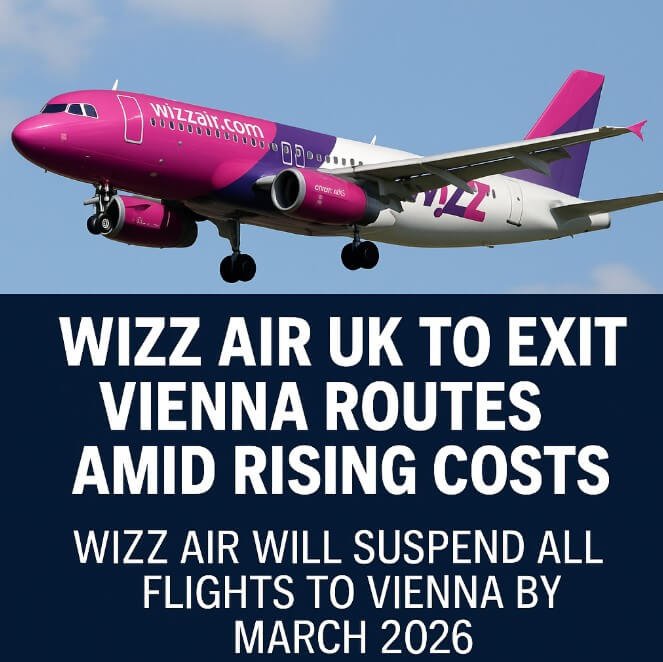
LONDON— Wizz Air UK will suspend all flights between the United Kingdom and Vienna by March 2026, marking a significant retreat from one of Europe’s most popular destinations. The low-cost carrier cited rising fees at Vienna International Airport as the key factor behind the withdrawal, which will end nearly eight years of service from London.
The decision affects operations from both London Gatwick (LGW) and London Luton (LTN), with routes phased out over the next 18 months. Flights between London Gatwick and Bilbao to Vienna will be terminated on October 26, 2025, while the last London Luton service will depart on March 15, 2026.
Cost Pressures Drive Withdrawal
Wizz Air, which launched its Vienna base in 2018 to strengthen its footprint across Central Europe, said the move reflects an unsustainable rise in operating costs at the Austrian hub. Increases in airport charges, taxes, and ground-handling fees have undermined the carrier’s ability to compete on price.
Mauro Peneda, Managing Director of Wizz Air Malta, described the decision as difficult but necessary. “While the decision was difficult, it was necessary to safeguard the airline’s long-term competitiveness,” Peneda said. He added that staff at the Vienna base would be offered roles elsewhere within the company’s extensive European network.
At present, Wizz Air runs two daily services between Gatwick and Vienna, reducing to one in winter. These will be gradually wound down before the complete exit in early 2026.
Options for Passengers
Travelers booked on Wizz Air flights to Vienna before October 26, 2025, will not see their itineraries affected. Customers scheduled to fly after that date will be contacted directly via the Wizz Air app or email.
The airline outlined two options for affected passengers: a full refund in WIZZ credits for use on alternative routes, or rebooking on another Wizz Air flight. Cash refunds will not be offered. Rival carriers such as easyJet, Ryanair, and British Airways continue to provide regular service between London and Vienna, ensuring options remain for UK travelers heading to Austria’s capital.
Wizz Air also highlighted its services to Budapest, a two-and-a-half-hour train ride from Vienna, and Bratislava, roughly an hour’s drive away, as alternatives for passengers still wishing to reach the city.
Broader Route Cuts
The Vienna pullback is not an isolated move. Wizz Air is simultaneously reducing other parts of its European network. The airline announced that flights from Liverpool to Budapest will end on October 24, 2025, followed by the suspension of Glasgow to Budapest on October 25, 2025.
These changes underscore a broader shift in Wizz Air’s strategy toward focusing on markets with stronger demand and less intense competition. The adjustments align with a cost-conscious approach as the airline manages high fuel prices, economic pressures, and competitive challenges.
Industry Reaction and Rival Criticism
The move has drawn comment from competitors, most notably Ryanair’s outspoken CEO Michael O’Leary. “Wizz Air’s strategy is unsustainable,” O’Leary said, predicting the carrier may not survive as an independent company within the next three to five years. He suggested European airline consolidation could see Wizz Air absorbed by a larger rival.
Wizz Air has pushed back on such claims, insisting its long-term growth strategy remains intact. The company emphasized its focus on connecting passengers across Central and Eastern Europe, regions where low-cost air travel continues to see strong demand.
Vienna’s Status and Market Outlook
The suspension is a notable development for Vienna, consistently ranked among the world’s most liveable cities. The Austrian capital attracts millions of visitors annually, both for its cultural heritage and its role as a key European business hub. While other carriers will continue serving Vienna, Wizz Air’s exit reduces budget options for travelers during peak seasons.
Industry analysts note that the retreat highlights the challenges low-cost airlines face when airport expenses climb. As European hubs raise fees to fund infrastructure upgrades and environmental measures, carriers are forced to weigh profitability against maintaining expansive route networks.
For now, passengers will have alternatives, but the withdrawal raises questions about how low-cost carriers will navigate similar cost pressures across the continent in the years ahead.
