


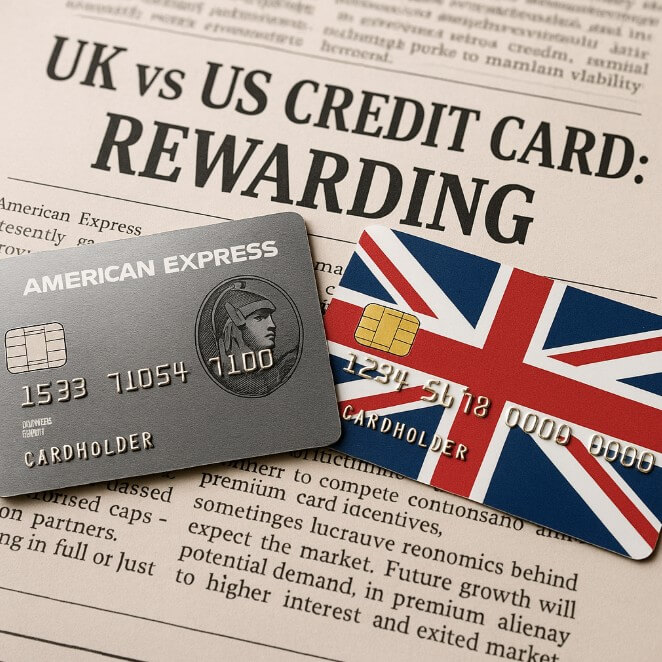
LONDON — For UK consumers, the allure of luxury travel rewards and generous cashback offers seen across the Atlantic often feels out of reach. While American credit card holders enjoy lucrative sign-up bonuses, premium perks, and extensive statement credits, British customers find themselves with scaled-down versions of the same products. The disparity, experts say, stems from fundamental differences in regulation, market structure, and the economics of card payments.
The Reward Gap
The contrast is most visible at the top end of the market. American Express Platinum Card holders in the United States recently received an upgrade that added over $3,200 in annual statement credits for services like Uber, Resy dinner reservations, hotels, and streaming platforms. The changes came with a $200 increase in the annual fee and a 175,000-point sign-up bonus for spending $8,000.
By comparison, the UK version of the same card offers a 50,000-point bonus and £400 in restaurant credits — a fraction of the U.S. value. The imbalance has less to do with corporate strategy and more with regulation: how card payments are structured and how much issuers can earn from each swipe.
The Power of Interchange Fees
When consumers make a purchase with a credit card, merchants pay a transaction charge known as the interchange fee. This fee, passed on to the card issuer, funds much of the rewards and benefits customers receive. In the U.S., interchange fees typically exceed 1.8% for standard cards and can rise above 2% for premium products such as Visa Signature or Infinite.
In the UK, however, regulators have capped interchange fees at 0.3% for credit cards and 0.2% for debit cards under EU rules. According to Head for Points, this drastic cut in revenue “reshaped the UK rewards market,” leading to fewer co-branded cards and scaled-back incentives.
Prior to the 2015 cap, UK issuers could charge around 0.8% on average. The new limits halved their revenue, forcing banks to withdraw many premium products. MBNA, once a major player in airline credit cards, pulled its Virgin Atlantic, Emirates, Etihad, and other co-branded cards from the market. Retailer and charity cards followed suit, and cashback rates plummeted to as little as 0.1%, or just 10 pence for every £100 spent.
How U.S. Issuers Keep Rewards Flowing
The American market operates under a different dynamic. With higher interchange fees and less restrictive regulation, issuers can afford to offer rich rewards, premium travel benefits, and status upgrades. These incentives are further supported by fierce competition between major players like Chase, Citi, and American Express.
Merchant costs are higher in the U.S., but the structure benefits consumers. Issuers can reinvest their larger margins into loyalty programs, travel insurance, and concierge services. Meanwhile, merchants often build these costs into retail pricing, ensuring the system remains sustainable despite higher fees.
American Express and Market Integration
American Express plays a unique dual role as both card issuer and payment network. This vertical integration allows the company to set its own merchant fees and maintain control over customer relationships. In the UK, however, legal rulings have forced Amex to lower fees on co-branded cards, though its proprietary products remain exempt.
This restriction means UK Amex rewards are less lucrative than their U.S. equivalents. For issuers across Britain, profitability now relies more heavily on interest charges, late fees, and foreign exchange (FX) income — particularly from customers who carry balances rather than paying in full each month.
Signs of Revival
Despite years of contraction, the UK rewards market is showing tentative signs of recovery. Virgin Atlantic re-entered the market in 2018 through a joint venture with Virgin Money, structuring products around a mix of fees, interest, and FX revenue. In 2021, Avios and Barclaycard launched new co-branded cards designed as strategic loss leaders to attract high-value customers.
Fintech companies are also innovating. Currensea, for instance, launched Hilton debit cards that earn loyalty points and even confer Hilton Honors Gold Elite status — a rare perk for a debit product. Meanwhile, business and SME cards, which are exempt from the interchange fee cap, are gaining traction with generous benefits from issuers like American Express and Capital on Tap.
Shifting Strategies and Limited Rewards
With only 0.3% of each transaction available to fund rewards, UK card issuers must limit perks to remain profitable. Some, like Virgin Money and Barclaycard, now cap the number of miles customers can earn monthly. Others focus on offering status tiers or exclusive experiences rather than pure cashback or points.
In this evolving market, rewards serve less as direct profit drivers and more as engagement tools — a way to build loyalty in a low-margin environment.
Lessons From the U.S. and What Lies Ahead
In the United States, the combination of higher fees, lighter regulation, and cutthroat competition keeps rewards flowing. Affiliate marketing sites earn substantial commissions from new card applications, underlining the lucrative economics behind the system. Legislative proposals like the Credit Card Competition Act could eventually alter the playing field by allowing merchants to choose between networks, but until such reforms pass, U.S. consumers will continue to enjoy unmatched card perks.
For UK issuers, the path forward may hinge on creativity rather than regulation. New models focusing on elite status, risk-sharing partnerships, and fintech-driven flexibility are beginning to emerge. While the golden era of UK credit card rewards may be over, the next phase — driven by innovation and targeted incentives — is only just beginning.
