


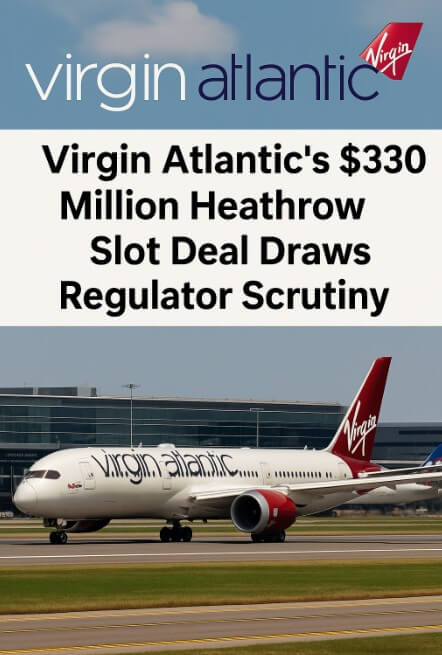
LONDON — Virgin Atlantic’s decision to mortgage a significant share of its London Heathrow landing and takeoff slots for $330 million is facing close scrutiny from UK regulators, raising fresh concerns about foreign influence over one of Britain’s most strategic aviation assets.
The financing arrangement, structured to pay dividends to shareholders rather than to fund new growth, highlights the growing role of airport slots as high-value financial instruments. Virgin Atlantic confirmed that proceeds from the transaction will primarily benefit its U.S. shareholder, Delta Air Lines, which owns a 49% stake in the UK carrier.
A Strategic Financial Move
The airline’s decision to mortgage its Heathrow slots marks a strategic financial move rather than an operational necessity. Virgin Atlantic remains profitable and is not seeking capital for fleet expansion or new routes. Instead, the airline transferred a large portion of its Heathrow slot portfolio into a subsidiary, Virgin Atlantic International Ltd, to facilitate the securitization and meet ownership compliance rules.
The move echoes an earlier £220 million transaction completed roughly a decade ago—Europe’s first-ever securitization of airport slots. Analysts note that such deals can unlock substantial liquidity from otherwise illiquid assets but also expose airlines to potential regulatory and ownership complications.
Regulator Concerns Center on Ownership Rules
According to aviation industry sources, the UK Civil Aviation Authority and government regulators are examining the deal amid concerns about how Heathrow slots are being used as collateral, particularly when tied to partial foreign ownership. The slots, while valuable, cannot legally be transferred to non-UK entities in the event of a loan default.
Regulators’ chief concern lies in maintaining domestic control of the assets. If bondholders were to seize the slots, they would be required to sell them to a UK-based airline or investor that meets local ownership criteria. This ensures compliance but adds layers of complexity for any future enforcement of the loan.
Industry analysts say that such restrictions underscore the delicate balance between encouraging financial innovation and safeguarding national aviation interests. “It’s a reminder that Heathrow slots aren’t just operational rights—they’re strategic national assets,” one London-based aviation consultant said.
Competition and Market Power at Stake
The potential redistribution of Heathrow slots, should the collateral ever be liquidated, raises competitive concerns. British Airways, already the dominant carrier at the airport, is widely viewed as the only major UK-based airline capable of acquiring additional slots on a large scale. Such a scenario could further entrench BA’s position, limiting competition.
Regulators are likely to resist any further concentration of Heathrow capacity under one carrier. To prevent excessive consolidation, policymakers could steer any resale toward British investors outside the major airline groups—a move that, while preserving UK control, may inflate slot values and indirectly benefit private equity or investment funds.
The debate underscores a long-running tension in UK aviation policy between protecting national assets and allowing open-market competition. Critics warn that excessive protectionism could distort the market, while supporters argue it’s a necessary safeguard against foreign control of critical infrastructure.
Slot Leasing Highlights Asset Value
Beyond the financing deal, Virgin Atlantic continues to generate revenue through slot leasing agreements with other carriers.
-
IndiGo (6E) – For Winter 2025/26, Virgin has leased a daily slot pair (14 weekly slots) to support IndiGo’s new Mumbai–Heathrow service, set to launch October 26, 2025. IndiGo will operate the route using a wet-leased Norse Atlantic Boeing 787-9 due to its narrowbody-only fleet.
-
Saudia (SV) – For Summer 2025, Virgin entered a slot trade allowing both airlines to operate preferred schedules on routes including Riyadh–Heathrow and New York–Heathrow.
-
El Al (LY) – For Winter 2025/26, Virgin leased eight weekly slots to El Al, enabling it to expand Tel Aviv–Heathrow service from 11 to 15 weekly roundtrips.
While financial details remain undisclosed, historical transactions show just how valuable these assets have become. Oman Air paid $75 million for a slot pair from Kenya Airways in 2016, while American Airlines spent $60 million for similar rights from SAS in 2015. Even short-term leases can generate multi-million-dollar returns.
Market Implications
Virgin Atlantic’s securitization highlights how Heathrow slots—among the world’s most sought-after—have evolved into tradable financial assets. With the airport at near-total capacity, slot scarcity has transformed them into powerful balance-sheet tools.
Industry observers suggest that Virgin’s latest move could set a precedent for other European carriers seeking liquidity through asset-backed financing. However, future deals are expected to face tougher regulatory oversight as governments balance market innovation with the imperative to maintain national control.
