


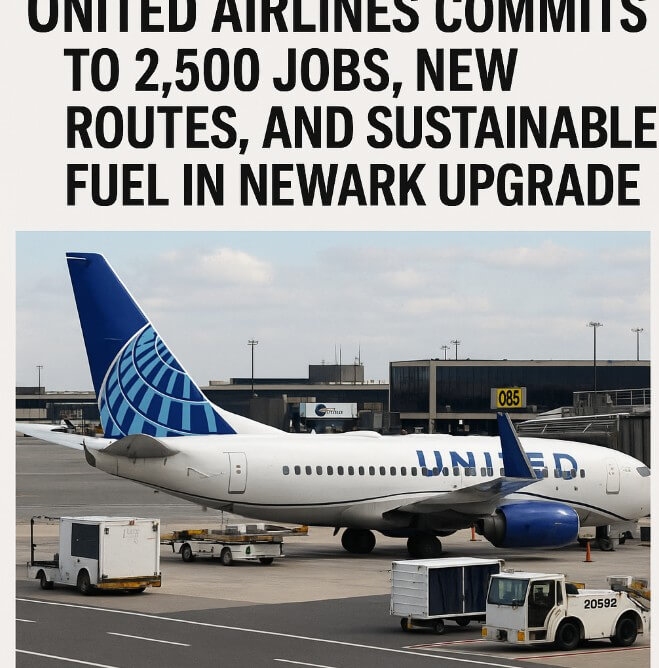
NEWARK, N.J. — United Airlines is making a multi-year commitment to expand its operations at Newark Liberty International Airport (EWR), pledging to hire more than 2,500 employees, open new international and domestic routes, and become the first major U.S. carrier to bring sustainable aviation fuel (SAF) to Newark.
The move comes after a turbulent period for one of the New York metro area’s busiest airports, where outdated technology, shortages of air traffic controllers, and runway construction led to widespread delays earlier this year. United, the airport’s largest carrier, is working with state and federal partners to stabilize operations while investing in long-term growth.
Recovery from a Difficult Summer
Earlier in the year, Newark faced significant disruptions tied to equipment failures, technology outages, and strained air traffic control staffing. Those setbacks created ripple effects throughout the region’s air travel system, putting pressure on both travelers and airlines.
Since then, United and the Port Authority of New York and New Jersey have made key infrastructure improvements. Runway construction was completed ahead of schedule, a new fiber-optic network has been installed, and hourly flight operations have been capped to reduce congestion. These changes have already shown results.
Over the summer, United recorded its best-ever on-time performance at Newark, with more than six million passengers departing as scheduled — a record that outperformed both John F. Kennedy International Airport and LaGuardia Airport.
A Boost in Hiring and Expansion
According to industry site islands.com, United plans to hire 2,500 employees at Newark by the end of 2026 to support growing demand. The new jobs will cover a wide range of positions, from flight crews and customer service staff to technical operations and ground services.
The airline already employs more than 14,000 people in the New York–New Jersey region, including over 3,000 pilots and 5,700 flight attendants. The additional hires will deepen the company’s presence in one of its most important hubs.
“United’s expansion here will mean more jobs, more connectivity, and more opportunities for the people of New Jersey,” Governor Phil Murphy said in a statement, calling the airline’s commitment “an important step in supporting our economy and ensuring Newark remains a vital international gateway.”
New Routes to Europe, Africa, and Beyond
The hiring push coincides with United’s plan to expand its route network out of Newark. By 2026, the airline intends to serve more than 160 destinations worldwide from the airport.
On the international side, new service will launch to Rome, Venice, Porto, Marrakesh, and Dublin, strengthening Newark’s position as a hub for transatlantic travel. Domestically, new flights will connect travelers to cities including Palm Springs, Orlando, Fort Lauderdale, Columbia, S.C., and Chattanooga, Tenn.
Industry analysts say the expansion underscores United’s strategy of leveraging Newark as a key transatlantic hub. The moves also follow steady demand growth among both leisure and business travelers, as international traffic continues to rebound.
A First for Sustainable Aviation Fuel at EWR
In a milestone for its sustainability goals, United will become the first major airline to purchase and use sustainable aviation fuel at Newark. The company has agreed to acquire up to one million gallons of SAF from Neste this year. SAF is considered a lower-carbon alternative to fossil jet fuel, cutting lifecycle greenhouse gas emissions.
“Introducing SAF at Newark is a significant achievement,” said a United spokesperson. “It supports our long-term commitment to decarbonizing aviation while continuing to serve millions of passengers each year.”
The move aligns with the airline’s broader climate strategy, which includes investments in SAF production, electric aircraft development, and other carbon-reducing technologies.
Ongoing Challenges Ahead
Despite progress, capacity at Newark remains under constraint. In May, the Federal Aviation Administration reduced the airport’s maximum number of flights per hour from 86 to 68 due to operational and safety concerns. The cap has since been tentatively raised to 72 flights per hour, a limit that will remain in place through summer 2026.
Industry experts caution that maintaining reliability at Newark will require continued investment in both infrastructure and staffing. Air traffic control modernization, new technology deployment, and additional hiring remain essential to avoiding the type of disruptions that plagued travelers earlier this year.
Still, United’s investment signals confidence in Newark’s long-term role as a cornerstone of its network. With job growth, new routes, and a sustainability-first fuel strategy, the airline is betting on the region’s enduring importance to international travel and commerce.
