


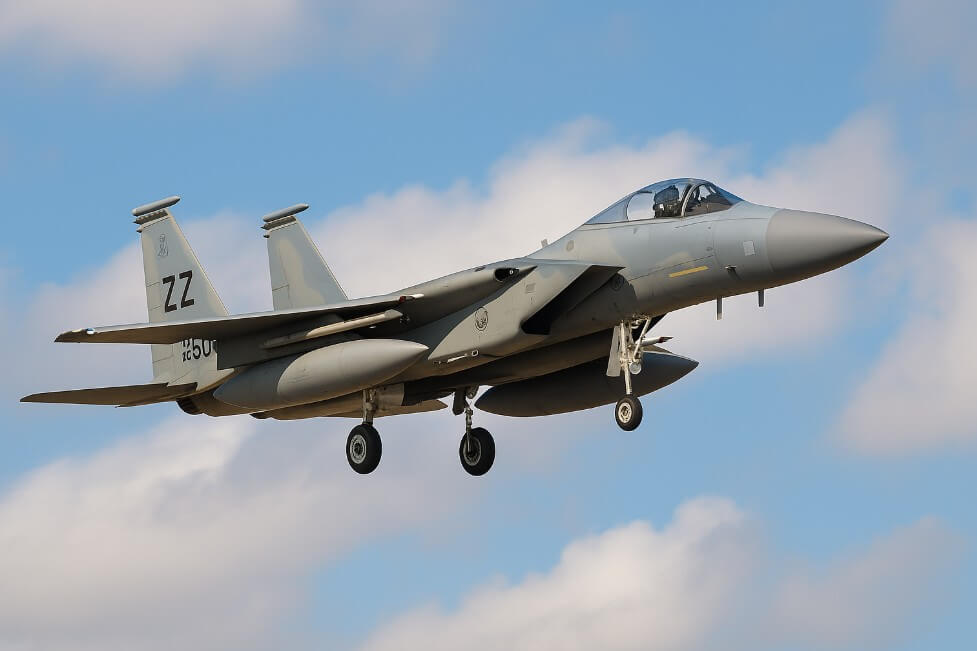
WASHINGTON — The U.S. Air Force has decided to keep a select number of its aging F-15C/D Eagle fighter jets flying through 2030, extending their homeland defense role for an additional four years as the service transitions to the next-generation F-15EX Eagle II.
The decision, outlined in the Air Force’s “Long-Term Fighter Force Structure” report submitted to Congress in August 2025, marks a notable adjustment in the service’s modernization timeline. Originally slated for retirement in fiscal 2026, the upgraded “Platinum Eagles” will continue to safeguard U.S. airspace until the new aircraft are fully operational.
Homeland Defense Mission Continues
According to the report, the extended-service F-15C/Ds will remain stationed at Fresno Yosemite International Airport (FAT), home to the California Air National Guard’s 144th Fighter Wing. These aircraft will continue to patrol and respond to potential airspace incursions across U.S. air defense identification zones.
The Air Force said maintaining a limited fleet of airworthy F-15C/Ds is critical for homeland defense readiness. Air Combat Command will oversee the force, ensuring only the most structurally sound and technologically capable jets remain active.
The report’s charts indicate a gradual phase-out: 42 aircraft will remain combat-coded through 2028, with 21 extending their service through 2030. These “Platinum Eagles,” the most robust of the remaining F-15C/D fleet, have received structural reinforcements and avionics updates to prolong their operational viability.
Aging Fleet, Targeted Upgrades
First introduced in the 1970s, the F-15C/D fleet has served as the backbone of U.S. air superiority for more than four decades. However, time has taken its toll. More than 75 percent of the aircraft are affected by airframe fatigue, which limits their top speed and G-load capabilities.
Despite these constraints, the Air Force said the remaining upgraded jets—with Active Electronically Scanned Array (AESA) radars and modern cockpit avionics—are capable of meeting the demands of air defense operations. These enhancements allow the aircraft to detect, track, and engage targets with greater precision.
The Air Force had originally expected the F-22 Raptor to replace the F-15C/D, but reduced F-22 procurement left a shortfall. To fill that gap, the F-15C/D fleet continued its service, particularly in key defensive roles both at home and abroad.
In recent years, the Air Force has replaced F-15 units at RAF Lakenheath in the United Kingdom and Kadena Air Base in Japan with rotating F-35 Lightning II and F-16 Fighting Falcon deployments. Once F-15EX production scales up, the service plans to permanently station the new fighters at those strategic locations.
Transition to the F-15EX
The Air Force expects to complete divestment of its legacy F-15C/D fleet by fiscal 2031, as the F-15EX Eagle II becomes fully operational. The new aircraft incorporates state-of-the-art avionics, digital fly-by-wire controls, and greater payload capacity—advancements designed to improve reliability and reduce long-term maintenance costs.
While modernization remains a priority, the Air Force stressed the importance of maintaining readiness throughout the transition period. The continued use of the “Platinum Eagles” ensures that the U.S. can sustain air defense coverage without operational gaps as the F-15EX fleet grows.
The report also underscores logistical challenges within the aging fleet. Increasing “cannibalization”—the practice of removing parts from one aircraft to repair another—has become a significant issue, highlighting the urgency of bringing F-15EX units online as quickly as possible. In parallel, select F-15E Strike Eagles are expected to remain active well into the 2030s, extending the platform’s long-standing service record.
Revised Fleet Accounting and Future Planning
Beyond aircraft maintenance, the 2025 Long-Term Fighter Force Structure report introduces updates to how the Air Force measures its operational capabilities. The service has reclassified its “Primary Mission Aircraft Inventory” as the “Combat-Coded Total Aircraft Inventory,” a term encompassing active, reserve, and backup assets. The new classification provides a clearer view of combat-ready aircraft available for immediate deployment.
The Air Force is seeking congressional approval to codify these changes, describing them as essential to aligning readiness metrics with long-term modernization objectives. Officials say the revised accounting system will help the service more accurately manage force structure decisions and budget priorities as it modernizes its fighter fleet.
Balancing Readiness and Renewal
The decision to extend the F-15C/D fleet underscores the Air Force’s balancing act between maintaining immediate defense capability and advancing toward next-generation systems. With airframe fatigue and parts shortages posing ongoing challenges, the “Platinum Eagles” serve as a critical bridge to the future force.
As the report notes, sustaining these proven aircraft for a few more years will preserve the Air Force’s ability to rapidly intercept and identify potential threats—a mission that remains at the core of U.S. air defense strategy.
Stay tuned for continued updates as the Air Force moves forward with F-15EX integration and reshapes its future fighter force structure.
