


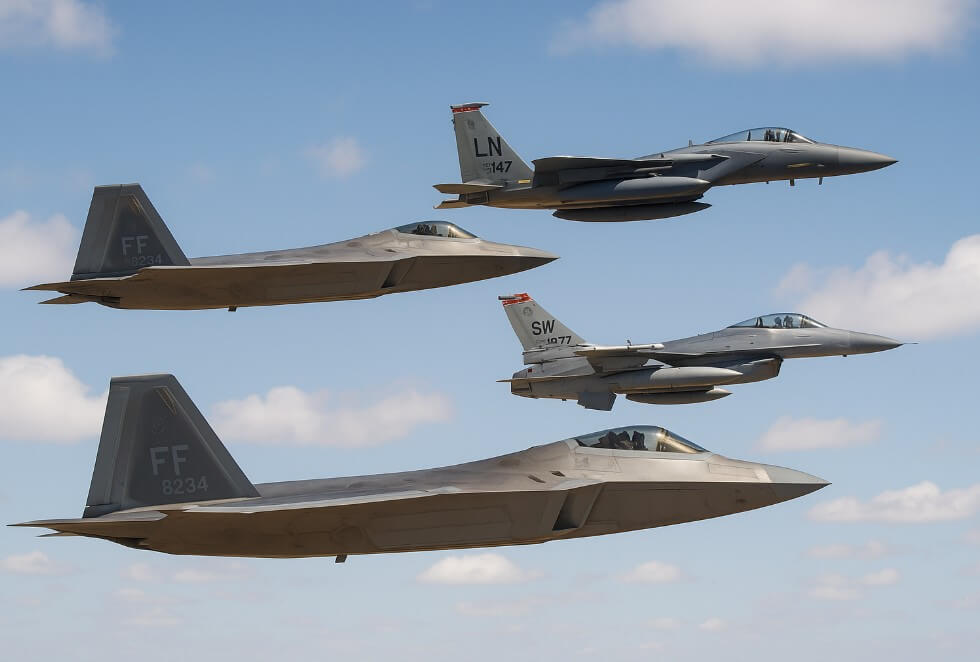
WASHINGTON — The United States Air Force has outlined an ambitious plan to expand and modernize its fighter fleet, warning that it needs 1,558 manned, combat-coded aircraft to maintain “low-risk” operational readiness—nearly 300 more than it currently fields. The proposal, detailed in a report to Congress, underscores the service’s growing concern over aging aircraft, production delays, and budget constraints as it prepares for future global conflicts.
The report, titled “Long-Term USAF Fighter Force Structure,” and signed by Acting Secretary Troy Meink, concludes that the service must “grow to minimize risk” while pursuing modernization across both fifth-generation and legacy fighter platforms. The target number marks a roughly 24% increase from today’s fleet of about 1,271 combat-coded aircraft, including 103 A-10 Thunderbolt IIs scheduled for retirement by the end of fiscal 2026.
Officials say the expansion is crucial to ensuring that the Air Force can meet all combatant commander demands while preserving the flexibility to respond to simultaneous crises. “Achieving low risk means being very likely to meet operational goals,” the report notes. A fleet of 1,367 fighters would constitute “medium risk,” where the service is only “likely” to meet objectives, while anything below that threshold would put missions in “high-risk” territory—where objectives may not be met and operational stress would sharply increase.
Budget Pressures Threaten Ambitions
The Air Force acknowledges that its 1,558-fighter goal may be more aspirational than achievable without significant funding increases. Procurement and sustainment costs continue to rise, even as Congress faces competing budget priorities. Senior officials warn that without a long-term funding commitment, the service may be forced to either scale back readiness targets or delay modernization programs.
“Funding gaps, production limits, and modernization delays could make the goal difficult to achieve,” the report cautions. Budget pressures have already slowed the pace of aircraft acquisition and delayed upgrades to key systems, raising concerns about the service’s ability to replace aging airframes before they become unsupportable.
Modernization at a Crossroads
The Air Force is pursuing what it calls the largest modernization effort in its history, centered on advanced platforms such as the Lockheed Martin F-35A Lightning II, Boeing F-15EX Eagle II, and the stealthy B-21 Raider bomber. At the same time, it is investing heavily in collaborative combat aircraft (CCAs)—unmanned drones designed to operate alongside piloted jets in contested environments.
Yet progress has been uneven. Persistent delays in the F-35’s Block 4 software upgrade have slowed procurement, prompting the Pentagon to propose cutting F-35 purchases by half in fiscal 2026. The upgrade is intended to expand weapon capacity and improve onboard sensors, both key to future combat missions.
Officials say production could accelerate once those issues are resolved. Lockheed Martin currently produces between 130 and 140 F-35s per year across all variants, with potential to scale to 100 annually for the U.S. Air Force alone once modernization stabilizes.
Aging Fleet, Shrinking Workforce
While modernization efforts advance, the Air Force continues to grapple with the cost of sustaining its older aircraft. The A-10 Warthog, F-15C/D, and early F-16 models are increasingly expensive to maintain, requiring extensive depot work and parts that are harder to source from a shrinking industrial base.
The service plans to retire all A-10s by September 2026 and phase out aging F-15C/Ds, while retaining upgraded F-15E Strike Eagles equipped with new Pratt & Whitney F100-PW-229 engines to enhance thrust and mission efficiency.
Compounding these challenges is a persistent pilot shortage, driven by training bottlenecks and competition from the private sector. The manpower gap threatens to slow the Air Force’s transition to a more technologically advanced fleet, even as new aircraft come online.
The Promise of Autonomous Systems
Emerging drone programs could eventually reshape the Air Force’s structure. New collaborative combat aircraft, including General Atomics’ YFQ-42A and Anduril’s YFA-44A, are being developed for missions ranging from strike operations to electronic warfare. The Air Force plans to field at least 1,000 of these autonomous systems in the coming decade.
Officials say the technology could reduce the total number of human-piloted jets needed, but they caution that it is too soon to assess how much CCAs will offset the fighter shortfall. “It’s too early to quantify the exact impact these drones will have on force structure and operational readiness,” the report says.
Balancing Ambition and Reality
The 1,558-fighter benchmark represents what the Air Force considers full-spectrum readiness—but reaching it will depend on sustained funding, industrial output, and steady modernization progress.
As the service races to keep pace with emerging technologies and evolving global threats, it faces a defining test: whether America’s air dominance can be maintained in an era of tightening budgets and technological disruption.
