


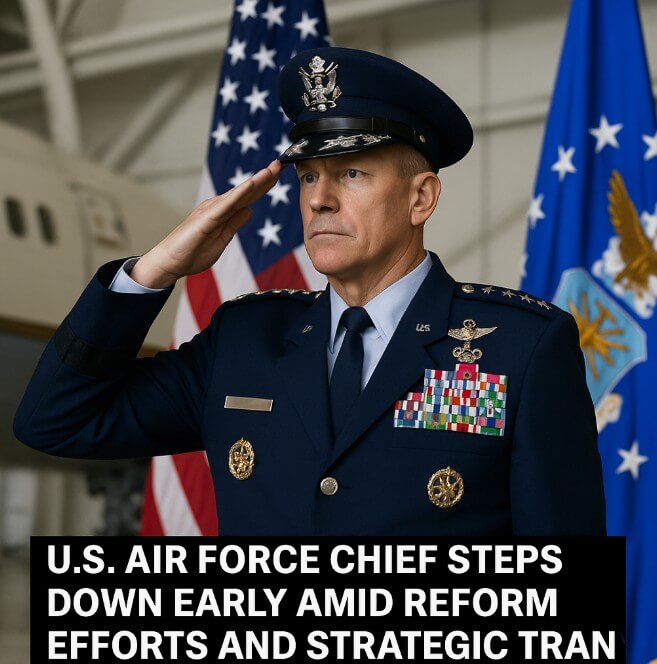
JOINT BASE ANDREWS, Md. — The U.S. Air Force is entering a pivotal transition as Gen. David Allvin, its Chief of Staff, prepares to retire earlier than expected following nearly two years of service marked by internal reform and organizational change. A retirement ceremony held Friday, October 11, 2025, at Joint Base Andrews served as both a tribute to his career and a signal of shifting leadership at the world’s largest air force.
Although the event did not formally conclude Allvin’s tenure, it effectively marked the beginning of the end. His successor, Gen. Kenneth Wilsbach, who faced no significant challenges during his Senate confirmation hearing, is widely expected to be confirmed soon.
A Sudden and Unusual Departure
Gen. Allvin’s decision to retire—announced in August—caught much of the defense community off guard. He pledged to remain in his post until his successor’s confirmation to ensure a smooth transition, with his formal retirement expected by early November. Appointed Chief of Staff in November 2023, Allvin’s exit comes roughly halfway through the Air Force’s customary four-year leadership term.
His early retirement is a rarity within the Air Force. Past chiefs who departed early typically did so to assume the higher role of Chairman of the Joint Chiefs of Staff or in response to controversy. Allvin’s departure, by contrast, appears to stem from internal reform dynamics rather than external pressure.
In a break from long-standing tradition, the ceremony did not include a formal change-of-command segment or the swearing-in of Gen. Wilsbach. The omission underscored the distinctiveness of this leadership shift. The last two chiefs—Gen. Mark Welsh and Gen. David Goldfein—each completed their terms with formal, simultaneous transitions to their successors, highlighting how Allvin’s exit diverges from precedent.
Reform and “Reoptimization”
Throughout his tenure, Gen. Allvin pursued an ambitious modernization initiative dubbed “reoptimization.” The plan sought to reconfigure the Air Force’s command and operational structure to better respond to evolving security challenges, particularly those posed by emerging technologies and great-power competition. His vision emphasized agility, efficiency, and a more integrated approach to air and space operations.
The “reoptimization” initiative gained momentum under the Biden administration after having been stalled during the Trump years. Reports from Defense One in August indicated that Allvin’s determined push for reform—and resistance within parts of the bureaucracy—may have contributed to his decision to step down before completing his term.
Allvin’s advocacy for structural change was seen as both forward-thinking and disruptive. While his proposals aligned with broader Defense Department goals for modernization, they also challenged entrenched processes within the service. His departure now leaves his successor with the dual task of sustaining momentum and managing institutional adaptation.
A Legacy of Modernization and Transition
Despite his early exit, Allvin’s impact on the Air Force’s trajectory is likely to be lasting. His emphasis on streamlining command structures and improving readiness reflected a broader Pentagon shift toward preparing for near-peer conflicts, particularly in the Indo-Pacific theater.
Under his leadership, the Air Force expanded its focus on digital integration, operational mobility, and force readiness—cornerstones of the “reoptimization” concept. While many of these reforms remain in development, observers note that Allvin’s leadership helped lay the groundwork for the next phase of transformation.
Gen. Wilsbach, currently serving as the commander of Pacific Air Forces, is expected to continue aspects of Allvin’s vision once formally confirmed. Known for his operational experience and Indo-Pacific expertise, Wilsbach’s appointment signals an emphasis on maintaining global readiness amid intensifying strategic competition.
Navigating a Critical Juncture
As the Air Force prepares for new leadership, the timing of this transition coincides with complex global defense demands—from modernization of U.S. air power to maintaining deterrence against near-peer rivals. The ceremony at Joint Base Andrews thus served not only as a farewell for a respected leader but also as a reflection on the institution’s broader evolution.
The service faces a period of introspection and adjustment as it balances tradition with transformation. Allvin’s push for reform—while cut short—may yet influence the Air Force’s future posture under Wilsbach’s stewardship.
The departure of Gen. Allvin underscores both the challenges and opportunities inherent in modernizing one of America’s most powerful military institutions. His tenure, though brief, leaves behind a framework for change that could define the Air Force’s path for years to come.
