


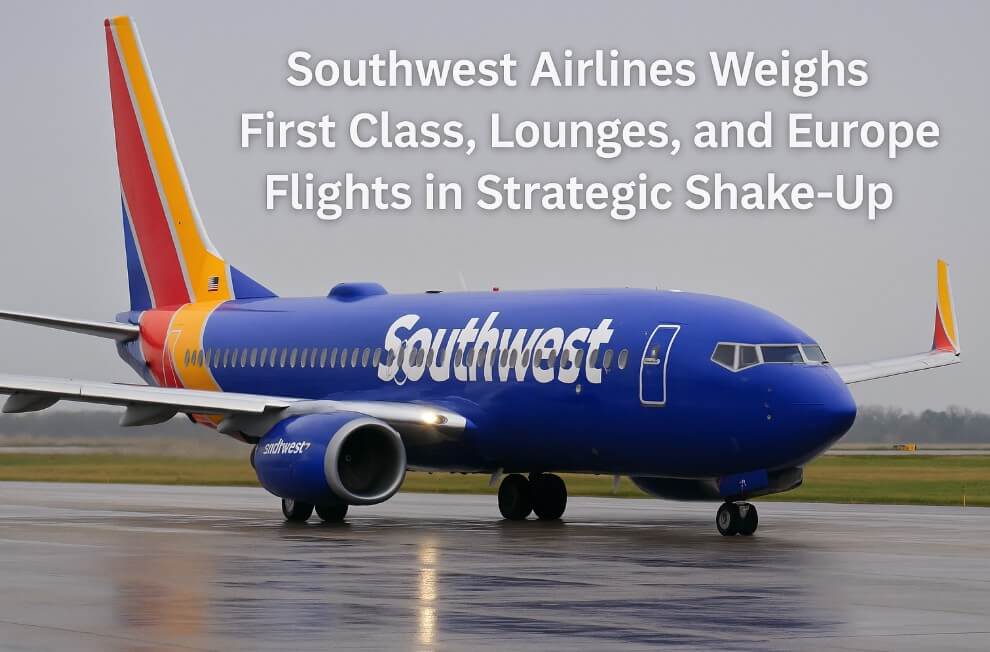
DALLAS — Southwest Airlines Co. (NYSE: LUV), long known for its bare-bones service model and single-fleet strategy, is weighing major changes that could reshape the carrier’s identity, including adding first class, airport lounges, and potential nonstop service to Europe.
Chief Executive Robert Jordan signaled the possible shift during remarks on September 9 at the U.S. Chamber of Commerce Global Aviation Summit in Washington, D.C., telling industry leaders that a transatlantic push would require rethinking aircraft and customer offerings.
“Serving Europe would require either a widebody or a new long-range narrowbody,” Jordan explained, acknowledging that the Boeing 737, the backbone of Southwest’s fleet, cannot cross the Atlantic. “We’re not ruling out anything in terms of what can serve that mission at this point.”
A Break from Tradition
For decades, Southwest has built its brand on simplicity: one aircraft type, no assigned seating, and a reputation for keeping costs low. But as competitive pressures mount and customer expectations evolve, the airline is reconsidering elements once viewed as untouchable.
Jordan said management is exploring options including first-class cabins, premium seating, and dedicated lounges—features standard at legacy carriers but absent from Southwest’s model.
“I’m not promising those things… Everything is on the table at Southwest,” he told the audience.
The airline has already begun to drift from long-standing traditions. It introduced fees for checked baggage earlier this year, is rolling out assigned seating in 2025, and is adding “premium” extra-legroom seats across its Boeing 737 fleet. These moves underscore a strategy to capture higher-yield travelers who expect more than basic service.
International Ambitions
Southwest’s network today is heavily domestic, with international service limited to leisure markets in the Caribbean and Central America. But recent booking partnerships with Icelandair, China Airlines, and EVA Air suggest a growing interest in global connectivity.
Jordan said the carrier sees clear demand from its millions of loyal passengers. “Customers would welcome the ability to fly Southwest to Europe,” he noted, while emphasizing that the path forward depends on the availability of suitable aircraft.
The Airbus A321XLR, with a 4,700-nautical-mile range, is already being deployed by rivals for long-haul narrowbody routes. Boeing, meanwhile, is considering both a new-generation narrowbody with transatlantic range and a larger jet modeled on the retired 757.
Jordan indicated Southwest may start with a narrowbody rather than attempt an ambitious widebody launch. “A widebody might be too ambitious at first,” he acknowledged, though he stressed that management is keeping its options open.
Competitive Landscape
Southwest’s hub cities—including Baltimore/Washington (BWI), Nashville (BNA), and Phoenix (PHX)—could provide strong launchpads for Europe service. Currently, customers in those regions must rely on legacy carriers or foreign airlines for transatlantic flights.
Direct European routes under the Southwest banner could strengthen customer loyalty and unlock higher-margin traffic, particularly as business travelers seek affordable but comfortable options.
At the same time, the U.S. airline industry is in flux. Discount carriers have been forced to adapt business models amid rising labor and fuel costs, while legacy airlines are investing heavily in premium products to compete for high-value passengers.
Southwest’s willingness to test its own long-held principles reflects this broader shift. The company faces the challenge of maintaining its reputation for affordability while introducing features that traditionally come with higher price tags.
No Set Timeline
Despite the bold ideas, Jordan stressed that no firm timeline exists for Europe service or for adding first class and lounges. Still, the willingness to publicly discuss such possibilities underscores how far Southwest’s leadership is prepared to go in rethinking its future.
Reported by FlightGlobal, the potential changes highlight the airline’s effort to adapt while retaining the loyalty of its core customer base.
As Jordan put it, Southwest remains committed to staying flexible.
