


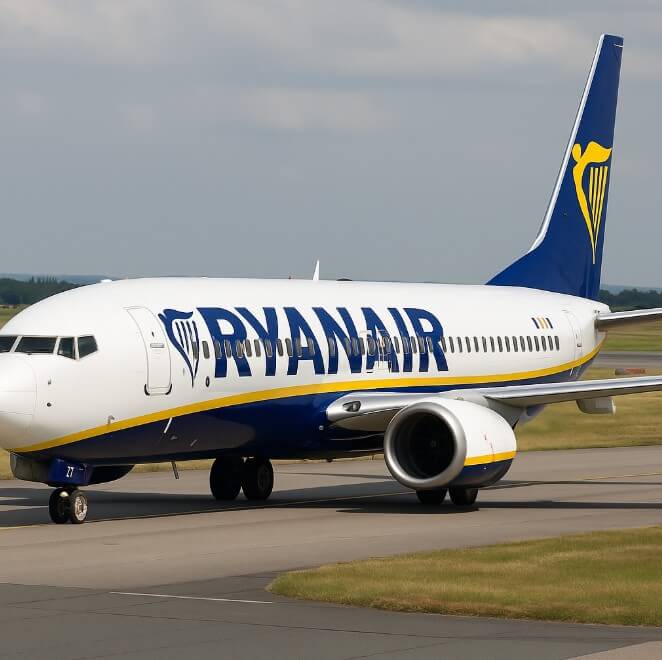
Ryanair is strengthening its presence in the UK market with a slate of new routes for its Winter 2025 schedule, while pressing the government for tax reforms and air traffic control overhauls that it says are critical to sustaining growth.
The airline announced Thursday that it will launch five new routes from London airports this winter, including flights from London Luton to Wroclaw and from London Stansted to Lübeck, Münster, Murcia, and Trapani. With these additions, Ryanair will connect Stansted to more European cities than Heathrow, a point the carrier underscored as it continues to pitch itself as the lower-cost alternative to Heathrow-based rivals.
Growth Plans Centered on UK Market
Ryanair, already the UK’s largest airline, expects to carry 60 million passengers in 2025—nearly twice the traffic of British Airways. The company has submitted growth plans to Prime Minister Keir Starmer’s government that would expand annual UK passenger volumes by 33% to 80 million over the next five years.
Those plans, however, hinge on changes in policy. The airline has repeatedly argued that Britain’s Air Passenger Duty (APD) taxes and inefficiencies at National Air Traffic Services (NATS) remain obstacles to expansion.
“We’ve surpassed EasyJet and British Airways to become the UK’s top airline, with 60 million passengers expected in 2025,” said Ryanair CEO Michael O’Leary. “We’re eager to drive further traffic and tourism growth across our 22 UK airports, supported by our order of 340 new Boeing aircraft arriving over the next eight years.”
Tax Reform at the Center of the Debate
O’Leary has been vocal in his calls for Chancellor of the Exchequer Rachel Reeves to scrap APD, which he described as a drag on competitiveness. “Rachel Reeves talks about growth but hasn’t delivered,” he said. “Scrapping APD would make UK air travel competitive again, especially in the regions, and mirror the success seen across Europe.”
He pointed to examples in Sweden, Hungary, Albania, and regional Italy, where governments eliminated similar environmental levies. In those markets, O’Leary argued, airlines responded with expanded routes, boosting passenger volumes, tourism, and jobs.
The CEO said that unless the UK follows suit, Ryanair may be forced to base its incoming aircraft in countries with more favorable aviation policies. “We’d love to base these new planes in the UK, but without APD reform, they’ll go to Sweden, Hungary, or Italy, where governments prioritize growth,” he explained.
Pressure on Air Traffic Control
Alongside its campaign against APD, Ryanair is lobbying for reforms at NATS, the country’s privatized air traffic control provider. O’Leary accused the agency, led by CEO Martin Rolfe, of chronic mismanagement leading to costly delays and disruptions.
“The government owns 49% of NATS and has the power to replace Rolfe with a competent leader,” O’Leary said. He dismissed Transport Secretary Heidi Alexander’s assertion that she lacks authority to intervene. “Transport Secretary Heidi Alexander’s claim that she can’t act is simply untrue. A capable CEO could transform NATS into an efficient service, ensuring a smoother travel experience for everyone this winter.”
New Aircraft Deliveries
Ryanair is set to receive 29 new Boeing 737 aircraft this winter, part of a broader fleet expansion that includes 340 planes arriving over the next eight years. O’Leary said he hopes to allocate many of those jets to the UK but again tied that deployment to government reforms.
The company has built its business around volume growth, low fares, and aggressive route expansion. The UK, with its dense network of regional airports and strong demand for European leisure travel, remains central to that strategy. But Ryanair’s leadership says the current policy environment risks diverting investment to more aviation-friendly European countries.
Outlook
The Winter 2025 schedule is a clear statement of intent: Ryanair wants to cement its dominance in the UK market with new destinations and capacity growth. Yet the airline is also making it equally clear that government policies will determine just how much of that ambition materializes.
By expanding routes, adding aircraft, and pushing for regulatory change, Ryanair is positioning itself as both an engine of UK tourism and a challenger to government policy. The company argues that abolishing APD and reforming NATS would not only benefit Ryanair but also unlock growth for the broader aviation sector, regional economies, and the tourism industry.
