


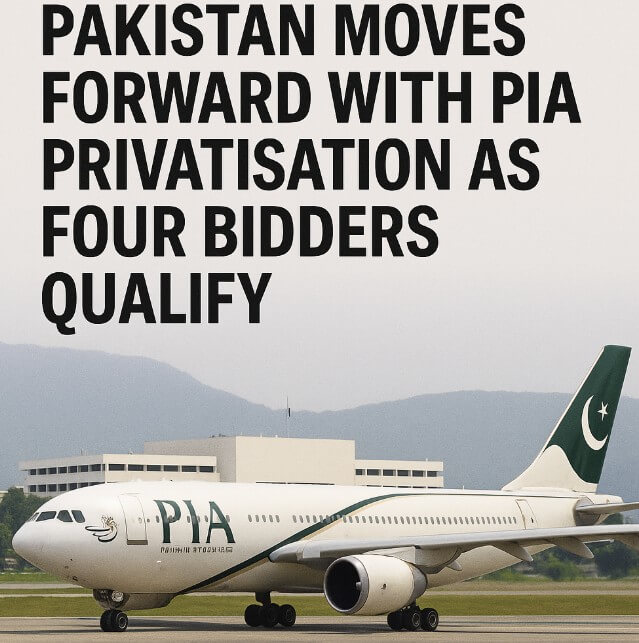
ISLAMABAD — Pakistan’s long-running push to privatize Pakistan International Airlines (PIA) advanced significantly this week as four bidders formally pre-qualified to move into the next stage of the sale process. The federal government confirmed the progress during a meeting of the Standing Committee on Privatisation, marking a major milestone in the effort to transfer between 51% and 100% of the airline’s shares, along with full management control, to a private-sector buyer.
Four Bidders Cleared to Advance
Officials told the committee that the Lucky Cement Consortium, the Arif Habib Corporation Consortium, Fauji Fertilizer Company Limited, and Air Blue Limited (PA) have been shortlisted to proceed.
The Ministry of Privatisation reported that the transaction structure for PIA’s divestment has already been approved, enabling the bidders to begin detailed due diligence. This includes access to PIA’s Virtual Data Room, site visits, and participation in the upcoming pre-bid conference.
Negotiations will now turn toward finalizing commercial terms, which government officials described as a crucial step in accelerating what is viewed as Pakistan’s second major attempt to privatize the loss-making national carrier.
Committee Presses for Clearer Timeline
Chaired by MNA Muhammad Farooq Sattar, the Standing Committee on Privatisation urged the commission to deliver a more detailed timeline during its next meeting. Members emphasized the need to fast-track the process amid persistent financial pressure on the national airline.
Lawmakers also stressed that employee protections must remain a top priority. They called for clear safeguards surrounding job security, pensions, and post-privatization benefits, noting that stability among PIA’s workforce is essential for a smooth ownership transition.
Employee Safeguards and Union Engagement
The committee instructed the Ministry of Privatisation and PIA Corporation Limited to maintain transparent communication with staff unions and associations. Lawmakers argued that early and open dialogue can prevent disputes once a strategic partner assumes control.
They further recommended that a restructured PIA adopt merit-based retention policies, saying the future success of the airline will depend on performance-driven staffing practices and streamlined operations.
Government Eyes Reforms Across Multiple Sectors
While PIA dominated the session, officials also provided updates on other high-profile divestment plans, including the Roosevelt Hotel in New York. The government has approved a Joint Venture model for the hotel following extensive due diligence, and seven firms have submitted proposals to serve as financial advisor for the next steps in the restructuring.
Privatization efforts in the power sector were also reviewed. Under the 2024–29 program, only operational generation companies (GENCOs) — specifically Guddu (747 MW) and Nandipur (525 MW) — will be offered for sale. Non-operational units could be delisted, with officials recommending that outdated assets be disposed of after internal approvals.
These updates signal a broader push by the government to streamline state-owned enterprises and reduce fiscal strain.
Broad Political Attention on PIA’s Future
The session was attended by multiple MNAs and senior officials from the Ministry of Privatisation, PIA Corporation Limited, and the Power Division, reflecting the high political stakes tied to PIA’s restructuring. The airline, which has struggled with operational inefficiencies and mounting debt, is widely viewed by policymakers as a priority case for reform.
The pre-qualification of four bidders marks one of the most significant steps to date in Pakistan’s multi-year effort to reshape PIA into a financially sustainable, commercially competitive airline.
PIA Privatisation Reaches Critical Phase
As the shortlisted bidders begin in-depth evaluations, the government faces mounting pressure to keep the process transparent, timely, and commercially credible. The outcome will have far-reaching consequences — not only for PIA’s long-term future but also for Pakistan’s broader privatization agenda.
With detailed assessments underway, Islamabad is entering what officials describe as a critical juncture: balancing the need for swift progress with the imperative to safeguard workers and secure a strategic partner capable of restoring stability to the national carrier.
