


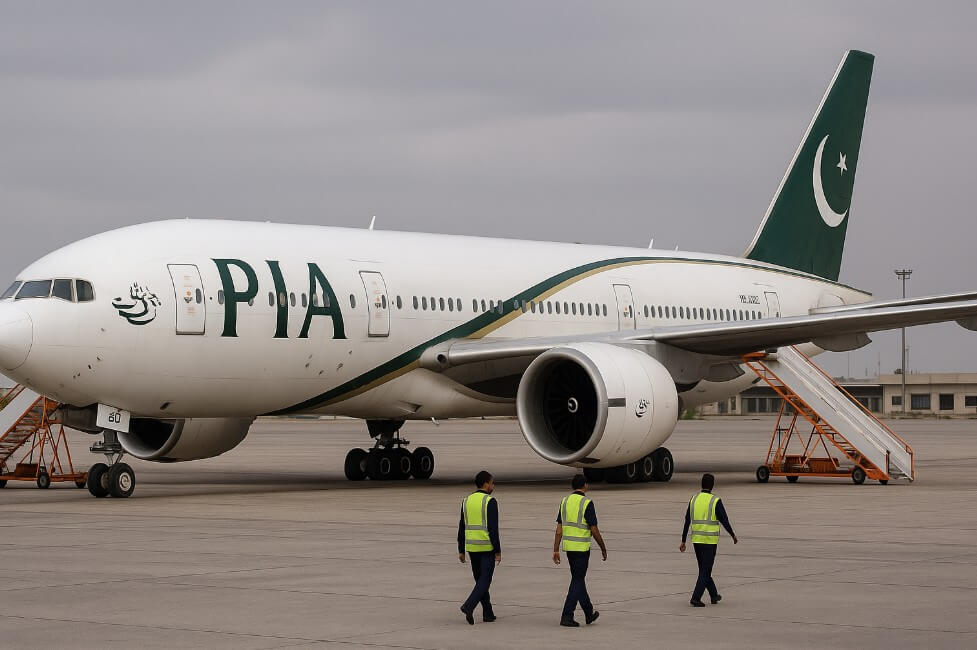
ISLAMABAD — Pakistan International Airlines (PIA) is grappling with major operational disruptions after aircraft engineers refused to certify several planes as airworthy, grounding much of the national carrier’s fleet and stranding passengers across the country’s busiest airports.
The move, led by members of the Society of Aircraft Engineers of Pakistan (SAEP), has paralyzed operations at Karachi (KHI), Lahore (LHE), and Islamabad (ISB) since late Monday. Engineers say they are adhering to safety standards and declining to sign off on aircraft they believe are not fit to fly, while PIA management has characterized the action as an unauthorized work stoppage that violates regulations and disrupts service.
Engineers Cite Safety Concerns
The engineers’ refusal to issue airworthiness clearances marks the latest blow for the state-run airline, already under financial and operational strain amid a government-led privatization push. According to airline officials, the stand-off has led to widespread cancellations and long delays, raising new questions about maintenance oversight and regulatory compliance.
PIA confirmed that dozens of aircraft remained idle on tarmacs, forcing the cancellation of at least five flights and delays of up to 14 hours on key international routes. The airline said it is working to restore service, but the shortage of certified aircraft has left schedules in disarray.
In remarks published by The News, SAEP representatives defended the engineers’ stance. “Six aircraft engineers posted at Peshawar airport have been transferred to Karachi…. They insisted the engineers are not on strike — they’re reporting for duty and clearing only the aircraft they believe are fit to fly. As part of a backup plan, PIA brought in engineers from a private company, but they managed to clear only two flights…”
The engineers maintain that their actions are in the interest of passenger safety and consistent with aviation law, not an industrial strike.
Widespread Passenger Disruption
Travelers across Pakistan faced extensive delays on Tuesday as flights were postponed or canceled outright. At Karachi’s Jinnah International Airport, hundreds of passengers — including umrah pilgrims bound for Saudi Arabia — were stranded in terminals as departure boards filled with red-flagged flights.
According to dawn.com, at least seven flights suffered serious delays, including PK747 (Lahore to Madina) delayed 14 hours, PK761 (Karachi to Jeddah) delayed 12 hours, PK233 (Islamabad to Dubai) delayed 9 hours, and PK300 (Karachi to Islamabad) delayed 4 hours. Five flights were cancelled entirely.
Temporary relief came when PIA brought in third-party engineers to inspect and certify some aircraft, but the effort produced limited results. Only a handful of flights were cleared to depart, and the backlog continued to grow through Tuesday evening.
Management Moves to Restore Order
Facing mounting pressure from passengers and regulators, PIA management said it has launched a series of measures to stabilize operations. In a statement, the airline confirmed that flights such as PK-245 (Islamabad to Dammam) and PK-761 (Islamabad to Jeddah) had resumed under alternative arrangements.
However, aviation analysts say the dispute exposes deeper systemic issues within the airline’s maintenance and compliance systems. A recent audit revealed that in 2021, five PIA aircraft were out of service for a combined 2,991 days — far exceeding the planned maintenance window of 19 to 28 days per aircraft. The extended downtime cost the airline an estimated Rs 38 billion, underscoring persistent inefficiencies in fleet management and repair scheduling.
Broader Implications Amid Privatization Push
The confrontation between engineers and management arrives as the government advances efforts to privatize the financially struggling airline. Analysts say the disruption could complicate those plans by drawing attention to operational vulnerabilities and raising concerns among potential investors about safety culture and workforce relations.
The situation also highlights the delicate balance between cost-cutting and compliance. While management insists that operations must continue uninterrupted, engineers argue that safety cannot be compromised — particularly as international regulators have previously flagged Pakistan’s aviation oversight.
Looking Ahead
As of Wednesday morning, PIA continued to report disruptions, with passengers facing long waits and limited flight availability. The carrier has pledged to work with aviation authorities and labor representatives to restore normal operations as soon as possible.
The grounding has left Pakistan’s flag carrier confronting twin challenges: the immediate need to resume reliable service and the longer-term imperative of rebuilding trust in its maintenance and safety procedures.
For now, travelers remain the most visible victims of the standoff — waiting in terminals for flights that may not leave the ground until the airline’s internal turbulence clears.
