


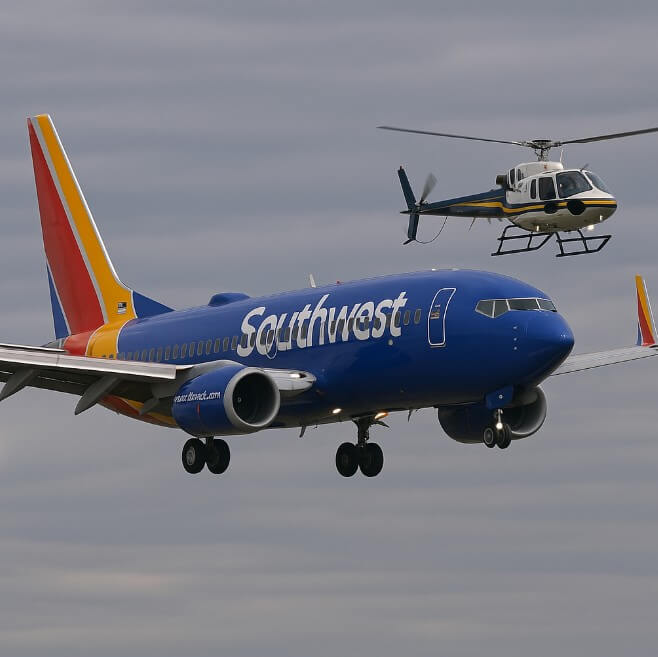
CLEVELAND — The National Transportation Safety Board (NTSB) has opened an investigation into a close call involving a Southwest Airlines Boeing 737 and a medical helicopter near Cleveland Hopkins International Airport (CLE) on October 29, in an incident that has renewed concern about U.S. airspace safety.
According to officials, Southwest Flight 1333 was on final approach from Baltimore/Washington International Thurgood Marshall Airport (BWI) when it came within less than a mile of a medical helicopter operating in the same airspace. The pilot of the Boeing 737 aborted the landing after the two aircraft drew dangerously close, executing a go-around maneuver to ensure passenger safety. The flight later landed safely with no injuries reported.
Incident Details and Airspace Conflict
Preliminary data from the NTSB confirmed the event constituted a loss of separation, meaning that the aircraft violated the minimum required distance between them while operating under air traffic control. Flight-tracking data from Flightradar24 showed that the Southwest jet and the helicopter were separated by just 0.56 miles (0.9 kilometers) at an altitude of approximately 2,075 feet (632 meters).
Controllers had initially instructed the helicopter to remain behind the arriving 737, but according to recordings of air traffic communications, the helicopter pilot requested to pass “above and in front” of the jet—an adjustment the controller approved. The maneuver placed the two aircraft on intersecting paths, triggering a resolution advisory (RA) alert in the cockpit of the Southwest plane, prompting the flight crew to climb and break off their landing approach.
Cockpit and Tower Communications
A detailed transcription of radio exchanges captured by aviation monitoring site You Can See ATC illustrates the sequence of events as the situation unfolded:
ATC: “Southwest 1333, traffic.”
Pilot (SW 1333): “It’ll be better if we go above it and in front of it if we can. We’re deviating right for the traffic.”
ATC: “Roger. Would you like…”
Pilot: “Negative, we can come back. Yeah, we’re going to execute a go-around. We got an RA right there.”
ATC: “Roger. When able, heading 060.”
Pilot: “Heading 060, Southwest 1333.”
The exchange continued with the controller issuing climb and turn instructions to restore safe separation, directing the 737 to “climb 4,000 and turn left 320.” The crew acknowledged the instructions and rejoined the traffic pattern for a subsequent safe landing.
Airline Response and NTSB Probe
Southwest Airlines commended the flight crew for their quick decision-making and confirmed it is cooperating fully with investigators. “Our pilots acted appropriately and in accordance with safety protocols,” a spokesperson said, emphasizing that passenger safety was never compromised. The medical transport operator involved has not yet issued a public statement.
The NTSB has begun collecting radar data, cockpit recordings, and ATC logs to reconstruct the incident timeline and determine whether controller procedures or pilot communications contributed to the loss of separation.
Broader Context: Airspace Safety Under Scrutiny
The Cleveland near-miss adds to growing concerns about the safety of the U.S. airspace system following a series of close encounters over the past year. The issue has drawn heightened attention since January 29, when a collision between an American Airlines regional jet and a U.S. Army helicopter near Ronald Reagan Washington National Airport (DCA) killed 67 people. That tragedy prompted the Federal Aviation Administration (FAA) to revise helicopter flight corridors around the Washington metropolitan area, including BWI and Dulles (IAD), to strengthen separation buffers.
Despite these reforms, NTSB data show that since 2021 there have been over 15,200 reported losses of separation near Reagan National, with 85 classified as “close-call” events. Aviation safety experts say the persistent frequency of such incidents underscores the need for better coordination between commercial, medical, and government flight operations in congested airspace.
Recent Close Calls and Systemic Challenges
The Cleveland event comes just weeks after another close call reported by The Aviation Herald involving a Delta Air Lines Airbus diverted from New York’s JFK to Boston Logan Airport. That aircraft narrowly avoided a Cape Air Cessna departing the same runway during adverse weather conditions, again raising questions about coordination and controller oversight.
Air traffic controllers are also facing operational pressures. A recent government shutdown forced controllers—classified as essential employees—to work without pay, exacerbating staffing shortages. According to Cleveland.com, 44% of flight delays last Sunday were attributed to inadequate staffing, compared to an annual average of just 5%.
The FAA has been criticized for lagging in policy responses to these recurring safety issues. Following a May 1 near-miss near the Pentagon, the agency imposed new restrictions on military helicopter flights in that area.
As federal investigators examine the Cleveland incident, aviation analysts say it will serve as a test case for how well new safety measures are working in real-world conditions.
