


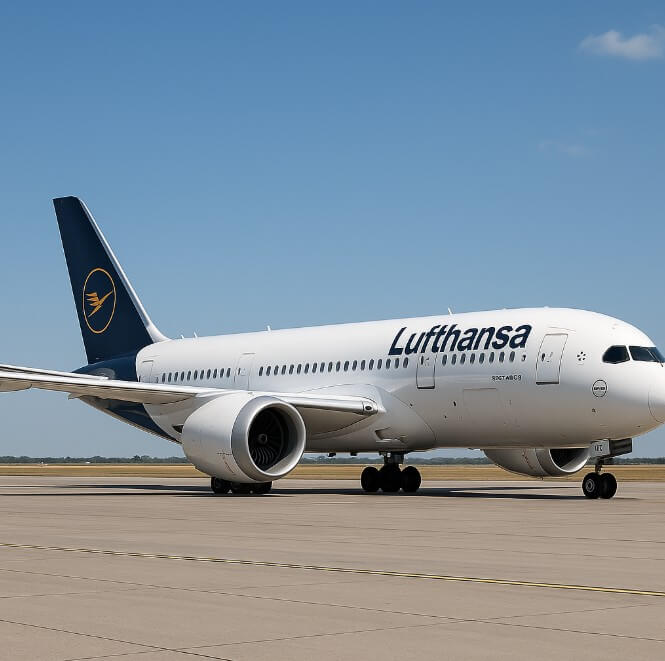
FRANKFURT – Lufthansa Group has announced a sweeping fleet overhaul that will see six long-haul aircraft types retired within the next five years, part of a strategy aimed at cutting costs, improving flexibility, and aligning operations with its sustainability goals.
The German aviation giant confirmed the changes will affect not only its flagship Lufthansa but also subsidiaries Swiss International Air Lines (LX), Austrian Airlines (OS), and Brussels Airlines (SN). Executives say the move will simplify training and maintenance across its network while preparing the group for a future anchored on next-generation aircraft.
Streamlining the Fleet
Lufthansa’s long-haul operations currently rely on a mix of aircraft ranging from decades-old workhorses to the latest fuel-efficient jets. Under the restructuring, the Airbus A340-300, Airbus A340-600, Boeing 747-400, Boeing 747-8, Airbus A330-200, and Boeing 777-200 will all be phased out.
By concentrating on a smaller number of aircraft families, Lufthansa expects to increase efficiency and cut overhead. “Fleet simplification offers several key advantages for Lufthansa Group. A standardized fleet allows more flexibility in crew assignments, lowers pilot training costs, and reduces spare parts inventories,” the company said.
The initiative is also designed to strengthen operations at major hubs including Frankfurt (FRA), Munich (MUC), Zurich (ZRH), Vienna (VIE), and Brussels (BRU).
Focus on Modern Aircraft
Going forward, Lufthansa will standardize around three core long-haul aircraft families: the Airbus A350, Boeing 787 Dreamliner, and Boeing 777X.
The Boeing 787 is gradually being introduced to replace older Airbus A340s and Boeing 767s, while the Boeing 777X is expected to succeed the Boeing 747 fleet on high-demand intercontinental routes once deliveries begin.
The shift signals the eventual farewell of the Boeing 747-400, an aircraft that has been central to Lufthansa’s intercontinental services since the 1980s. The more recent 747-8, though newer, will also leave the fleet as part of the consolidation.
Efficiency and Sustainability Gains
According to the airline group, the benefits of a standardized fleet extend beyond cost savings. Simplifying aircraft types enhances scheduling reliability, reduces the complexity of maintenance, and makes it easier to roll out uniform service standards across brands.
By 2030, Lufthansa expects the strategy to deliver “significant cost savings, while also reducing emissions per passenger.” The shift is aligned with global airline industry efforts to modernize fleets, cut fuel burn, and lower environmental impact.
The changes will also provide consistency for travelers. With fewer aircraft types, passengers can expect more uniformity in cabin interiors, entertainment systems, and service offerings across Lufthansa, Swiss, Austrian, and Brussels Airlines flights.
Broader Industry Context
Lufthansa’s decision mirrors a growing trend among major carriers to shed older, less efficient jets in favor of new-generation aircraft. The COVID-19 pandemic accelerated this transition for many airlines, forcing companies to rationalize operations and invest in sustainability as part of long-term recovery plans.
Analysts note that while the exit of aircraft such as the 747-400 and A340 marks the end of an era for aviation enthusiasts, the move positions Lufthansa to remain competitive against rivals in Europe, the Middle East, and Asia who are similarly modernizing their fleets.
Looking Ahead
The transition is expected to be gradual, with aircraft phased out over the next five years. For Lufthansa Group, the endgame is clear: a leaner, greener, and more profitable operation built around aircraft that offer both lower emissions and improved passenger experience.
For travelers, that will mean fewer nostalgic encounters with classic widebodies—but more predictability and efficiency when flying across the Atlantic or to Asia.
As the group put it in its announcement: “This decision ensures the group will focus on fewer, more efficient aircraft families, particularly the Airbus A350, Boeing 787, and Boeing 777X.”
