


Fatal Test Flight Near Ivanovo Raises Safety and Capacity Concerns
The crash of the world’s largest turboprop aircraft in central Russia has drawn renewed attention to the country’s growing reliance on aging Soviet-era aviation platforms, exposing vulnerabilities in both military logistics and aviation safety.
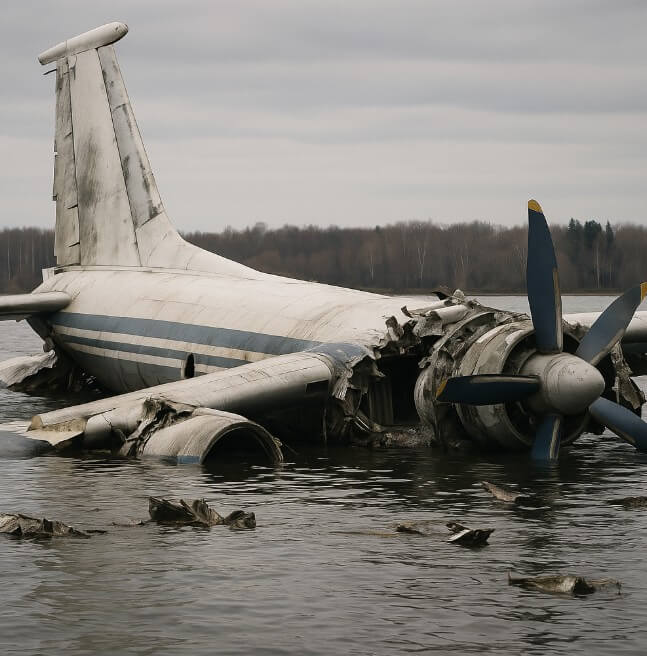
A rare Antonov An-22 Antei operated by the Russian Ministry of Defence crashed into the Uvodskoye Reservoir in the Furmanovsky District near Ivanovo during a post-repair test flight. Early reports indicate that all seven crew members aboard the aircraft are believed to have died. Only scattered fragments of the aircraft were visible on the reservoir’s surface following the incident.
The flight occurred as Russia was preparing to withdraw the An-22 from service, underscoring the risks associated with extending the operational life of legacy aircraft amid sustained military and logistical demands.
Retirement Plans Collide With Operational Reality
Russian officials had previously confirmed plans to retire the An-22 fleet in 2024. However, pressure on the country’s transport aviation capabilities has complicated that timeline. Ongoing military operations have stretched available heavy-lift platforms, forcing continued use of aircraft that are decades beyond their intended service lives.
According to data from the Russian Planes database, only three An-22 aircraft remain flight-capable, while another ten are in storage. Of the 68 aircraft originally produced, the remainder have either been scrapped or lost in accidents over time.
The decision to return the aircraft to test flying suggests a shortage of alternatives. Russia’s fleet of Il-76 transports is limited, its An-124 heavy-lift aircraft are few in number, and older An-12 and An-26 models are steadily being phased out. Together, these constraints have narrowed the country’s heavy airlift options.
A Landmark Aircraft With a Storied Legacy
The Antonov An-22 Antei first flew in 1965 and entered military service shortly thereafter. Its debut at the Paris Air Show that same year attracted global attention due to its unprecedented size and performance.
Powered by four Kuznetsov NK-12MA turboprop engines, each producing more than 14,800 horsepower, the An-22 remains the most powerful turboprop aircraft ever built. Measuring nearly 58 meters in length with a wingspan exceeding 64 meters, it became the world’s first widebody transport aircraft.
Its cavernous cargo hold and payload capacity of approximately 80 tonnes allowed it to transport armored vehicles, heavy machinery, and humanitarian supplies to remote or poorly prepared airstrips. Over its service life, the aircraft set 41 world records related to payload and performance and supported the production and transport of components for later aircraft such as the An-124 and the An-225.
Mounting Maintenance and Safety Risks
Despite its historic role, sustaining the An-22 has become increasingly difficult. Aging airframes, limited spare parts, and rising maintenance demands have accelerated the aircraft’s decline. Aviation analysts note that continued reliance on platforms approaching 60 years of service increases operational risk, particularly when high-tempo missions limit opportunities for thorough maintenance.
The loss of the An-22 near Ivanovo further reduces Russia’s already constrained heavy airlift capacity, intensifying challenges for military logistics and large-scale cargo operations.
Separate Civilian Crash Deepens Aviation Concerns
The military accident comes amid broader scrutiny of Russia’s aviation sector following a deadly civilian crash in the country’s far east. A Soviet-era Antonov An-24 operated by Angara Airlines AG crashed while approaching Tynda Airport, killing all 48 people onboard.
The aircraft had departed from Blagoveshchensk and lost contact with air traffic controllers shortly before landing. Authorities later located burning wreckage approximately 15 kilometers from Tynda Airport on a remote mountainside, with rescue teams forced to clear dense forest to reach the site.
Investigation, Mourning, and Industry Pressures
Investigators confirmed that the flight was carrying 42 passengers, including five children, along with six crew members. A criminal case has been opened to examine potential violations of air traffic and operational rules, with early assessments citing possible technical failure or human error.
The An-24 involved was built in 1976 and had previously experienced multiple technical issues, including a generator failure in 2022 and radio communication problems earlier this year.
Together, the two crashes highlight the operational strain facing Russia’s aviation industry. Sanctions linked to the conflict in Ukraine have restricted access to spare parts and complicated maintenance, prompting calls from regional operators to extend the service lives of aging aircraft. The An-24 crash marks Russia’s first fatal passenger aviation accident since July 2021, reinforcing concerns over fleet modernization amid limited resources.
