


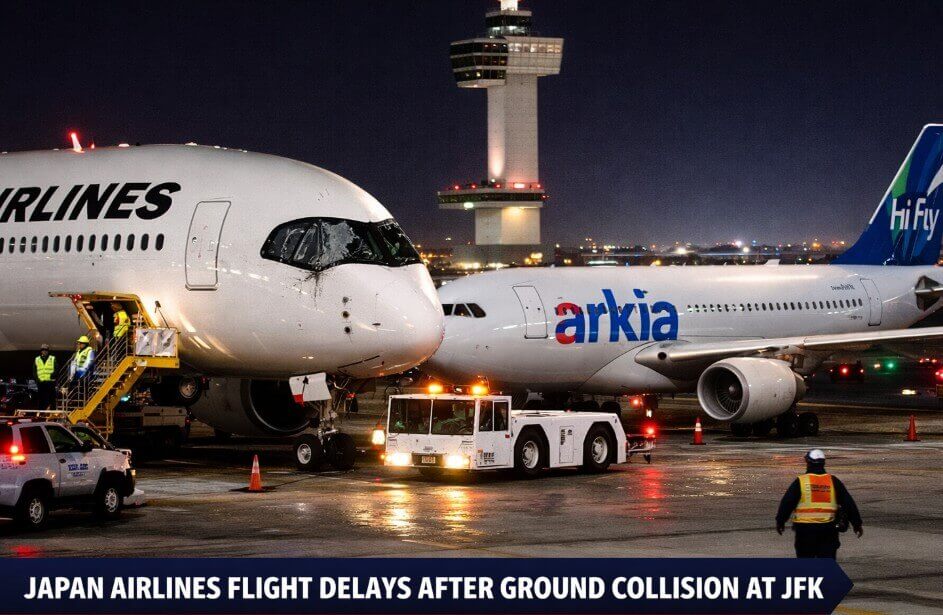
NEW YORK — Japan Airlines (JL) is grappling with significant operational disruptions after a ground collision involving one of its Airbus A350 aircraft at John F. Kennedy International Airport, triggering delays across multiple long-haul international routes and affecting thousands of passengers.
The incident has forced the airline to delay 16 scheduled flights, with some departures postponed by as much as 15 hours and 55 minutes. According to the carrier, the ripple effects will extend for several days as maintenance teams complete repairs and fleet substitutions are put in place.
Details of the JFK Ground Collision
The collision occurred at approximately 12:40 a.m. on December 14, 2025, while a Hi Fly–operated Airbus A330, chartered by Arkia Airlines (IZ), was being towed by ground staff at JFK. During the maneuver, the A330 made unintended contact with the left-side cockpit window of a Japan Airlines Airbus A350 that was parked for routine maintenance.
No passengers or crew were onboard either aircraft at the time, and no injuries were reported. Airport operations were not significantly disrupted immediately following the incident.
Despite the limited physical scope of the collision, the damage rendered the A350 temporarily unavailable for service, creating downstream scheduling complications for Japan Airlines’ long-haul network.
Impact on Japan Airlines’ Global Network
Japan Airlines confirmed that flights departing from and arriving at Tokyo Haneda Airport (HND) would experience the greatest disruption. The affected routes include major international hubs such as London, New York, Singapore, Los Angeles, and Dallas–Fort Worth.
The airline reported that 3,144 passengers are impacted by the delays between December 19 and December 22, and warned that additional schedule changes could continue beyond December 23 as recovery efforts progress.
Aircraft substitutions have been implemented where possible, though the airline acknowledged that limited widebody availability has constrained its ability to fully mitigate delays.
Arkia and Hi Fly Respond to Disruptions
Arkia Airlines, whose chartered aircraft was involved in the collision, promptly notified passengers and began rebooking them on alternative flights. Hi Fly has committed to supplying a replacement aircraft to support Arkia’s operations and minimize prolonged service interruptions.
Both companies emphasized that safety procedures were followed and that coordination with airport authorities and Japan Airlines remains ongoing.
Passenger Communication and Ongoing Updates
Japan Airlines stated that customer and stakeholder understanding is appreciated as the airline works to restore normal operations. Travelers have been advised to monitor the airline’s website for updated departure times and rebooking options.
Customer service teams have been mobilized to assist affected passengers, particularly those traveling on long-haul international itineraries during the peak holiday travel period.
A Pattern of Ground Incidents Raises Scrutiny
The JFK collision follows another recent ground incident involving Japan Airlines earlier this year. On February 5, 2025, a Japan Airlines Boeing 787-9 made contact with a parked Delta Air Lines Boeing 737-800 while taxiing at Seattle–Tacoma International Airport.
That incident involved full passenger loads on both aircraft and prompted an emergency response, though no injuries were reported. The Federal Aviation Administration confirmed that an investigation was launched to examine ground procedures, aircraft positioning, and communication protocols.
While unrelated, the back-to-back incidents have drawn attention to ground handling risks at major U.S. airports, particularly during peak operational periods.
Regulatory Oversight and Next Steps
In the JFK case, authorities are expected to review towing procedures, ramp communications, and aircraft clearance standards as part of routine post-incident assessments. Japan Airlines has not disclosed the extent of the A350’s damage or provided a definitive timeline for its return to service.
As repairs continue, the airline remains focused on stabilizing its schedule and minimizing further passenger disruption. Additional findings and operational updates are expected to be released once inspections and internal reviews are completed.
For now, travelers are encouraged to remain flexible and stay informed as Japan Airlines works through the recovery phase following the incident.
