


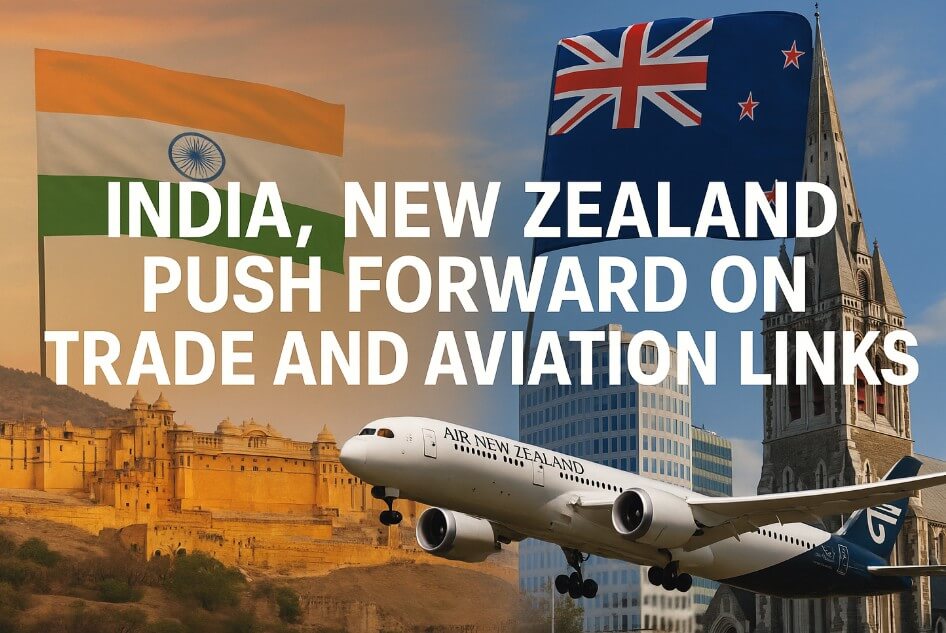
CHRISTCHURCH — India and New Zealand are moving closer to sealing a bilateral Free Trade Agreement (FTA) and a new aviation partnership that could reshape economic and travel ties across the Indo-Pacific. The latest round of talks marks one of the most substantial steps yet in efforts to deepen engagement between the two nations, with Air New Zealand emerging as a strategic player at the intersection of trade and connectivity.
India’s Industry Minister Piyush Goyal met with Nikhil Ravishankar, the newly appointed chief executive of Air New Zealand, during an official visit aimed at advancing the fourth round of FTA negotiations. The meeting underscored how aviation is increasingly viewed as both an economic enabler and a symbol of strengthening relations.
Trade Negotiations Gain Momentum
The five-day talks, held in Rotorua and Auckland, focused on building a “sector-specific” trade framework designed to expand cooperation while preserving each country’s policy priorities. Both delegations described the discussions as “constructive” and “forward-looking.”
India’s merchandise trade with New Zealand reached USD 1.3 billion in fiscal 2024-25 — a 48.6 percent jump from the previous year — reflecting growing confidence in bilateral commerce.
Appointed in October, Ravishankar called himself a “transformation expert” and “systems thinker” taking the helm during what he described as a particularly challenging moment for the carrier and the broader economy. He told reporters that New Zealand was “potentially moments away” from finalizing the deal, although he added that in trade diplomacy, “moments can stretch out.”
Minister Goyal said the negotiations were unfolding “in a spirit of enthusiasm and mutual respect” and would produce an agreement that “reflects the interests of both nations.”
Aviation as a Trade Catalyst
A central theme of the meeting was the use of aviation as a bridge for commerce and innovation. Ravishankar signaled that Air New Zealand intends to become a platform for Indian enterprises “to test products and services in New Zealand before scaling globally,” linking the airline’s success directly to national economic performance.
Goyal, highlighting India’s rapidly expanding aviation market, confirmed discussions around direct flights between Air India and Air New Zealand by 2028. He said he was “delighted to meet” Ravishankar and described the exchange as an opportunity to explore regional connectivity and new openings in the Indian market.
The prospect of direct routes would mark the first such connection between the two countries, potentially driving a sharp rise in tourism, cargo, and business travel while embedding aviation cooperation within the broader FTA framework.
Strategic Stakes for Air New Zealand
The airline’s renewed engagement comes amid financial turbulence. Air New Zealand expects a pre-tax loss of up to NZD 55 million (about USD 33 million) for the six months ending December, largely due to the grounding of 11 aircraft — roughly one-fifth of its fleet — over engine issues. Rising lease and maintenance costs have intensified pressure to restore profitability.
For New Zealand, the airline’s fortunes mirror broader economic trends. “When the airline does well, so too does the economy,” one industry observer noted, underscoring its central role in trade and tourism.
The government views partnerships like the India FTA as tools for long-term recovery, with new air links expected to enhance supply-chain resilience and export competitiveness across manufacturing, agriculture, and pharmaceuticals.
India’s Expanding Aviation Market
India’s aviation industry, projected to become the world’s third-largest by 2030, represents one of the most dynamic opportunities in global transport. Rising passenger demand, infrastructure upgrades, and policy reforms have created a fertile environment for foreign collaboration.
For New Zealand, the growth translates into fresh prospects for tourism, air-cargo logistics, and technical services. Experts say the planned direct flights could “reshape travel patterns,” boosting business exchanges and cultural ties. The two sides are also exploring cooperation in sustainable aviation, including biofuels and carbon-efficient technologies.
Next Steps and Outlook
In the near term, Air New Zealand’s focus will remain on stabilizing operations and returning grounded aircraft to service. For policymakers, the priority is to maintain momentum in trade talks through inter-sessional dialogue and technical consultations.
Medium-term projections from Indian officials suggest the agreement could “boost trade ten-fold in ten years,” creating a framework that integrates connectivity, commerce, and national infrastructure.
Ravishankar summed up the airline’s role within that vision: the challenge, he said, “is not to choose between profit and public service, but to achieve both simultaneously.”
A New Economic Flight Path
The convergence of trade diplomacy and aviation strategy signals a pivotal shift in India–New Zealand relations. As Air New Zealand navigates operational headwinds, participation in this partnership could open new avenues for resilience. For India, the collaboration aligns with its ambitions to expand export markets and regional air links.
If the FTA and flight agreements proceed as planned, both nations could soon be connected by more than just commerce — a direct air bridge joining two maritime economies with shared aspirations for growth and global reach.
