


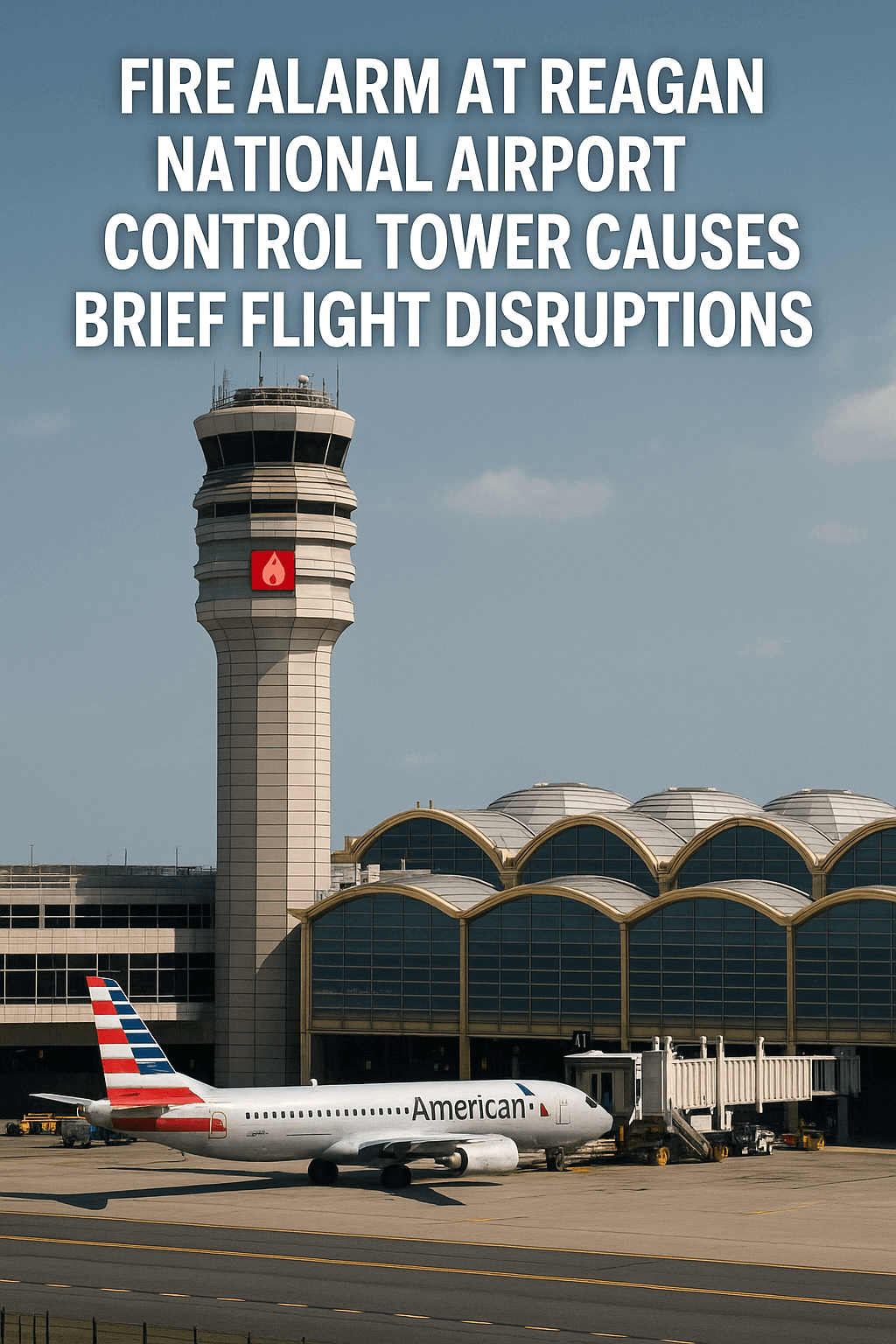
WASHINGTON, D.C. — August 19, 2025 — Flights at Ronald Reagan Washington National Airport (DCA) were briefly halted on Monday morning after a fire alarm in the air traffic control tower triggered an evacuation, disrupting air travel across one of the nation’s busiest airports.
The incident occurred around 10:45 a.m. on August 18, when the alarm forced controllers to leave the tower as a precautionary measure. While no fire or equipment damage was reported, the evacuation led to delays that rippled through airline schedules at a critical East Coast hub.
Flights Temporarily Halted
The Federal Aviation Administration (FAA) confirmed that all inbound and outbound flights were paused during the evacuation. “The evacuation was a standard procedure, and after a thorough inspection, officials confirmed no fire or damage,” the agency said.
By noon, controllers were back at their stations and normal operations resumed. But the downtime, lasting just over an hour, resulted in an average flight delay of 39 minutes due to heavy traffic volume, according to FAA data.
Passengers at DCA, which handles millions of travelers annually and serves as a gateway to the capital region, reported long waits but no cancellations. “Travelers at DCA, a major hub serving the Washington, D.C. area, faced inconvenience but no reported cancellations,” the FAA noted in its statement.
Cause Under Investigation
Officials have not disclosed what triggered the alarm. The FAA is now investigating the cause, but the lack of details has fueled questions from both passengers and aviation analysts about the reliability of safety systems.
Industry experts said the disruption underscores the vulnerabilities in airport operations when even minor issues occur. Air traffic control towers are considered the nerve centers of aviation, guiding aircraft during takeoffs, landings, and ground movements. Any interruption, even from a false alarm, can ripple across flight schedules nationwide.
“This lack of clarity has sparked curiosity among passengers and aviation experts, who are eager to understand how such incidents can be prevented in the future,” the FAA acknowledged.
Safety in the Spotlight
The incident comes at a time when Reagan National remains under heightened scrutiny following a catastrophic accident earlier this year. In February 2025, a collision between an Army helicopter and an American Airlines jet on the airport’s tarmac killed 67 people, raising urgent questions about safety and coordination at DCA.
While the two events are unrelated, the timing has added to public concern. “The timing of this disruption is notable, as DCA has been under scrutiny since a tragic incident in February 2025,” the FAA statement read.
Experts say the fire alarm disruption, though far less severe, is a reminder of how dependent air travel is on robust and fail-safe systems. Airports like DCA operate under intense pressure, balancing high traffic volumes with the need for continuous safety oversight.
National Implications
Aviation analysts suggest the incident could prompt other airports to review their fire and safety protocols. “Airports nationwide are likely to review their protocols to prevent similar occurrences,” the FAA said, noting that while the disruption was brief, the operational impact was significant.
The FAA’s rapid response was seen as a positive sign. By immediately halting flights, the agency ensured that no aircraft were placed at risk during the evacuation. “The FAA’s quick response demonstrates the priority being placed on safety,” the statement concluded.
Advice for Travelers
For passengers, the event was a stark reminder of how quickly travel plans can be disrupted. Industry officials advise travelers to build extra time into their schedules when flying through major airports and to rely on airline apps for real-time updates.
“Passengers are encouraged to check with airlines for updates and allow extra time for potential delays,” the FAA recommended.
With the investigation ongoing, aviation authorities are working to reassure the public that safeguards are in place to prevent more serious consequences from such alarms. The goal, they said, is to ensure that incidents like Monday’s remain rare disruptions rather than warnings of larger systemic vulnerabilities.
Looking Ahead
For now, operations at Reagan National have returned to normal. But with questions unanswered about what triggered the alarm, attention is likely to remain on the FAA’s findings.
“This incident, while resolved quickly, reminds us how interconnected and sensitive airport operations are,” the FAA said in closing. “With ongoing investigations, the FAA aims to ensure such disruptions remain rare, keeping passenger safety first.”
