


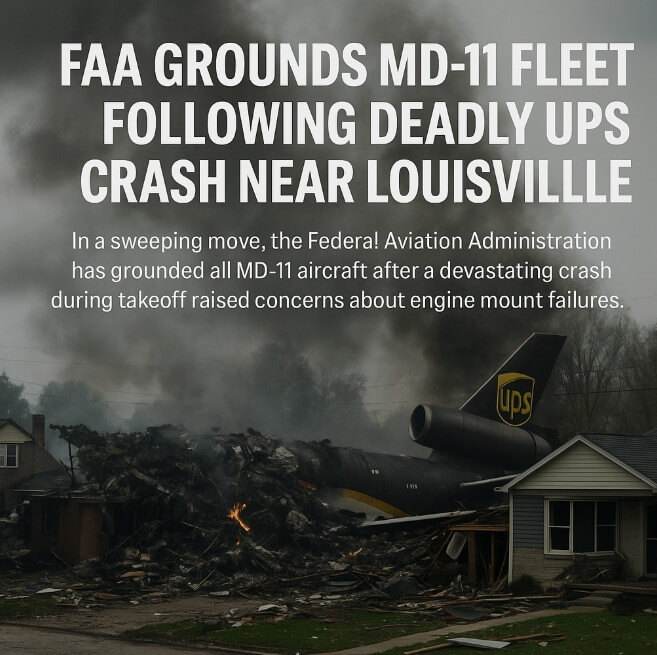
In a sweeping safety move, the Federal Aviation Administration (FAA) has ordered the immediate grounding of all McDonnell Douglas MD-11 and MD-11F aircraft after a UPS cargo jet crashed near Louisville Muhammad Ali International Airport, killing 14 people and leveling part of a nearby neighborhood. The decision marks one of the most significant fleetwide groundings in recent years and underscores growing concerns over aging cargo aircraft and potential engine mount failures.
FAA Issues Emergency Directive
The FAA’s directive, announced Saturday, suspends all MD-11 operations pending complete structural inspections of the aircraft’s engine mounts and pylons. The order follows the catastrophic crash of UPS Flight 2976, an MD-11F that went down shortly after takeoff from Louisville (SDF) on Tuesday. The fiery crash destroyed homes and businesses and left a scene of devastation that officials compared to “a war zone.”
According to the National Transportation Safety Board (NTSB), the aircraft’s left-hand engine and pylon detached during takeoff, causing a rapid loss of control. Both UPS and FedEx—operators of the world’s largest MD-11 fleets—voluntarily grounded their aircraft before the FAA’s formal directive “out of an abundance of caution.”
UPS confirmed that MD-11 freighters make up roughly nine percent of its active fleet but said contingency plans are in place to maintain essential cargo operations. FedEx, the only other major U.S. carrier using the MD-11, said it is conducting a “comprehensive safety review” in collaboration with Boeing, which inherited the McDonnell Douglas product line after its 1997 merger.
Investigation Centers on Maintenance and Engine Mount Failure
Preliminary evidence points to a structural failure linked to the aircraft’s engine assembly. The UPS jet had recently undergone heavy maintenance in San Antonio, prompting investigators to scrutinize inspection procedures, replaced components, and maintenance records.
Aviation analyst Mary Schiavo said the incident could indicate a potential “uncontained engine failure,” explaining that such an event “can send debris into the aircraft’s structure and fuel tanks.” The MD-11’s General Electric CF6 engines have been involved in past incidents, although investigators have yet to confirm a connection between the engine model and Tuesday’s crash. The detached engine and pylon are now being examined at an NTSB facility.
Investigators said the cockpit voice recorder captured two hours of clear audio. The recording confirmed that the flight crew executed all standard takeoff procedures before the sudden failure occurred. Early flight data showed the aircraft reached only about 100 feet of altitude before losing lift and descending rapidly into a commercial area.
Legal Fallout and Corporate Responsibility
In the aftermath, a lawsuit has been filed in the U.S. District Court for the Western District of Kentucky on behalf of residents and businesses affected by the crash. The suit names UPS, Boeing, and General Electric as defendants, alleging negligence and mechanical failures that contributed to the tragedy.
The complaint claims that long-standing design flaws in the MD-11—combined with UPS’s modifications for cargo operations—may have compromised structural integrity. Attorneys cited earlier MD-11 crashes, including a 2009 FedEx accident in Tokyo, as evidence of a broader safety concern with the model. Lawyers representing victims vowed to “uncover the truth” and seek accountability from all parties involved.
Neither Boeing nor UPS has commented publicly on the lawsuit, though both companies issued statements expressing condolences to the victims’ families. The FAA declined to speculate on possible enforcement actions until the NTSB completes its investigation.
Louisville Community Mourns
The crash site, located near Grade A Auto Parts on the outskirts of Louisville, remains cordoned off as investigators continue recovery efforts. Officials confirmed 14 fatalities, including all three crew members: Capt. Richard Wartenberg, First Officer Lee Truitt, and International Relief Officer Capt. Dana Diamond.
Residents gathered downtown for a vigil honoring the victims, lighting candles and laying flowers in a makeshift memorial. Mayor Craig Greenberg said the city is supporting displaced families and coordinating with federal agencies. “We will not rest until every family has answers,” Greenberg said, noting that DNA testing is underway to identify remaining victims.
What’s Next for the MD-11 Fleet
The NTSB plans to release a preliminary report within 30 days, though the full investigation could take up to two years. Investigators are focusing on whether a design flaw, maintenance lapse, or material fatigue caused the catastrophic engine separation.
In the meantime, the FAA has directed global MD-11 operators to conduct mandatory inspections before resuming service, warning that “an unsafe condition is likely to exist or develop in other products of the same type design.” The grounding has reignited debate over the safety oversight of older cargo aircraft that continue to operate decades after production ended.
The tragedy near Louisville serves as a sobering reminder of the risks in commercial cargo aviation—and the ongoing need for vigilance as fleets age and mechanical systems endure years of heavy use.
