


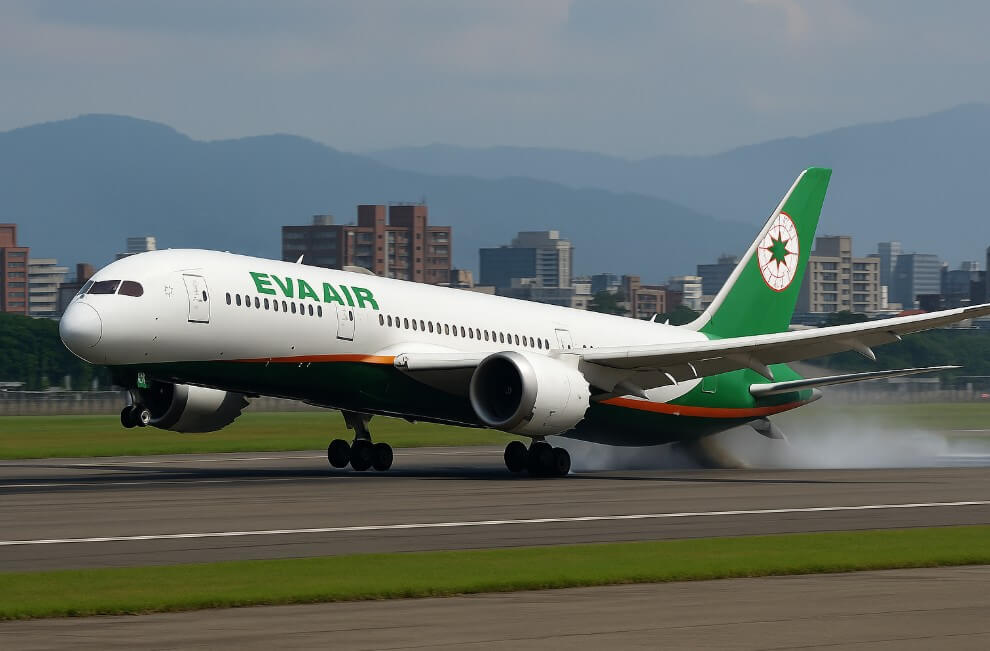
TAIPEI — An EVA Air Boeing 787-9 Dreamliner experienced a tail strike while performing a go-around maneuver at Taipei Songshan Airport (TSA) on October 4, 2025. The aircraft, operating as flight BR-711 from Shanghai Pudong (PVG), landed safely without injuries to passengers or crew, according to the airline.
The widebody jet, registered B-17881, briefly touched down before its tail made contact with the runway surface, then climbed away to reposition for another approach. The crew later landed the aircraft safely at Songshan after circling for approximately 15 minutes.
In a statement, EVA Air confirmed that the incident resulted in minor damage to the aircraft’s tail strike protection system. The airline said maintenance teams would replace the protective strip and carry out a detailed inspection before returning the Dreamliner to service. “No passengers or crew members were injured and safety protocols were followed throughout,” the carrier added.
Flight Data and Operational Response
According to preliminary flight data, the aircraft was on short final approach when pilots initiated a go-around at low altitude. During this maneuver, the main landing gear lightly contacted the runway, leading to the tail scrape. The jet climbed to roughly 3,000 feet before completing its safe return to the airport.
As of the latest available data from flight-tracking platform Flightradar24, the Boeing 787 remains grounded at Taipei Songshan Airport pending inspection.
Aviation analysts note that while tail strikes are uncommon, they require careful post-incident checks to ensure no structural damage to the fuselage or tail assembly. “Modern aircraft like the Boeing 787 are equipped with tail strike protection systems that absorb much of the impact,” said one industry safety expert. “Still, operators conduct thorough examinations before clearing any aircraft to fly again.”
Understanding Tail Strike Risks
Tail strikes occur when an aircraft’s tail contacts the runway surface during takeoff or landing. Such events are typically linked to excessive pitch angles or misjudged control inputs during rotation or flare. While generally non-catastrophic, the resulting stress on the aircraft’s rear fuselage demands detailed engineering assessment before resuming operations.
The Boeing 787-9, a stretched variant of the Dreamliner family, features advanced sensors and protection systems designed to mitigate tail strike risks. However, aviation regulators worldwide emphasize that pilot technique and adherence to standard operating procedures remain the most critical factors in preventing such incidents.
Broader Context: Similar Events Across Asia
The EVA Air occurrence follows a series of recent tail strike events in Asia that have drawn regulatory attention. The Directorate General of Civil Aviation (DGCA) in India, for example, suspended IndiGo (6E) pilots after a tail strike involving flight 6E6054 at Delhi Airport (DEL) on September 9, 2024. The Airbus A321neo, registered VT-IBI, was operating a scheduled service to Bengaluru (BLR) when its tail contacted the runway during takeoff.
According to a DGCA preliminary report, both the pilot-in-command and co-pilot received show-cause notices and were suspended pending investigation. The aircraft remains grounded as inspectors evaluate the extent of the damage. The regulator has not yet disclosed the duration of the flight crew’s suspension.
The DGCA previously fined IndiGo Rs 30 lakh in 2023 after four separate tail strike incidents involving its A321neo fleet between January and June of that year. Those events, occurring across multiple airports during both takeoff and landing phases, led to tighter scrutiny of the airline’s pilot training and standard operating procedures.
In one earlier case at Ahmedabad Airport (AMD), the DGCA imposed a three-month suspension on the pilot-in-command and a one-month suspension on the co-pilot for failing to adhere to prescribed pitch control procedures. The regulator later called for expanded simulator training to reduce rotation-angle errors, particularly for the A321neo’s longer fuselage design.
Continuing Investigation
While EVA Air’s Taipei incident caused only minor damage and no injuries, it underscores ongoing industry focus on operational precision during critical flight phases. The airline said maintenance crews are coordinating with the Taiwan Civil Aeronautics Administration to complete the inspection process before the aircraft’s return to commercial service.
