


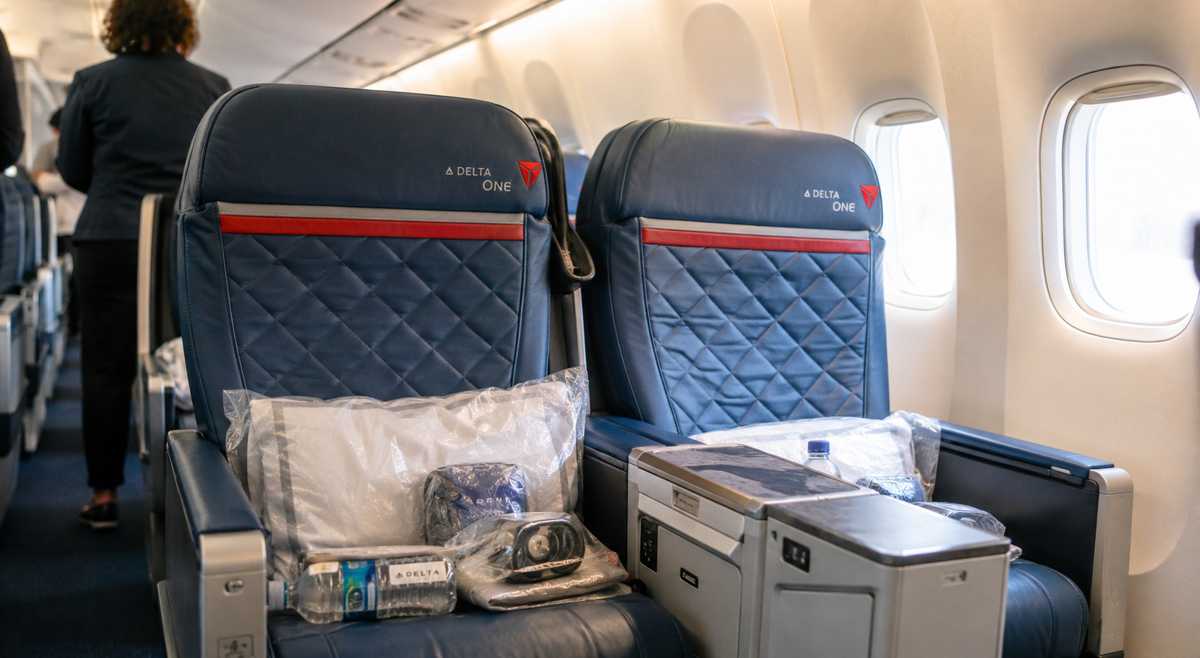
Former Delta President Says Airline Now Sells Nearly 90% of Domestic First Class Seats
ATLANTA — Delta Air Lines transformed the economics of premium air travel by turning domestic first class from a frequent-flyer perk into a major revenue engine, according to former president Glen Hauenstein.
Speaking on a recent episode of the Airlines Confidential podcast, Hauenstein detailed how Delta steadily shifted away from offering complimentary upgrades and instead focused on selling premium seats directly to travelers. The strategy, he said, helped the airline dramatically increase revenue while reshaping the broader airline industry’s approach to premium cabins.
The numbers illustrate the scale of the shift. Delta once sold only about 13% of its domestic first class seats, according to Hauenstein. Excluding connecting international traffic, that figure fell closer to 6%. Today, the airline sells roughly 87% of those seats.
The transformation marked a major departure from the long-standing airline model in which domestic first class largely served as a loyalty reward for elite travelers.
From Loyalty Perk to Profit Center
Hauenstein described the change as a deliberate effort to stop treating premium cabins as a loss leader.
For years, airlines routinely upgraded frequent flyers at no additional cost, particularly on domestic routes. Delta gradually reversed that model by assigning a monetary value to premium seating and expanding the number of customers willing to pay for the experience.
The financial logic was straightforward. Providing a complimentary upgrade to a traveler already spending tens of thousands of dollars annually with the airline generated no additional cabin revenue. Selling the same seat, even at a relatively modest price point, created incremental income across Delta’s vast domestic network.
Spread over thousands of flights, the strategy evolved into one of the airline’s most important profit drivers.
Hauenstein framed the initiative as part of a broader “premium product strategy,” an evolution of what he previously called “decommoditization.” The effort initially aimed to prevent revenue leakage from high-value travelers before becoming a central pillar of Delta’s business model.
As reported by View from the Wing, Hauenstein also hinted that Delta is preparing to introduce a “reinvigorated” premium product in the near future.
Coastal Expansion Strengthened Delta’s Market Position
Hauenstein said Delta concentrated much of its expansion in large coastal metropolitan markets, including Los Angeles, New York, Boston, and Seattle.
Those cities became especially important in strengthening Delta’s partnership with American Express, which operates the airline’s co-branded credit card program.
According to Hauenstein, Delta’s dominance in high-spending urban markets helped create the industry’s most profitable airline-card partnership. He argued that the airline’s success was driven less by offering the richest loyalty benefits and more by maintaining a strong brand presence in economically powerful regions.
Delta reported $5.8 billion in operating income in 2025 and generated $8.2 billion in revenue from its American Express partnership. With Delta previously disclosing a 39% margin on its SkyMiles program, the arrangement likely produced roughly $3.2 billion in profit, representing a significant share of the airline’s total earnings.
Hauenstein tied much of that success to Delta’s acquisition of the former US Airways hub at New York LaGuardia roughly 15 years ago, a move that strengthened the airline’s position in one of the nation’s most competitive travel markets.
Revenue Strategy Replaced Cost-Cutting Focus
Hauenstein argued that airlines historically focused too heavily on cost reduction while overlooking opportunities to improve revenue generation.
He recalled an era when major consulting firms encouraged carriers to prioritize lower operating costs above nearly everything else. That mindset gave rise to low-cost airline spinoffs such as Song at Delta, TED at United Airlines, and Continental Lite at Continental Airlines.
Hauenstein described those brands as “rescue boats” designed to compete with emerging low-cost carriers using simplified operations and cheaper fare structures.
But he questioned why airlines failed for so long to monetize their most premium products.
Industry assumptions held that roughly 65% of purchasing decisions depended on schedule and price. While Hauenstein agreed with that estimate, he argued that airlines largely ignored the remaining 35% of travelers who prioritized comfort, service quality, and premium amenities.
Delta moved aggressively to capture that segment, helping the airline convert first class into what Hauenstein described as a major profit center.
Competitive Gap Widens Across the Industry
Although Hauenstein did not directly criticize rivals, his comments pointed toward strategic differences with American Airlines.
He suggested that management teams shaped by lower-cost operating models focused too heavily on maximizing seat density and reducing costs at a time when many travelers were increasingly willing to pay for differentiated experiences.
That divergence, analysts say, contributed to widening revenue gaps between Delta and several competitors.
Hauenstein also expressed skepticism about ultra-low-cost carriers successfully building premium cabin businesses.
Spirit Airlines previously experimented with premium seating, while Frontier Airlines, JetBlue, and Southwest Airlines have either introduced or explored similar concepts.
However, Hauenstein argued that premium travel requires more than larger seats. Lounge access, flight frequency, network depth, and broader service infrastructure all contribute to attracting high-value customers.
Without those systems in place, airlines often must heavily discount premium cabins to fill seats, limiting profitability.
Delta Still Faces Pressure to Maintain Premium Edge
Despite Delta’s financial success, Hauenstein acknowledged the airline still faces operational and product challenges.
Travel industry analyst Henry Harteveldt raised concerns during the interview about disruptions linked to pilot scheduling, reduced beverage service on some short-haul flights, and first-class meal offerings viewed as less substantial than in previous years.
He also noted that Delta’s business-class suites remain available on only about half of the airline’s fleet despite being introduced roughly a decade ago.
The concerns highlight the difficulty of maintaining a premium reputation as competitors continue investing in upgraded cabins and customer experience improvements.
Even so, Delta’s strategy of monetizing premium seating has fundamentally altered how airlines think about domestic first class — and created a blueprint many competitors are now attempting to follow.
