


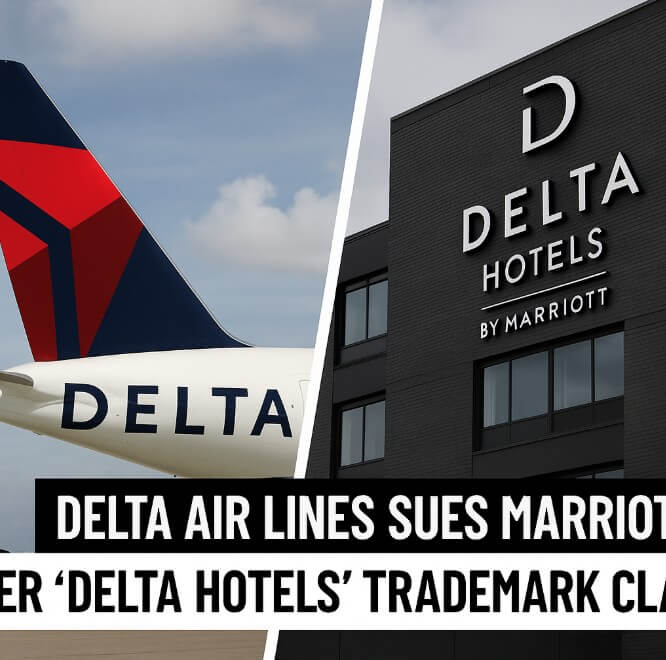
ATLANTA — A long-simmering corporate trademark dispute between two travel industry giants reached the courtroom this week as Delta Air Lines filed suit against Marriott International, alleging that Marriott’s “Delta Hotels” brand infringes on the airline’s long-established trademark. The trial opened in the U.S. District Court for the Northern District of Georgia, where the Atlanta-based carrier is seeking to protect what it calls one of its most valuable brand assets.
Allegations of Brand Confusion
Delta Air Lines argues that Marriott’s continued global use of the “Delta Hotels” name creates confusion among travelers who associate the word “Delta” exclusively with the airline. According to filings in Delta Air Lines, Inc. v. Marriott International, Inc. (N.D. Ga. No. 1:20-cv-01125), the carrier presented survey data and customer complaints demonstrating “real instances of confusion between the two brands.”
The airline contends that the overlap is particularly problematic in shared markets such as Toronto and Vancouver, where both companies operate prominently. Delta asserts that Marriott’s hotel branding “misleads customers and takes advantage of its reputation and goodwill,” potentially diluting the value of the DELTA trademark, which the airline has held for decades.
Marriott’s Defense and the 2015 Agreement
Marriott acquired the Delta Hotels brand in 2015 as part of an effort to broaden its midscale and full-service hotel offerings. The company maintains that it acted within its rights based on an earlier agreement between the two firms that permitted limited use of the Delta name in Hong Kong and China.
However, the court has already ruled that this agreement does not extend beyond those regions. Delta now claims that Marriott improperly expanded Delta Hotels throughout the U.S. and Canada, failing to differentiate the hotel brand sufficiently from the airline. The company alleges that Marriott “hijacked” its brand identity, according to reporting by View from the Wing.
A Complicated Legacy
Delta Hotels itself predates Marriott’s involvement by decades. Founded in Canada more than 50 years ago, the chain became part of Marriott International’s portfolio to attract property owners seeking more affordable brand conversions. As The Wall Street Journal reported, the Delta Hotels name appealed to hotel developers because it required fewer expensive upgrades than other Marriott lines.
Despite that heritage, the expansion of Delta Hotels into U.S. markets has reignited questions over brand overlap. While the name “Delta” may seem generic—derived from the Mississippi Delta in the airline’s case—its widespread commercial use complicates trademark enforcement. Hundreds of businesses use “Delta” in their names, but Delta Air Lines argues that its customer base and Marriott’s hotel clientele overlap enough to cause marketplace confusion.
Stakes for Both Companies
The trial’s outcome could have far-reaching implications for corporate branding and travel partnerships. If the court sides with Delta Air Lines, Marriott could be forced to modify its hotel branding significantly—potentially limiting use of the word “Delta,” emphasizing “by Marriott” more prominently, or adopting disclaimers and revised visual identity standards.
A ruling in favor of Marriott, however, would affirm that “Delta Hotels by Marriott” is sufficiently distinct from the airline’s brand. Such a decision could set a precedent allowing similar coexistence among unrelated businesses using shared or generic terms, especially in industries where cross-brand exposure is common.
Broader Industry Implications
The dispute highlights how global travel brands increasingly blur traditional boundaries. Airlines and hotel chains now compete for customer loyalty across integrated travel programs, co-branded credit cards, and shared digital platforms. As these sectors converge, legacy trademarks—once confined to specific industries—face new pressures in a connected marketplace.
Regardless of the verdict, the case underscores how valuable and vulnerable brand identities have become in an era when a single word can define billions in goodwill. For Delta Air Lines, the courtroom fight is as much about protecting its reputation as about legal rights. For Marriott, the case tests whether decades of legitimate hotel operation under the Delta banner can coexist with one of the world’s best-known airline names.
The trial continues this week in Atlanta, with industry observers watching closely for a decision that could reshape how global hospitality and travel brands navigate the crowded trademark landscape.
Stay tuned for updates as the proceedings unfold.
