


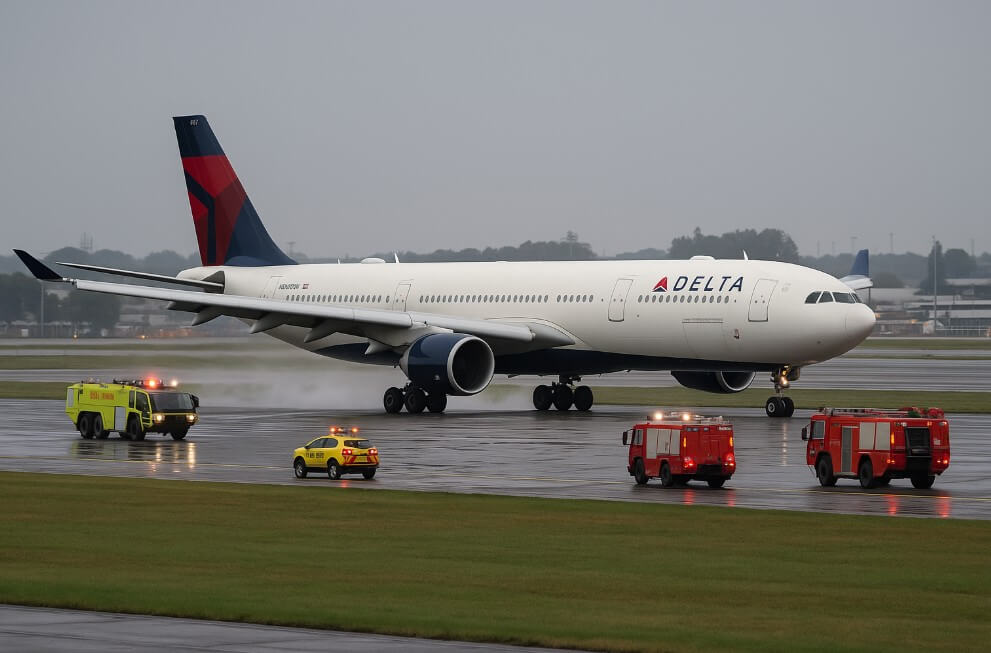
ATLANTA — A Delta Air Lines flight from London Heathrow to Boston Logan made an emergency return to Heathrow on Saturday after pilots detected fumes in the cockpit shortly after takeoff, the latest incident to draw attention to cabin air quality concerns across modern jetliners.
Flight DL59, operated by an Airbus A330 with 259 passengers on board, departed Heathrow’s Runway 27R around 10 a.m. local time on October 5. Minutes into the climb, the cockpit crew noticed what the airline later described as “reports of smoke in the aircraft,” prompting an immediate decision to turn back.
Flight-tracking data showed the twin-aisle jet looping southwest over Cornwall before re-entering UK airspace and performing a sharp turn over South London for its approach back to Heathrow. Emergency vehicles met the aircraft on the runway as fire crews boarded to inspect the cabin. Passengers were transported by bus to the terminal while maintenance teams began evaluating the jet.
Delta confirmed the aircraft “landed safely” and said the diversion was made out of caution. The carrier added that the flight to Boston would operate the following day, with customers rebooked and provided overnight accommodations.
The A330 involved was a relatively new addition to Delta’s long-haul fleet, delivered in 2021 from Airbus’s Toulouse assembly line, according to aviation tracking outlet PYOK. The aircraft’s modern design underscores that such air-quality events are not confined to older models, even as airlines update equipment to minimize potential contamination.
Maintenance Program in Focus
The incident comes as Delta continues an extensive replacement program for the Auxiliary Power Units (APUs) installed on many of its Airbus aircraft. The APU— a compact turbine housed in the tail— supplies electrical power on the ground and helps start the main engines. Certain legacy APU models across the industry have been linked to so-called “fume events,” in which cabin air becomes tainted by traces of engine oil or other chemicals.
Delta’s APU replacement initiative began in 2022 and encompasses hundreds of aircraft in its narrow-body fleet. The company has described the campaign as part of its “ongoing investment in reliability and safety systems.” Analysts note that while new APU technology reduces risk, it does not address all possible sources of airborne contamination inside aircraft.
Most commercial jets, including the A330, use a “bleed-air” system that channels compressed air from the engines into the ventilation network to pressurize and heat the cabin. In rare cases, oil-seal leaks or maintenance residues can introduce contaminants into that airflow.
Broader Debate on Fume Events
While industry regulators characterize fume events as uncommon and typically non-hazardous, pilot associations and cabin-crew unions have urged airlines to adopt improved detection technology and standardized response protocols. Research into cabin-air quality has gained traction as crews report headaches, dizziness, or eye irritation following exposure.
Aviation safety experts emphasize that most reported incidents resolve without lasting harm. Still, the lack of real-time air-quality sensors aboard most aircraft complicates investigations and fuels debate about the need for new monitoring standards.
Regulators on both sides of the Atlantic continue to study the phenomenon. The European Union Aviation Safety Agency (EASA) and the U.S. Federal Aviation Administration (FAA) have each published guidance encouraging carriers to document fume-related occurrences and ensure medical evaluation for affected crew.
Delta’s Response and Next Steps
In a statement, Delta said passenger and crew safety “remains our top priority,” adding that “the diversion was precautionary.” The airline confirmed that maintenance engineers are conducting a full inspection of the A330 before it re-enters service. No injuries were reported.
The episode highlights Delta’s broader focus on preventive maintenance and fleet modernization. Along with the APU replacement program, the carrier has accelerated upgrades to air-filtration systems introduced during the pandemic and continues to refine cockpit safety checklists for environmental alerts.
For passengers, Saturday’s event ended with inconvenience rather than danger. For Delta and the wider airline industry, it served as another reminder that even new-generation aircraft remain susceptible to the complex interactions between mechanical systems and cabin air— an area of aviation safety still under scrutiny.
