


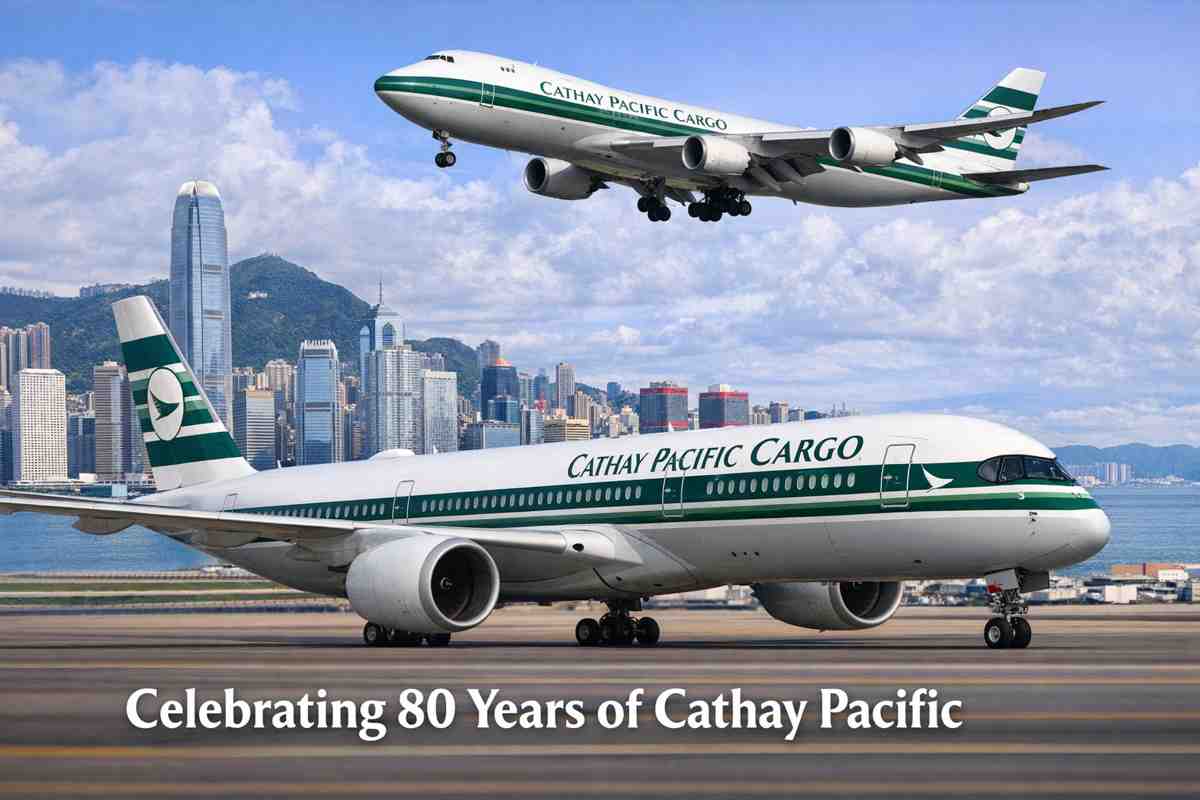
Cathay Pacific has unveiled a retro aircraft livery to commemorate its 80th anniversary, reviving one of the most recognizable paint schemes in commercial aviation as the airline reflects on its long history and evolving global role. The move forms part of a broader anniversary program highlighting eight decades of growth, transformation, and international expansion from its Hong Kong base.
The heritage livery, widely known among aviation observers as the “lettuce leaf sandwich” design, has been reapplied to a modern aircraft, blending historic branding with contemporary fleet technology. The unveiling coincided with the return to service of a specially painted Airbus A350-900, which entered commercial operations this week from Hong Kong International Airport.
Return of a Heritage Design
Cathay Pacific confirmed that two aircraft will carry the revived livery during the anniversary year. The first is an Airbus A350-900 registered as B-LRJ, which officially entered service on January 6, 2026. The aircraft is now operating scheduled passenger flights across the airline’s international network, placing the heritage design in regular service rather than limiting it to ceremonial or promotional appearances.
A second aircraft, a Cathay Pacific Cargo Boeing 747-8 freighter, is scheduled to join the fleet in the same retro paint scheme later in January. The cargo aircraft is expected to debut the design around January 24, extending the anniversary theme beyond passenger operations and into the airline’s dedicated freight business.
The airline has also indicated that a third special livery is planned as part of the anniversary celebrations, although details regarding the aircraft type and design have not yet been disclosed. According to OMAAT, this phased rollout allows Cathay Pacific to showcase its heritage across different segments of its fleet.
Origins of the “Lettuce Leaf Sandwich” Livery
The revived livery dates back to the 1970s and remained in use until the early 1990s, a period widely regarded as formative in Cathay Pacific’s development as a long-haul carrier. The design featured alternating green and white striping on the tail, creating a layered visual effect that became closely associated with the airline’s identity during its expansion years.
During this era, Cathay Pacific introduced widebody aircraft such as the Lockheed L-1011 TriStar and early variants of the Boeing 747. These aircraft enabled the airline to significantly expand its long-haul network, connecting Hong Kong with major destinations in Europe, North America, and Australia and establishing the carrier as a key player in global aviation.
In the 1990s, Cathay Pacific transitioned to the brushwing logo and jade-green color palette that remains the foundation of its current branding. The change was intended to emphasize the airline’s Hong Kong roots and modern ambitions as it entered a new phase of growth. While the newer branding has defined Cathay Pacific for decades, the older livery has retained a strong emotional connection for long-time employees, passengers, and aviation enthusiasts.
Modern Fleet, Historical Branding
Applying the heritage livery to modern aircraft highlights the airline’s operational and technological evolution. The Airbus A350-900 represents Cathay Pacific’s current-generation long-haul strategy, offering improved fuel efficiency, lower emissions, and enhanced passenger comfort compared with earlier widebody aircraft.
The inclusion of a Boeing 747-8 freighter underscores the continued importance of cargo operations within Cathay Pacific’s overall business model. Cargo services remain a critical contributor to revenue and network resilience, particularly given Hong Kong’s role as a major global logistics hub.
By pairing historic branding with advanced aircraft types, the airline positions its 80th anniversary as both a reflection on its past and a signal of ongoing commitment to innovation and global connectivity.
Bottom Line
Cathay Pacific’s decision to revive the “lettuce leaf sandwich” livery celebrates a defining chapter in its aviation history while placing that legacy into active, front-line service. The return of the iconic design on modern passenger and cargo aircraft marks 80 years of growth, resilience, and international reach, reinforcing the airline’s enduring presence in the global aviation market.
