


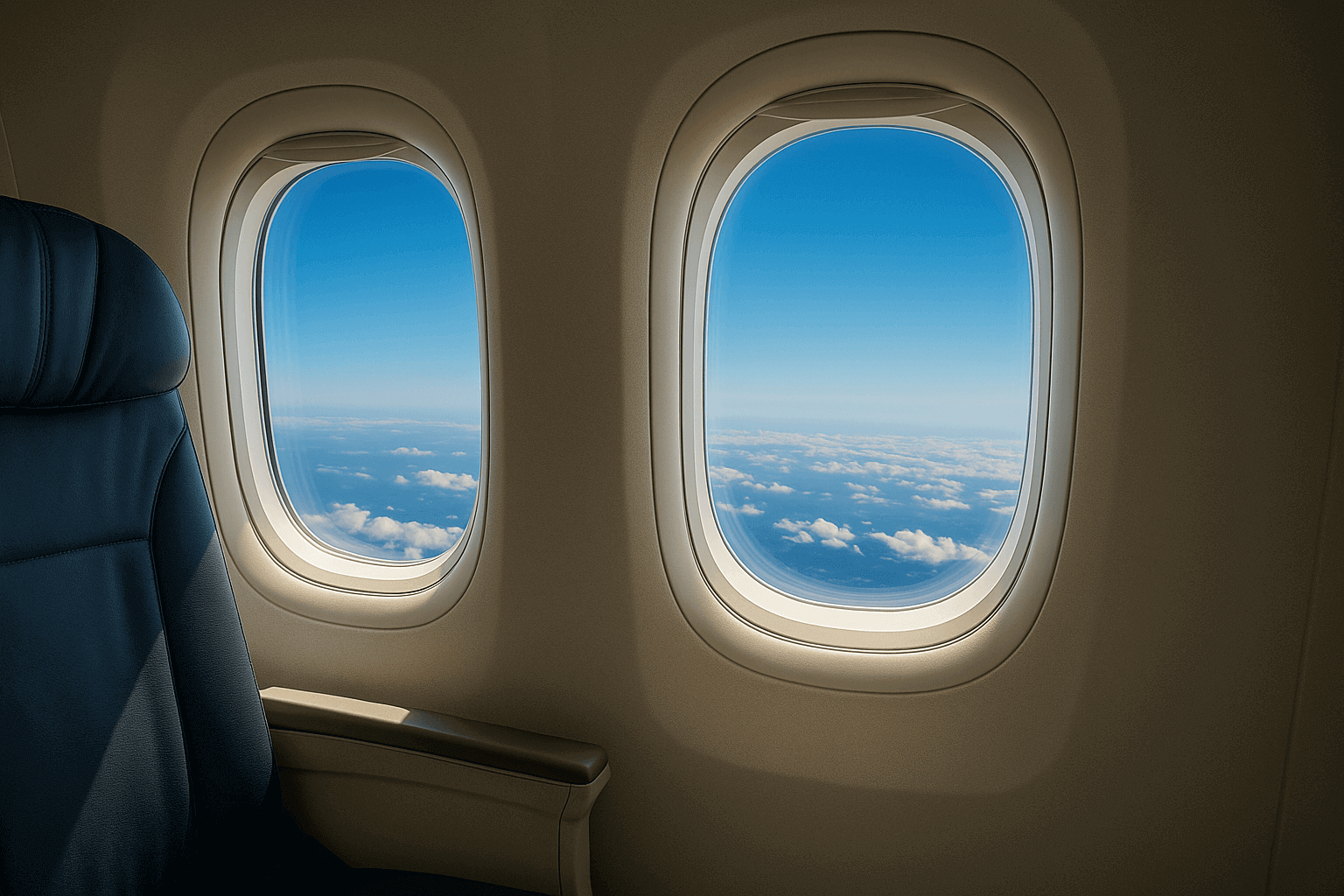
New York — The race to redefine passenger comfort in modern aviation increasingly hinges on a simple but powerful detail: the size of airplane windows. From Boeing’s widebody Dreamliner to Airbus’s sleek A220, aircraft makers are marketing window design as a central part of the flying experience—an element that influences not only aesthetics but also traveler well-being.
Bigger Views, Brighter Cabins
For travelers departing from hubs such as London Heathrow (LHR) or New York’s John F. Kennedy (JFK), the window seat has always carried extra appeal. But the dimensions of the pane itself are now shaping perceptions of air travel comfort. Larger windows allow more natural light, create a sense of openness in the cabin, and ensure that passengers—even those seated away from the aisle—can see the horizon.
Industry analysts say that this emphasis reflects a broader shift in how aircraft interiors are designed. “Larger windows not only enhance the flying experience but also give passengers a brighter, more spacious cabin atmosphere,” Boeing has highlighted in promotional materials.
The Dreamliner Advantage
Among commercial jets in active service, the Boeing 787 Dreamliner claims the top spot. Each of its widebody windows measures 27.2 cm x 46.7 cm (10.7 inches x 18.4 inches)—the largest of any jetliner flying today. Boeing emphasizes that the design ensures every passenger has a clear view outside, reinforcing the brand’s focus on customer experience.
The Dreamliner also broke new ground with electrochromic dimming technology. Instead of traditional pull-down plastic shades, passengers can adjust brightness electronically at the touch of a button. This feature lets travelers maintain visibility while reducing glare and preserving cabin ambiance.
According to reporting by aviation site Simple Flying, the technology has been “well received by both airlines and travelers,” distinguishing the Dreamliner in a crowded long-haul market.
Airbus Counters With Narrowbody Strength
While Airbus’s flagship A350 widebody offers windows that measure slightly smaller at 24.1 cm x 34.3 cm (9.5 inches x 13.5 inches), the European manufacturer has secured bragging rights in another category: narrowbody jets.
The A220 family, originally developed by Canada’s Bombardier as the CSeries, boasts single-aisle windows measuring 28 cm x 40.6 cm (11 inches x 16 inches). That makes them the largest on any narrowbody jet currently in service.
Operators like Latvia’s airBaltic have publicly praised the design. The airline described the A220’s “extra large windows” as offering passengers a sense of openness more typical of larger, widebody aircraft.
Lessons From Aviation History
While today’s designs represent a leap forward, oversized windows are not new to aviation. Mid-20th-century aircraft such as the Vickers Viscount and Vickers Vanguard featured massive elliptical panes measuring 48 cm x 66 cm (19 inches x 26 inches)—more than double the surface area of the Dreamliner’s.
These large windows became a selling point for carriers like British European Airways, but engineers later moved away from the format due to concerns about structural efficiency and pressurization limits.
Similarly, the Douglas DC-8, used by carriers including Japan Airlines, sported windows measuring 43.5 cm x 52.39 cm (17.13 inches x 20.63 inches), the largest among jets of its time. While no longer in service, such designs remain a touchstone in discussions about passenger-focused engineering.
Why Window Size Matters
The push for larger airplane windows reflects both technical innovation and changing consumer expectations. Advances in materials such as carbon fiber allow manufacturers to incorporate bigger openings without compromising structural integrity.
From a passenger health perspective, access to more daylight helps regulate circadian rhythms and reduce fatigue during long-haul journeys. Airlines have leaned into this messaging, promoting brighter cabins as a differentiating factor on competitive international routes.
Practical considerations also play a role. Flight attendants benefit from larger windows, which provide better visibility of outside conditions during safety checks and potential emergencies at busy airports like Chicago O’Hare (ORD).
Looking Ahead: The 777X and Beyond
The trend is poised to continue with Boeing’s forthcoming 777X, set to feature enlarged windows designed to reinforce the aircraft’s reputation as a passenger-friendly long-haul workhorse. Lufthansa, for example, has announced plans to deploy the 777X on routes to Frankfurt (FRA), underscoring its value for premium international operations.
Industry experts expect window design to remain a key factor in fleet marketing. “The trend toward larger windows is evident in upcoming aircraft like the Boeing 777X, which will further enhance the passenger experience,” Boeing has noted.
As manufacturers balance structural efficiency with customer appeal, one thing is clear: the humble airplane window is no longer just a portal to the skies—it is a strategic feature in the competition for passenger loyalty.
